Blog post #10 (January 2026)
The winding road of transdisciplinarity towards climate-neutral cities
Oussama Chaabouni | University of Girona
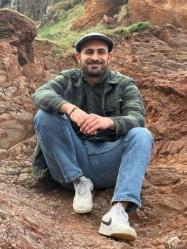
Oussama Chaabouni is a doctoral candidate at the University of Girona, Spain, within the Marie Sklodowska-Curie Actions (MSCA) Doctoral Network C-NEWTRAL. His research interests are around justice and equity in Sustainability Transformations, and his doctoral thesis investigates a critical approach to the green and digital transition in EU urban water management.
If you get a headache when you hear terms such as multidisciplinarity, interdisciplinarity and transdisciplinarity in the academic jargon, then welcome to the club. Don’t worry, this isn’t a scientific journal article. I will try to describe how I became interested in the topic, what it looked like to me through my participation in two conferences, and why the types of debates it initiates were helpful to me at the beginning of my journey into investigating urban water management in climate-neutral and smart cities.
As you may know, or not, attending scientific conferences is an important part of every academic’s journey. It doesn’t matter where you are on the academic ladder. It’s an important activity to present your research results to your peers, receive their feedback, and engage in sometimes tense yet always fruitful conversations about the conference topics. Often, these conferences treat specific topics within a scientific field. This year, I had the privilege to participate in 2 conferences that manifested transdisciplinarity for me. The first was a European Conference titled “Eco-Social Determinants of Health Inequities” organised by The Johns Hopkins University-University Pompeu Fabra Public Policy Centre (JHU-UPF PPC) in Barcelona, Spain, between the 22nd and 23rd of May 2025. The second was the 18th Conference for the International Society for Ecological Economics, which happened this year in parallel with the 11th International Degrowth Conference in Oslo, Norway, between the 22nd and 27th of June. In the latter, I presented my preliminary results of the review I am doing for my thesis. As a presenter for the conference, I had the possibility to apply to attend the summer school happening before the conference on “Justice within Boundary Limits”.
Barcelona as a hub for transdisciplinarity and the planetary health approach
The objective of the “Eco-Social Determinants of Health Inequities” conference was the incorporation of a new transdisciplinary perspective, which critically challenges hegemonic theoretical and methodological paradigms that fail to fully comprehend the structural determinants of health inequities. The different sessions were very helpful for me to have a critical look into health inequalities, especially with the tight link between water, sanitation and hygiene and how they impact health outcomes in cities. The first day was full of panels by different experts from different disciplines, academic and non-academic institutions. A keynote by Joan Benach about Transdisciplinary perspectives on the eco-social determinants of health was very informative to have a “bird’s eye" look into transdisciplinary in social ecological systems and health outcomes. What stuck with me from that keynote is his critique of the Planetary Health approach, an approach that seeks to address the interlinked well-being problems of the planet and all of its inhabitants. Principally, his critique is around going beyond technocratic neutrality and adopting a health approach that connects earth and ecological systems with social and political systems. This means looking into historically and geopolitically created structures, such as neoliberalism, globalisation, neofascism, neocolonialism, extractivism and so on. This point was also mentioned by another Keynote presenter, Nicoletta Dentico, and her metaphor when she described COVID-19 as a watershed in the recent developments around the pandemic convention. In addition to its effects on processes for knowledge production, vaccine exchange and global solidarity in health crises, this moment was particularly characterised by big-tech intervention in global healthcare, a pattern I am also examining in my research around digitalisation in water management. Indeed, the digital and green transition, or the Twin Transition as the European
Commission want to call it, was triggered primarily by COVID-19.
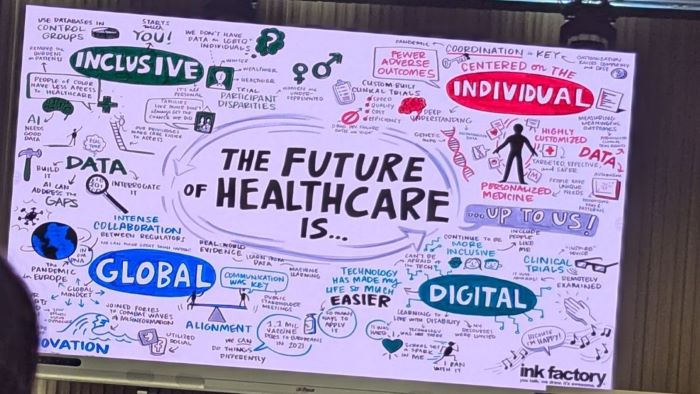
The second day of the conference was full of workshops and small group discussions where I had the chance to discuss with different participants. I participated in workshops under the theme Just & sustainable cities, where we discussed that cities must be transformed to become spaces of eco-social justice in which technology is harnessed to promote equity. In total, these two days allowed me to understand how I should frame my research in a way that sheds light on the historical-social development of digitalisation in urban water management, and how macro-level structures in European environmental governance interact with national, regional and local realities, and vice versa.
The Barcelona conference left me with more questions than answers—which is exactly what good research should do. I understood better how macro-level European governance structures shape local realities in cities, and how digitalisation in water management sits at the intersection of technological change, political economy, and social justice. But I wanted to go deeper into the planetary boundaries framework and understand how we can pursue justice while respecting ecological limits. This desire led me to Norway, where a very different but complementary learning experience awaited.
Justice within Boundary Limits
At the end of June, I travelled to Ås, a 30 km town near the Norwegian Capital, to attend the Summer School within the premises of the Norwegian University of Life Sciences. On the first night, we had a welcoming dinner where we were grouped into random tables to share a tasty vegan meal prepared by a local food collective. One can’t imagine how different the areas of research topics of the people I met that night were. But what mostly unified us was our interest to learn new insights about planetary boundaries and how to respect them with justice and equality in mind. We had many fruitful conversations, not only about our hobbies and cultures, but also on topics related to what our just and sustainable world might look like.
During the next two days, we attended many different lectures on how Planetary Boundaries are defined from natural science to political ecology and about interesting tools for transformation, ranging from philosophy of science to urban transformation. We also had the opportunity to work in groups and identify strategies to live within the planetary boundaries while preserving justice. Of course, I am not going to get into the details of these discussions as I promised, but one thing that captured my enthusiasm during the different lectures was the need to critically utilise the research tools in our possession and work within (new) settings that can mediate and unify our understanding of the natural world and the social complexities. This way, we can have a better understanding of what is causing the problems we face, so we can think of transformative solutions.
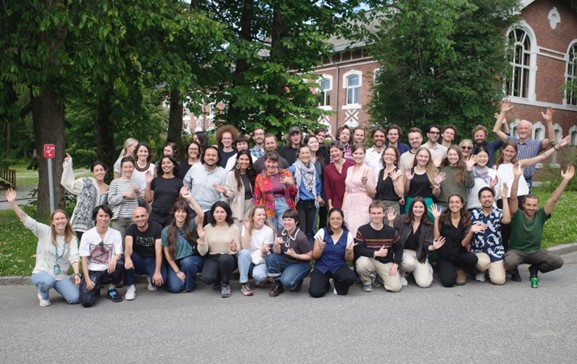
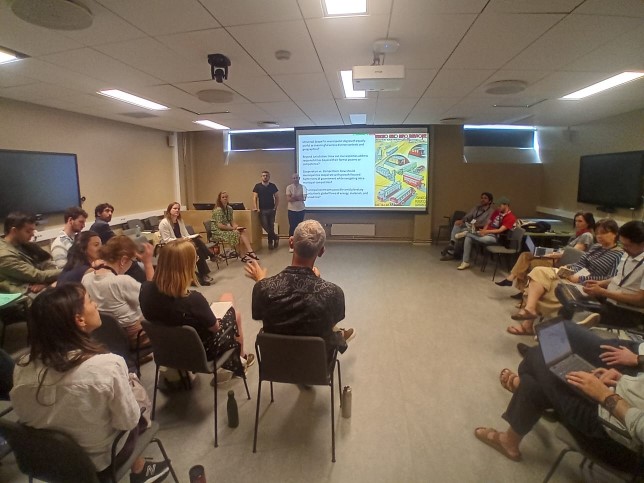
After the end of the summer school, the organisers shuttled us to the opening ceremony of the conference in the premises of the University of Oslo. There, for three days, I attended sessions and keynotes, which at first glance seem unrelated, but at their core, they contributed to my understanding of what a just world within boundaries might look like and what are the challenges that need to be addressed urgently in both research and practice. I tried to attend different types of sessions, from very theoretical ones on ecological economics, philosophy of science, ontology, and epistemology, to more sessions focused on more concrete topics like the one discussing post-growth Artificial Intelligence, to a research workshop in the intersection of climate research and humanities exploring the role of redefining masculinities and tackling climate crises. This session I attended and the notes I took from the plenary session have ignited a lot of thoughts towards bringing those discussions into the understanding of the digital transition in water management. The conference was also a place to meet different scholars working on similar research, presenting my review and assisting in organising a special session where LEQUIA colleagues facilitated discussions on degrowth municipalism, exploring the opportunities and limits of postgrowth urban governance.
Weaving the threads together
Looking back at these two conferences, I realise that my initial headache about transdisciplinarity has transformed into something more productive: a that the complex challenges we face, whether in urban water management, public health, or climate neutrality, cannot be solved within the confines of a single discipline. The Barcelona conference showed me how health inequities are inseparable from water access, digital infrastructure, and political-economic structures. The Oslo gathering reinforced my conviction that respecting planetary boundaries while ensuring justice requires us to bridge natural sciences, social sciences, and humanities in meaningful ways.
For my own research on the digital and green transition in urban water management, these experiences have been invaluable. They've taught me that investigating “smart” water systems isn't just about technology or efficiency, it's about understanding who benefits, who decides, whose knowledge counts, and how historical power structures shape what is considered “innovation” and “sustainable”. The transdisciplinary lens helps me ask better questions: not just "how can we digitalise water management?" but "how can we ensure digital water systems serve justice and equity within planetary boundaries?"
The winding road of interdisciplinarity is indeed challenging: it requires us to learn new languages, challenge our assumptions, and work across boundaries that academia often reinforces. But it's also the only road that leads to the kind of transformative change our cities urgently need. As I continue my doctoral journey, I carry with me the insights, connections, and questions from these conferences, knowing that the most important work happens not within disciplines, but in the creative spaces between them.