
Blog post #7 (October 2025)
Towards Urban Ecology, From Citizen Engagement to Urban Governance: Building the Bridge with Digital Tools and SETS Thinking
Yanxia Qiu | University College Dublin
 (5)-252x240.png)
Author's Introduction:
Yanxia Qiu is a doctoral researcher in the C-NEWTRAL programme at University College Dublin, focusing on data-driven approaches to nature-inclusive and participatory urban planning. She holds a master’s degree in Urban Studies and Planning (Landscape Architecture) from Aalto University and has worked as a landscape architect, urban designer, computational designer, and researcher across China, Finland, and the Netherlands, focusing on ecological planning in cities. Her research interests include digital tools for climate adaptation, data-driven environmental landscapes, and integrating digital technologies in landscape and urban planning.
____________________________
Throughout my academic journey as a landscape architect, I often returned to a simple but profound question: “Landscape for whom?” Human societies have long sought to frame nature in terms of its usefulness; ecosystem services are still described as services to humans, with the integrity of the ecosystem itself often treated as secondary. In earlier projects, I attempted to challenge this paradigm by experimenting with eco-centric approaches: designing landscapes for the benefit of birds and wolves or reimagining urban space through the perspectives of bumblebees. However, environmental challenges in human society require us to deal with the complexities by interweaving nature and human society. Natural landscape is for both humanity and nature itself. Cities are a human-nature habitat, where human and ecological systems interweave into complex, dynamic interactions.
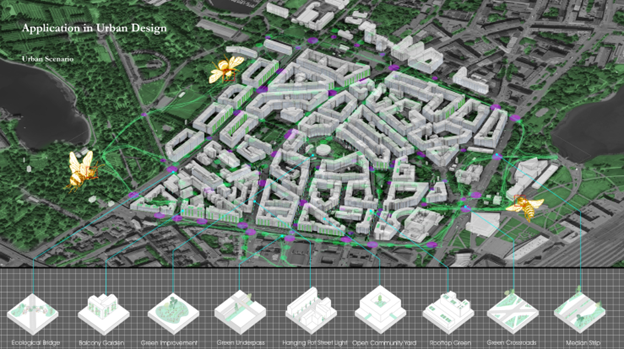
Agent-based modelling to simulate bumblebees’ movement in cities, and further inform urban ecological planning (source: author)
Recognising this complexity calls for more innovative ways of thinking and solutions. It has drawn me towards the potential of digital tools and technological solutions to act as mediators between social and ecological systems, helping us better understand the intricate patterns of urban complexities. I started exploring innovative solutions to complex social-ecological challenges in my master's thesis: studying bumblebee behaviour in urban settings through agent-based simulation modelling. Constructing this real-time simulation model provides valuable insights into the flight patterns of bumblebees in the city and facilitates a broader interplay and interaction involving various stakeholders. This social-ecological inclusive approach revealed the complexities of the urban ecosystem and offered potential guidance for planning well-connected green networks for urban wildlife, emphasising the importance of digital solutions in shaping sustainable urban environments.
As I began my PhD within the C-NEWTRAL programme, this orientation deepened. Participating in two intensive training sessions and attending CUPUM 2025, I started to see more clearly how digital innovation and systems thinking, particularly the social-ecological-technological systems (SETS) perspective, can help us bridge citizen engagement with urban governance. What emerges is a possibility: by combining social, ecological, and technological dimensions, we can co-create cities that are not only liveable for people but also sustainable for the more-than-human world.
In January, we explored practical and theoretical approaches to participatory planning during the Citizen Engagement training in Girona. Prof. Gerhard and Caroline Walter from Heidelberg University shared methods and tools that emphasised how public input can become a meaningful part of the planning process. Norbert Steinhaus from WILA Bonn brought valuable real-world insights from decades of citizen involvement across European projects, reminding us that participation is not only about tools but about trust, time, and transparency. Dr Hrishikesh Ballal, founder of Geodesign Hub, showed us the potential of digital platforms to coordinate diverse stakeholder inputs and visualise the spatial impact of decisions.
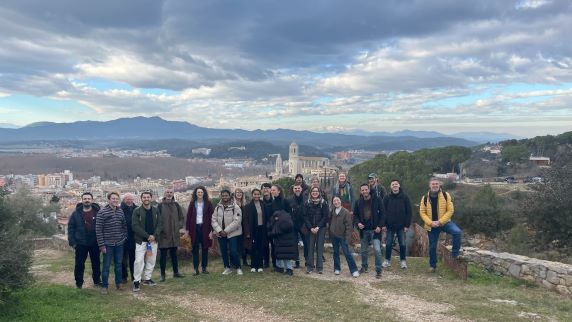
Group Picture in Girona in January
A few months later, in Belfast, we turned to the institutional and political side of things in the City Governance & Decision-Making training at Queen’s University. Prof. Geraint Ellis presented the challenges of governing urban transitions in Belfast, particularly under the pressures of climate change. Michalina Kułakowska led a workshop on systems thinking using serious games, a powerful reminder that governance involves navigating complex, interdependent relationships. We also saw how digital tools like Tygron (introduced by Waard van Laatum) and AI-based traffic simulations (presented by Jørgen Bundgaard Wanscher) can support more informed and collaborative planning.
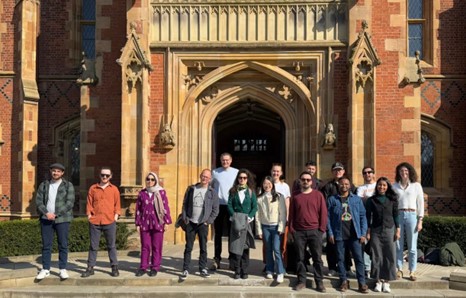
Group Picture at Queen’s University Belfast this April
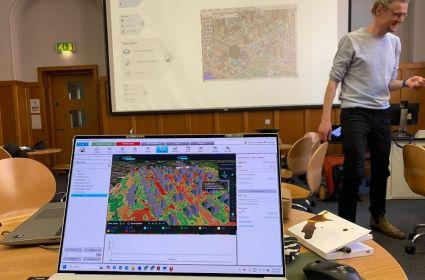
A training session on the Tygron platform will inform climate-neutral planning.
Then came CUPUM 2025, where a wide range of advanced research in computational urban planning and management inspired me. Seeing so many researchers using digital technologies to address complex social-ecological challenges was incredibly motivating, especially regarding how digital tools can leverage participatory planning. One particularly thought-provoking presentation came from Juliana Gonçalves, who examined whether digital tools empower citizens in planning processes. Her findings showed that digital tools can strengthen citizen engagement, a promising sign for the future of participatory planning.
I also had the opportunity to present my first-stage PhD findings during the poster session. My research explores how digital tools can support integrating Nature-based Solutions (NbS) into different stages of urban planning, while enhancing public participation, all through the lens of the Social-Ecological-Technological Systems (SETS) framework. One of my key takeaways is that although many digital tools already exist, few are fully aligned with the SETS framework. Many hold untapped potential, especially if further developed to better reflect urban complexity, inclusivity, and ecological priorities. This opens exciting possibilities for designing tools that engage, inform, and transform urban decision-making.
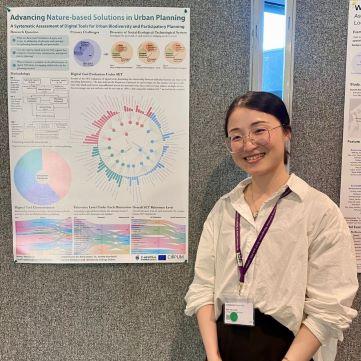
Presenting my preliminary findings at the poster session
Social-ecological challenges, such as climate change to society, the human-nature relationship, and urban biodiversity, are urgent and complicated, calling for a more systematic and innovative approach to their complexity. Through the knowledge I gained from these experiences, I believe that bridging citizen engagement with governance requires more than just inviting the public to participate. It’s about ensuring that participation informs practical decisions. Digital tools, when thoughtfully designed, can act as potent mediators in this process, helping cities visualise trade-offs, coordinate stakeholders, and incorporate local knowledge into policy.
Moving forward, I’m excited to explore how SETS tools can support more participatory and ecologically resilient urban futures, and how we can design not just for engagement, but for impact.