
Blog post #9 (December 2025)
C-NEWTRAL Summer School 2025 - Reflections on Research, Responsibility and Sustainability
Nyma Haqqani | University College Dublin

Nyma Haqqani has a background in sustainable prosperity, participatory research, and social inclusion in urban spaces. She holds a master’s degree in Global Prosperity from UCL and her prior work in sustainability includes building a toolkit with and for community groups to make urban greenpaces more inclusive to ethnic minorities, developing participatory methodologies for Nature-based Solutions, building Indigenous partnerships, and business development for circular economy solutions that address both environmental and social issues. Nyma's current research is focused on the intersections of social sustainability, climate action, and just urban transitions. Her work explores how inclusive approaches to climate action, such as sustainable mobility, can advance equitable and resilient pathways toward climate-neutral cities.
Exploring the unspoken values behind sustainability research
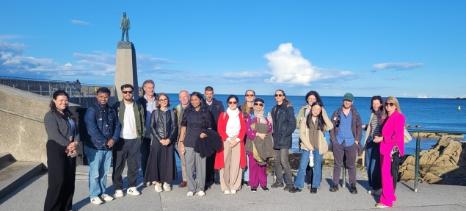
The very first summer school of the C-NEWTRAL consortium began at the end of summer 2025, with UCD hosting the consortium in Dublin, Ireland. Lasting one week and packed full to the brim with helpful sessions on conducting doctoral level research, career path options, self-management exercises, publication and writing guidance, and site visits to Dun Laoghaire and the Liberties, the week was full of learning and intellectual insights.
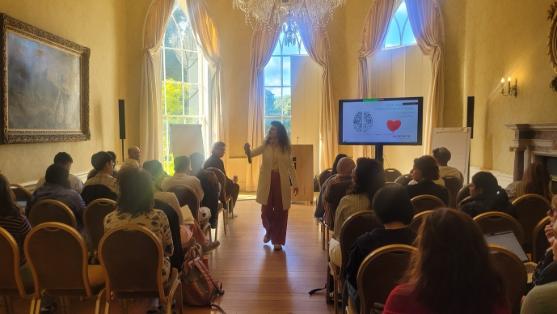
On the last two days researchers presented their work in front of the consortium, giving everyone a chance to hear about the 12 doctoral projects and exchange thoughts and perspectives. Listening to some of the debates, I found myself thinking about the implicit moral and political judgements that shape what we call sustainable or green.
As sustainability researchers, we often begin from shared assumptions of what counts as progress.
But how often do we stop to ask where those assumptions came from and whose vision of sustainability they serve?
I found myself reminded of (opens in a new window)Agyeman’s caution that for ‘wicked problems’ like climate change ‘the challenge is not the science, but the social science’. And although he asks how we can ‘shift the paradigm, the political and civic culture […] and inculcate public understanding such that the need for action is both supported and assured?’, in light of society at large, it made me wonder if that social dimension didn’t include our own role as researchers who shape what counts as a solution to the climate challenge. If the science of climate change is robust and settled and the real challenge is societal, then are we, as researchers part of that society, doing enough to confront the assumptions driving our own work?
As researchers we have a responsibility to acknowledge these assumptions. Much of climate research, and ours no different in this regard, already embeds normative assumptions often as a result of political or policy agendas. If these assumptions are not surfaced we run the risk of obscuring alternative perspectives. Alternative visions for sustainability and better futures exist and do deserve their own space in research, but how well is this tension between technocratic optimisation and democratic pluralism reflected in the sustainability agendas that drive and fund climate research?
For the record, I’m not arguing that climate research should be ‘value-neutral’, or if in fact, it’s even possible for it to be. (opens in a new window)Schmeig and colleagues (2017) assert that ‘the idea of sustainability is intrinsically normative’, while (opens in a new window)Hormio (2024) makes a case for the necessity of values in setting climate policy while being vigilant that those normative positions are not presented as neutral solutions. The issue is not normativity itself, rather it is unexamined normativity – where values are baked into research agendas and go uninterrogated. Are we as researchers merely aligning our research to existing political agendas? Or are we critically examining the trade-offs and societal impacts that are embedded into the very value-laden premises we begin with?
How do we ensure the sustainability projects driven by our research are indeed transformative and not, like so many other sustainability initiatives, performative? Performative research often ends up reinforcing existing agendas and systemic problems under the guise of innovation, while transformative research attempts to reimagine systems and the values that underlie them. The broader systemic risks must not be downplayed – it is vital to consider the value-laded premises our research is propagating and what the unintended consequences of our projects could be. Mass electrification of transportation being a net positive is often taken as a universal truth, but with electrification at the scale hypothesised to address climate change, the resulting ecological impacts of mining lithium and human rights abuses imply that we would be content with displacing tragedy from a global level to a local one. While a European city resident may be able to feel good about their ‘green’ choice of transport, the (opens in a new window)Paiute-Shoshane tribe of the Indian Reservation in Nevada, USA endure gross violations of the rights to their land with a lithium mining project steamrolling ahead to begin operations in 2026. The project will build an open pit lithium mine on the land where the tribe’s ancestors were massacred in 1865 and essentially propagates settler colonialism through external colonial modes. How can this be justified in the pursuit of more ‘sustainable’ transportation? Sustainable for who? If these issues are addressed by researchers in the climate space, in a systems thinking way we will be in a much better position to avoid repeating harmful historical patterns. These are not abstract concerns – our research decisions, even when motivated by sustainability can have very real human and ecological consequences.
The political discourse after the global Covid-19 pandemic has centred around ideas of ‘building back better’ and ‘just transitions’ to a better future. Surely, this would be the time to closely analyse the unintended consequences of proposed solutions. Although democratic nations champion the idea of representation for all, climate action at the policy level has become dominated by masculine, technocratic solutions, that operate on the assumption that the destructive, resource-hungry systems we have built our current world on simply need the right technological fix to continue on. Take for instance, the voluntary carbon market. Although creating it necessitated recognising that carbon emissions are a massive problem, the solution itself was not to assess and change the underlying behavioural cultures of consumerism and unequal excess, but rather another capitalist market that incentivises and rewards more of the same psychology that got us into this mess in the first place.
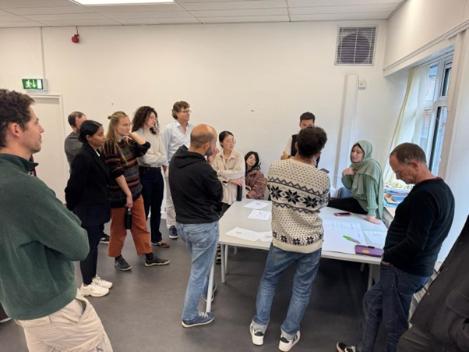
As one of the researchers within C-NEWTRAL, I’m conscious that I am part of the very structures I’m critiquing. Yet that is precisely why such reflexivity feels necessary. Perhaps this is what makes spaces like the C-NEWTRAL research consortium summer schools so valuable. They create opportunities for researchers to question, debate and collectively reimagine what truly transformative sustainability research can look like.