

Metacognition Framework
Metacognition Design Framework to support metacognitive skill development through blended learning

Why Metacognition?
Metacognitive skills are key transversal skills, strongly linked to academic achievement and essential for effective lifelong learning.
They are widely recognised to underpin many of the core competencies required for effective social and professional participation, including core competencies such as critical thinking, problem-solving, and self-awareness, high-lighted by UNESCO as key to Education for Sustainable Development.
Digital learning technologies and virtual learning environments increasingly form a core strategic dimension of teaching and learning within Higher Education, however effectively harnessing them to enhance student learning remains challenging.
Metacognition Design Framework
The Metacognition Design Framework is an evidence-based learning design that scaffolds the development of metacognitive skills in students through blended learning.
Drawing on the tools available within the virtual learning environment to provide a unique, and potentially powerful, opportunity to extend ‘metacognitive influence’ on student activity and learning outside standard class times with realistic levels of staff input.
The design supports:
- Planning of accessible learning interventions
- Their linkage with appropriate technology
- Mapping of how face-to-face and online, or fully online, components interrelate
Delivering an effective conduit to convey information in a practical format that readily permits adaptation to local contexts.
Offers a practical way to re-frame educators as designers, increasing educator design capacity and the effective deployment of technology to enhance learning, at the same time targeting a learning outcome with high potential impact.
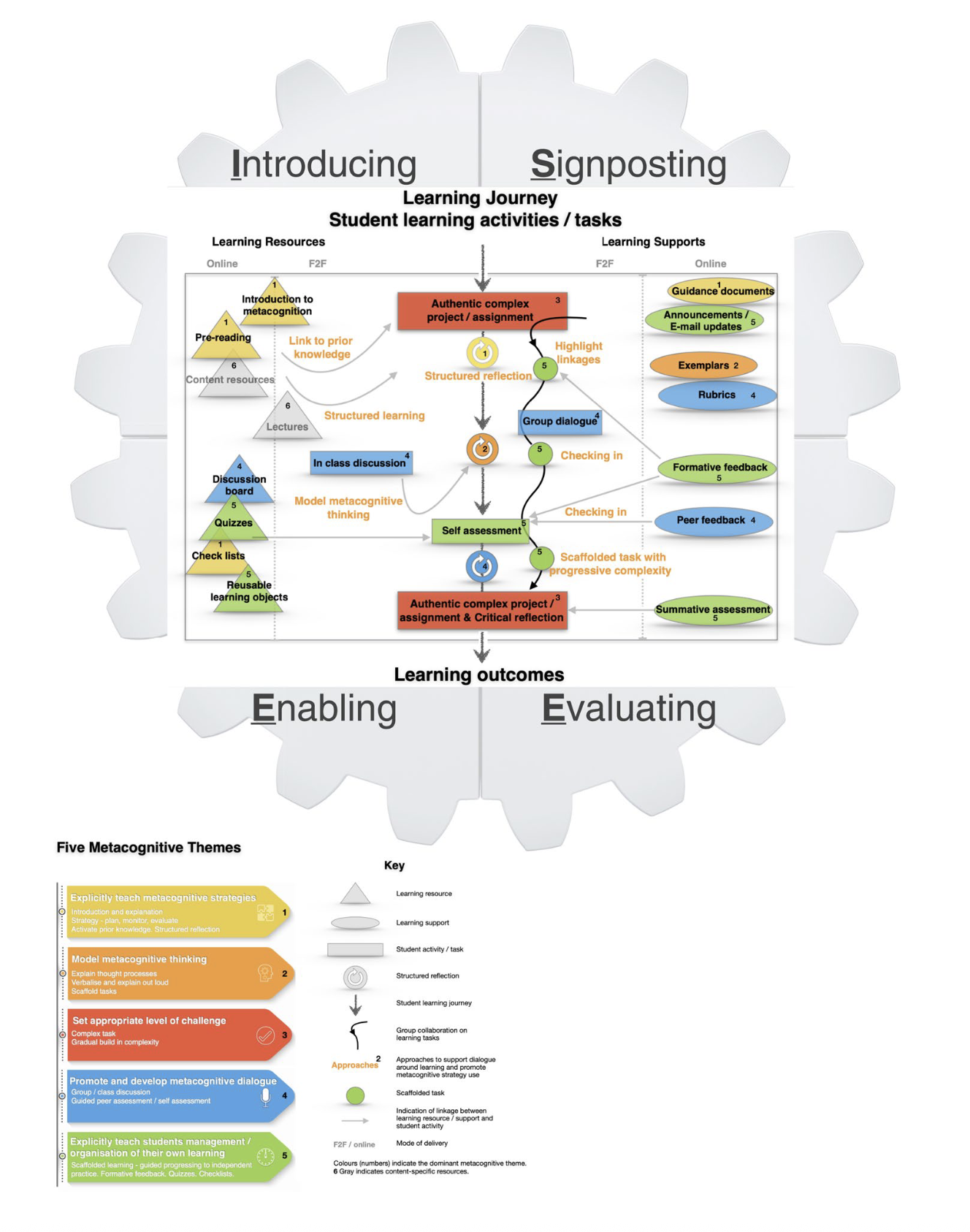
Metacognition design framework showing the ‘I-SEE’ strategies for learning.
This figure shows the five evidence-based metacognitive themes that form the core of the Metacognition Design Framework.
This learning design framework was developed by mapping learning approaches aligned to the five metacognition themes (coded by colour), building on and adapting the task, resources, and supports classification developed by Oliver (1999); Oliver and Harrington (2003).
It shows the student learning activities / tasks (rectangles) to be completed as the student progress on their learning journey towards attainment of the learning outcomes. Learning resources (triangles) and supports (ellipses) available to aid them as they progress are shown to the left and right respectively. These resources / supports are available either online or face-to-face (F2F; this can also be substituted for synchronous online), as depicted by their location (left / right) on the framework.
The colours broadly depict linkage to the five metacognitive themes, although many items target more than one of theme. Reflection on learning (circle with arrows) is a core student activity, introduced and developed through discussion and feedback, all designed to promote dialogue around learning.
Other approaches to support dialogue around learning and promote metacognitive strategy use are indicated in orange text. Group collaboration on learning tasks is also a core part of the learning journey with all learning supported by the appropriate scaffolding of tasks.
The resources and supports can be broadly grouped into themes; Introducing, Signposting, Enabling, and Evaluating; the ‘I-SEE’ strategies for learning occupying the four quadrants of the framework. These overarching strategies are depicted as interlinking parts of a cog, symbolising that, whilst Introducing and Signposting strategies are presented first initially, with Enabling and Evaluating occurring next, all become recursive elements integrated throughout the learning journey and applied within multiple learning elements over time.
The overall result is an iterative process that scaffolds student learning and the development of metacognitive skills as they progress towards achievement of their learning outcomes
Abstract summarised. Figure and legend reproduced without adaptation from: (opens in a new window)https://link.springer.com/article/10.1007/s11423-025-10574-y
Open Access: This article is licensed under a Creative Commons Attribution 4.0 International License. To view a copy of this licence, visit (opens in a new window)http://creativecommons.org/licenses/by/4.0/

Designing using the Framework
The Metacognition Design Framework is designed as a general 'blueprint' to depict the student’s learning journey within a generic learning task, module, or even programme.
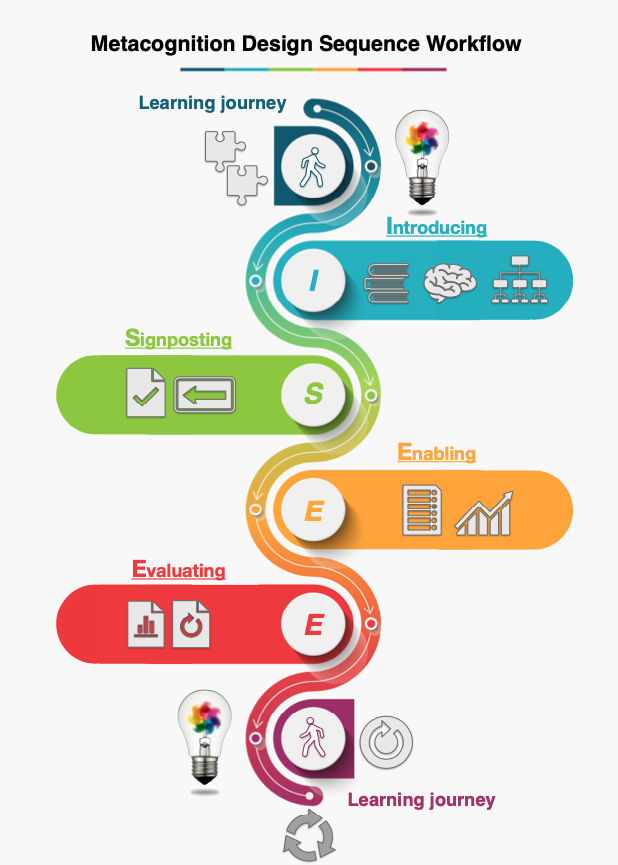
This provides a practical guide for the creation of more procedural Metacognition Design Sequences that can be adapted for specific educational settings.
Metacognition Design Sequences
This graphic provides an overview of the process for creating Metacognition Design Sequences guided by the Metacognition Design Framework and 'I-SEE' Learning Strategies.
The following Guidance notes are available to support this process:
- Creating Metacognition Design Sequences (Appendix 1)
- Aligning technology with the ‘I-SEE' learning strategies (Appendix 2)
Learning Journey
This starts with design of an authentic complex project / assignment and appropriate supporting learning activities / tasks that are all clearly aligned to achievement of the learning outcomes. These learning activities should gradually increase in complexity and be appropriately scaffolded to support students as they progress on their journey. This complex assignment should involve at least some group work to promote collaboration and discussion. A core student activity that should be encouraged throughout the learning journey is critical reflection on their learning, with thought given to scaffolding this process.
Overall, consider how the virtual learning environment can be leveraged to enhance exposure time to 'metacognitive influence' (the voice on the shoulder reminding student to consider their learning) whilst additionally managing staff workload.
Introducing
- Introduce metacognition and metacognitive strategies
- Clearly structured delivery of learning resources to aid integration of knowledge
- Provide a variety of resources (aligning with Universal Design for Learning)
- Structure to support effective collaboration
- Integrate metacognitive strategy use with subject-specific material
Signposting
- Clearly communicate requirements and expectations for learning tasks (e.g. guidance documents, rubric, exemplars)
- Clear regular announcements / email updates
- Support clear effective knowledge construction
- Support dialogue around metacognition
Enabling
- Providing opportunities for students to plan, monitor, and assess their learning
- Scaffolding of tasks which progressively increase in complexity (e.g. check lists, quizzes, re-usable learning objects)
- Opportunities for discussion and a dialogue around learning
Evaluating
- Provision of timely, targeted, actionable feedback providing opportunities for students to assess, monitor, and reflect on their progress (multiple formats, e.g. automated, staff, peer)
- Opportunities for discussion and a dialogue around learning
Learning Journey
Throughout the learning journey the aim is to emphasise critical reflection on learning and promote a culture of dialogue about learning. Framing the reflective process around the progression of learning and the promotion of a growth mindset, and encouraging students to complete the feedback loop. Overall, the dialogue around learning should encourage questioning and the linkage of new learning to prior learning supporting effective knowledge construction.
Metacognitive Learning © 2023 by (opens in a new window)EJ O'Neill, C Fulton, C Hensey & J Matthews is licensed under CC BY-NC-SA 4.0

Publication
O’Neill, E.J., Fulton, C., Matthews, J. et al. Metacognition design framework to aid metacognitive skill development in university students supported by the virtual learning environment. Education Technology Research & Development (2025). (opens in a new window)https://doi.org/10.1007/s11423-025-10574-y
The Guidance notes available on this webpage - Creating Metacognition Design Sequences (Appendix 1) and Aligning technology with the ‘I-SEE' learning strategies (Appendix 2) - were originally released linked to this paper.
The Metacognition Design Sequence Exemplars available here are also published in this paper. They have been reproduced here without adjustment.
They are all reproduced here under a Creative Commons Attribution 4.0 International License. To view a copy of this licence, visit (opens in a new window)http://creativecommons.org/licenses/by/4.0/.
Veterinary Clinical Neurology
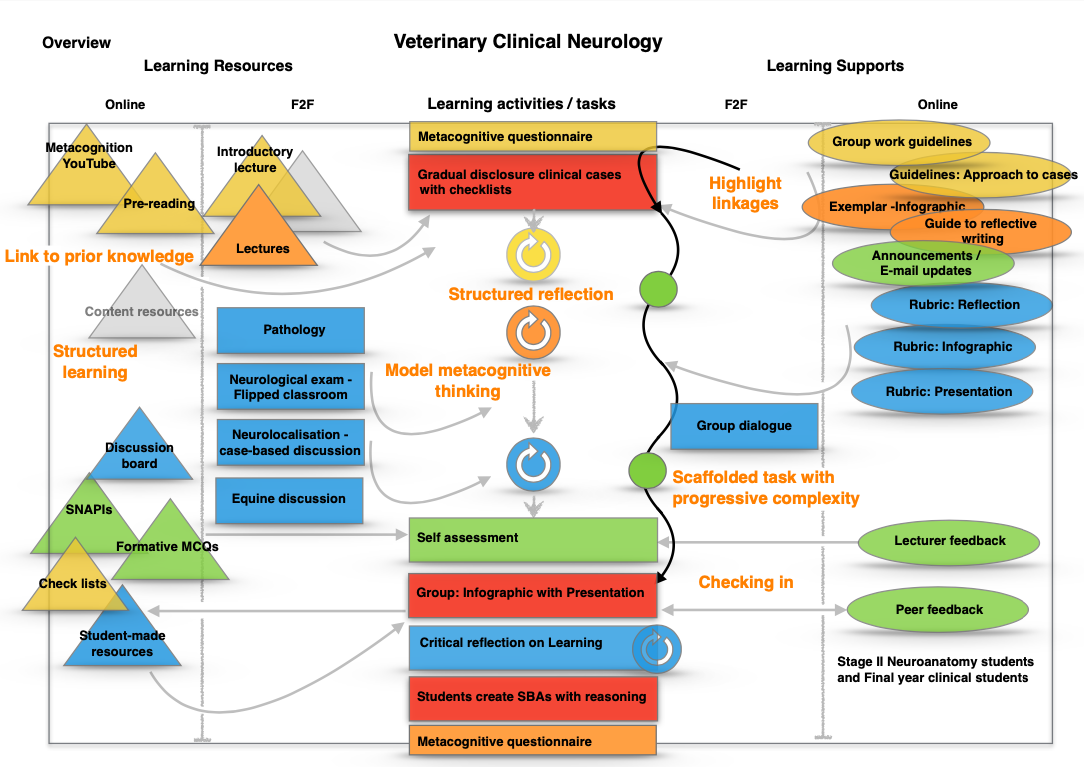
Example from School of Veterinary Medicine
Stage 4 students on Bachelor of Veterinary Medicine (MVB) programme enrolled on this normally face- to-face module, Veterinary Clinical Neurology, which was redesigned as a blended module. They participated in group work, peer- and self-assessment, and reflective practice. Students within Stages 2 & 5 of the MVB programme aided the peer review process which centred around presentations of Infographics made during group work centred around gradual release clinical cases.
Video exemplar can be accessed in the Further Details section.
DigiLife
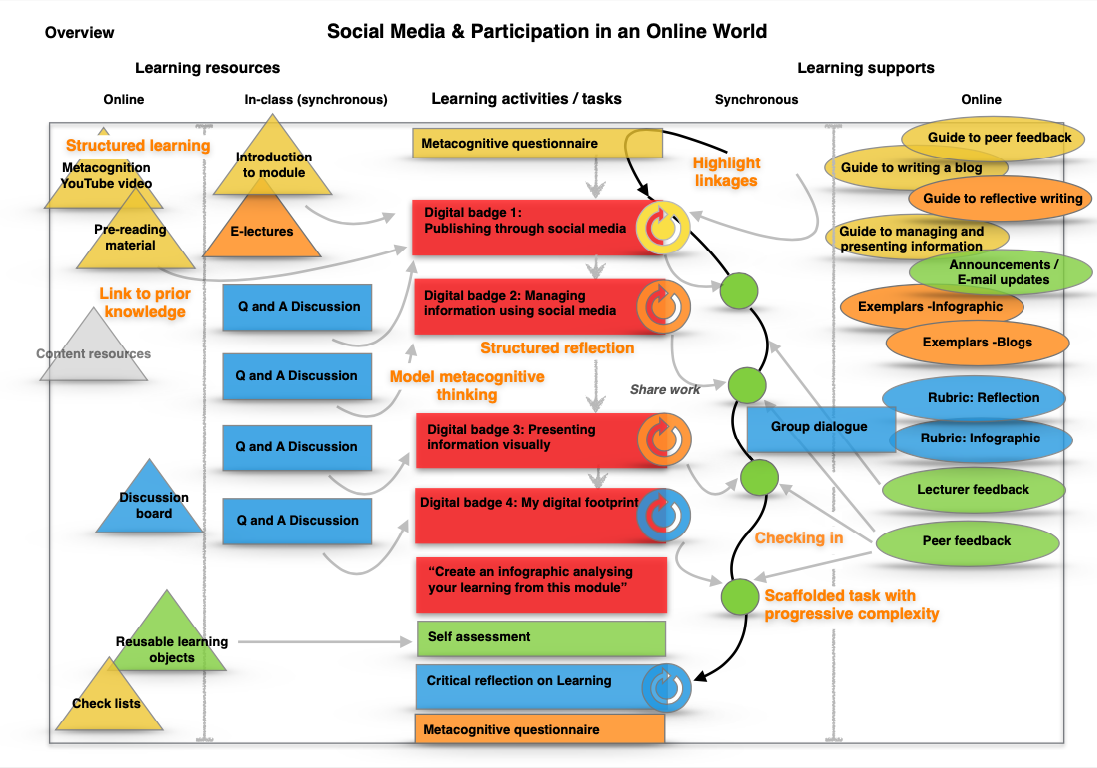
Example from School of Information & Communication Studies
Stage 2 students from across the Bachelor of Social Sciences programme enrolled for a newly designed module, “DigiLife: Social Media & Participation in an Online World.” They participated in a series of digitally badged social media activities, involving use of social media tools and analysis of issues relating to social media. Students submitted reflections on their acquired learning and used video peer review to deepen their reflections. A VLE checklist tool facilitated students’ self- assessment of their learning. Additional tools aided communication. This module ran fully online during the COVID-19 pandemic.
Video exemplar can be accessed in the Further Details section.
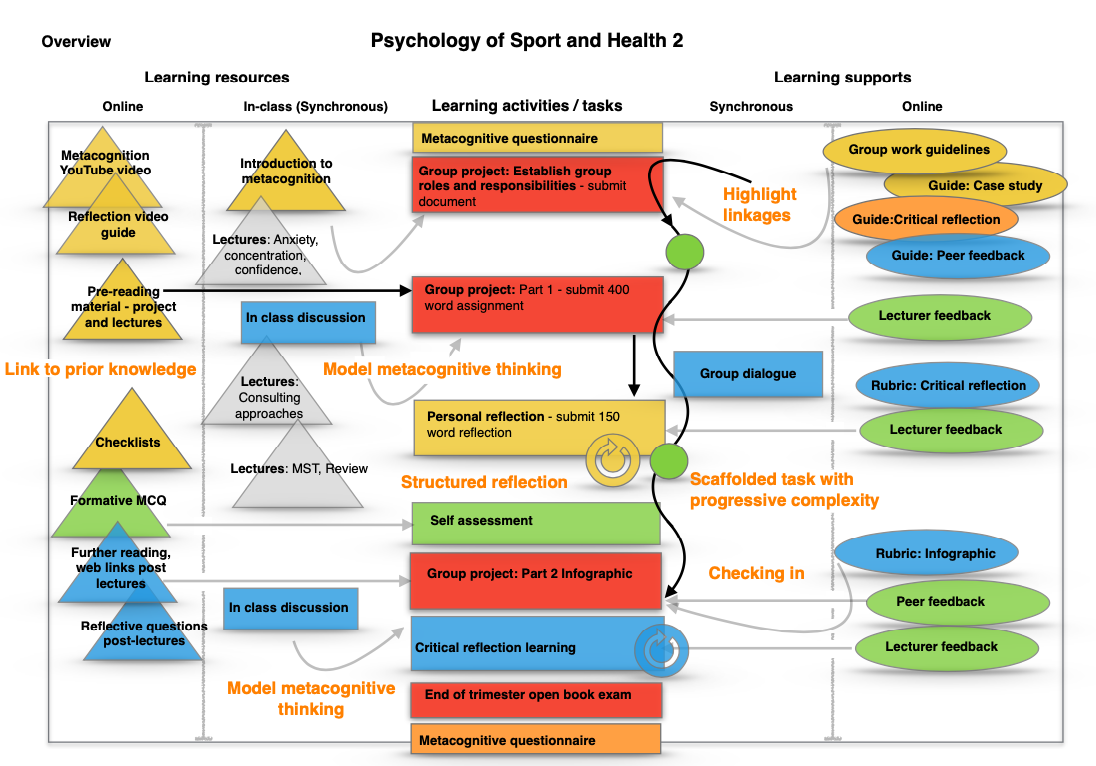
Psychology of Sport and Health
Example from School of Public Health, Physiotherapy and Sports Science
Stage 2 students on the BSc in Health & Performance Science enrolled in this normally face-to-face module, The Psychology of Sport and Health 2, redesigned as a blended module. The module transitioned to fully on-line during the COVID-19 pandemic.
Video exemplar can be accessed in the Further Details section.