Community mapping workshop in Clifden
Thursday, 27 November, 2025
IE-NARR held the third and final community mapping workshop in the series in Clifden Town Hall, Connemara on the 8th of November 2025. Unlike our other workshops, the team brought one map to Clifden due to the smaller numbers in attendance and the need to form a cohesive conversation.
We chose Clifden due to its proximity, on the Western Atlantic seaboard, to the recently cancelled Sceirde Rocks offshore windfarm scheme - a 450 megawatt, 30 turbine offshore wind project development of up to 325 meters in height. But it is also home to the first regular transatlantic radio transmission station in Derrigimlagh Bog, where Guglielmo Marconi established one of the pivotal telecommunications infrastructures of his global radio empire in the early-1900s. Utilising turf cut from the local bog to power this advanced technological apparatus, this site is especially significant because the Irish government’s renewable energy transition is closely bound up with the country’s current digital transition. Ireland’s historical business strategies and its concomitant hosting of multinational data centres in Dublin have cemented Ireland’s position as a hub for digital industries, central to the Government’s “twin transition” strategy (“digitalisation and decarbonisation”) whereby energy transition and industrial growth are promised to go hand-in-hand.
However, the impacts of the twin transition - and what has prompted it, climate change - are felt unevenly across Connemara and Dublin. The west experiences the brunt of the impact of Atlantic storm systems, which are increasing in severity due to climate change. Notably, Connemara already experiences strong winds and waves, making it susceptible to storm damage. In particular, the Sceirde Rocks, site of the planned eponymous wind farm, are off the coast of Carna and the “Iorras Aintheach” peninsula, which is Irish for the “Windy Peninsula”. The tides break at the rocks, and Dúchas archive materials reveal that due to the ocean spray it appeared as though a city was on the rocks, while Connemara-based historian and geographer Tim Robinson described how the rocks seemed to locals like the gates of hell. Unsurprisingly then, the windfarm scheme was cancelled following the measurement of very high windspeeds and wave heights, making near-shore windturbines in this area untenable.
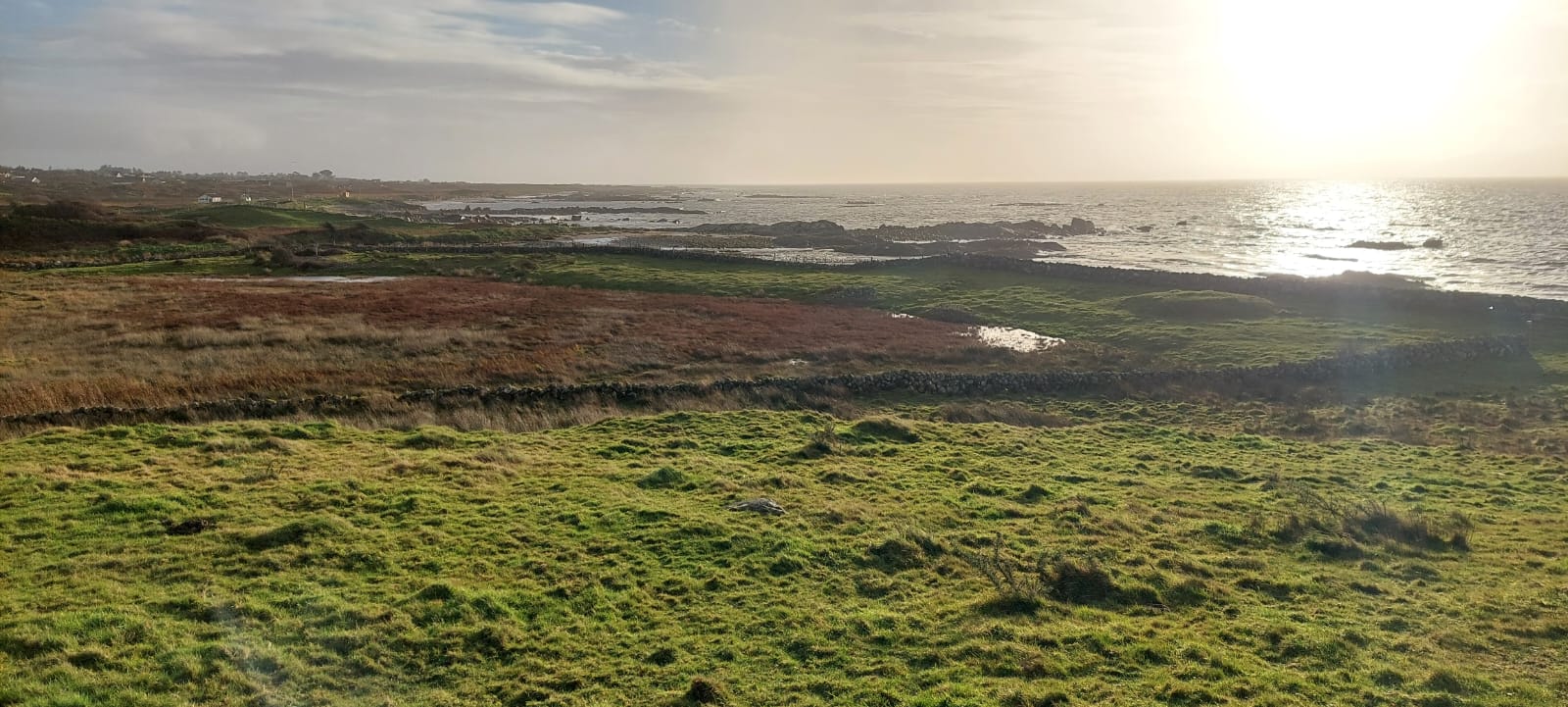 Photo of the coastal landscape in Connemara
Throughout our conversation on 8th November, we discussed how the impact of high winds on underserviced infrastructure structured the lived experience of climate change in Connemara. During Storm Éowyn downed electricity and telecommunications poles, and a lack of wifi and mobile networks, caused disruption for weeks. Discussion noted that electrified houses (generally the most modern or newly retrofitted houses) fared poorly in the storm – but if electrification is to expand, then climate resilience must be central to infrastructural development. This may mean more dispersed forms of renewable energy or community based energy schemes, consideration of mixed energy sources (back up generators for example), the introduction of more batteries, and perhaps the inclusion of marine energy (while still in experimental stages). The group and facilitators noted that the current plans were for energy from the Sceirde Rocks scheme to go south for storage at Moneypoint and to power other communities and industries during Ireland’s current push for artificial intelligence (AI) capacity, largely expressed in the form of data centres. And in tandem with accounts of failing infrastructure were discussions around housing – it is challenging to get planning permission for housing in the west of Ireland, often due to ecological reasons. But the windfarm did not seem subject to such stringent planning concerns.
Throughout we grappled with different definitions and politics of sustainability; and the need to centre local voices and knowledge. The community are very well attuned to the potential impact of the wind farm development on local ecology, including on lobsters, basking sharks, cold coral reefs, maerl, kelp, and prawn beds; and on migrating birds; and are involved in multiple local projects on nature restoration. But this rich ecological knowledge seems in friction with the development of renewable energy. Does it need to be? Is there a path forward that enables the development of such infrastructure but in a way that doesn’t harm local ecology and subvert local democracy?
The history of this area suggests not. This is a region which has experienced multiple rounds of coastal industrialisation – from Victorian era kelp mining for soda and potash, to contemporary offshore fish farms. The latter has had an impact on local salmon in particular and on water quality. The community strongly felt that the seas and fisheries are a resource to be protected – but they need long-term policies, support and funding for this work. And crucially, a bigger voice. Objections cost €50 per person, and changes are occurring at An Coimisiún Pleanála about how communities can object, creating worries about disenfranchisement.
Members of the community stated that they wished for nature to be recentered in conversations about the energy transition, rather than being sacrificed for development – while still desiring the development of energy infrastructure that will support the local community, social good, and wider environmental policies and goals at the same time. These are complex but necessary demands. There is hope for the potential of the new Maritime Area Regulatory Authority (MARA), and the upcoming Nature Restoration Plan. This is a community that stays in Connemara in spite of underinvestment in jobs, housing, infrastructure, and the Irish language. They wish to see it thrive, and they are not short on ideas as to how to put this into action. These ideas need to be listened to, re-centred, and taken seriously in energy transition policy.
.jpeg) Community inputs related to the energy transition in Connemara as recorded on a map of the area
Community inputs related to the energy transition in Connemara as recorded on a map of the area
This workshop was supported by the Earth Institute Strategic Priority Support Mechanism at University College Dublin; MESSAGE, the Marine & Energy Social Sciences & Humanities Interdisciplinary Research Group at University College Dublin; and the Marine Institute Networking & Marine Research Communication Award.