Muddying the waters - how 'sludge' can complicate and delay urgent climate action plans
Wednesday, 26 November, 2025
Share
.jpg)
The second of the Earth Institute’s Adapt for the Future lunchtime sessions - entitled Bureaucratic Burdens in a Warming World - which took place in the Museum of Literature Ireland yesterday, focused on how paperwork and frustrating administrative hurdles can delay climate action.
Defined as ‘sludge’, excessive behavioural friction can muddy the waters by making it harder for people to do what they intend to do – or in the case of climate action, stall vital projects such as afforestation or local energy initiatives.
The first speaker, Dr Cara Augustenborg, Head of Environmental Policy at UCD School of Architecture, Planning and Environmental Policy, outlined her work on an EPA-funded research project assessing ‘Administrative Burdens as Barriers to Implementation of Ireland’s Climate Action Plan’ (ABICAP).
Through this project, she and a team of researchers have carried out ‘sludge audits’ and looked at ways of (opens in a new window)reducing administrative frictions in Ireland’s afforestation scheme, removing barriers to (opens in a new window)Ireland’s Shared Island Sports Club EV Charging Scheme and (opens in a new window)improving engagement with Ireland’s solar schools scheme by reducing administrative frictions.
These audits revealed that administrative frictions are often highest at the point of delivery, thereby threatening applicant retention and uptake; scheme design can be improved through cross-agency collaboration, and friction assessments provide a valuable lens for evaluating climate policy.
Dr Desmond O'Mahony echoed Dr Augustenborg’s sentiments, adding that sludge audits can result in making public services and processes more accessible, user-friendly and fair.
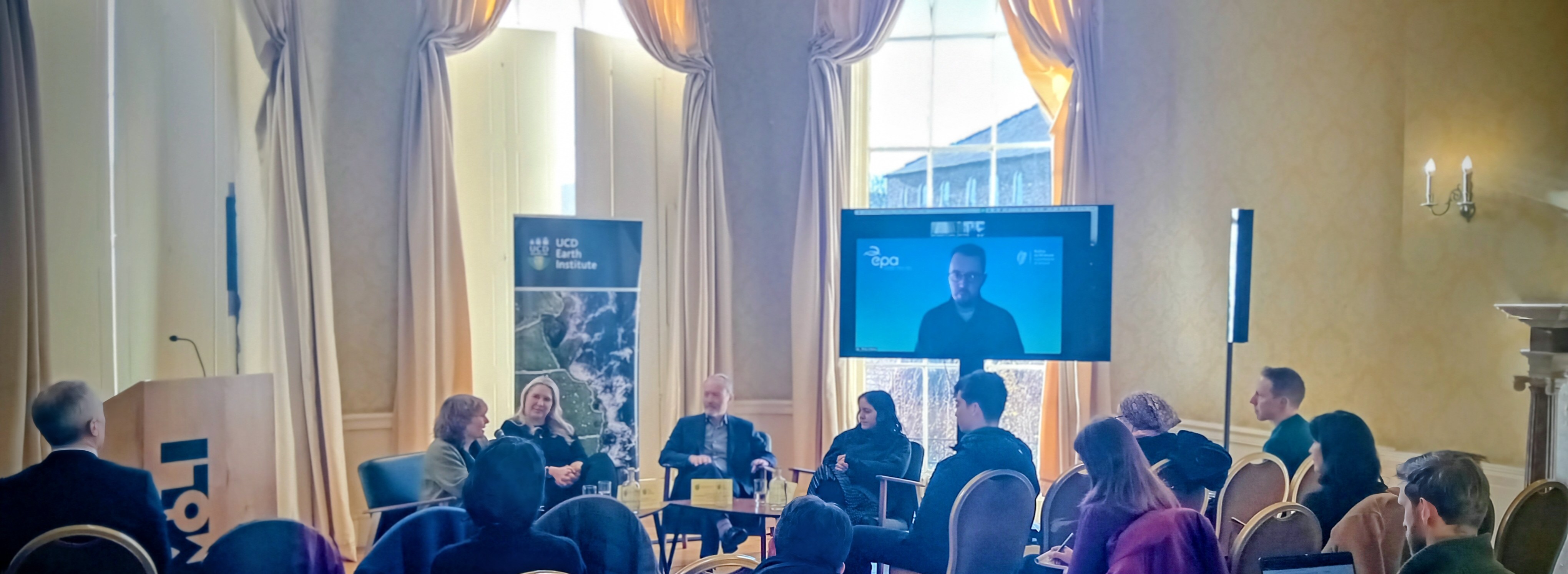
The full panel, including Dr O'Mahony who joined via Zoom
The Scientific Officer with the Environmental Protection Agency’s (EPA) Behavioural Insights team, who was the second speaker at the event, also said that these audits provide a data-driven business case for change and challenge assumptions, often showing that the most pressing issues – and high dropout rates – sometimes occur at the later stages of a process.
Dr Augustenborg and Dr O’Mahony’s remarks were followed by a panel discussion chaired by Dr Jeanne Moore, Policy Analyst at the National Economic and Social Council (NESC).
While not a fan of the term ‘sludge’, panellist Dr Gerry Clabby, Principal Advisor at the Environment and Climate Research Advisory Unit in the Department of Climate, Energy and the Environment (DCEE), said that government policies need to be implemented quickly but also should be reviewed regularly. These review processes, he added, should be embedded into the system.
Fellow panellist Dr Hannah Julienne, Programme Manager for Behavioural Economics at the Sustainable Energy Authority of Ireland (SEAI), highlighted how mapping out the customer journey has been helpful for tackling the seemingly insignificant issues that kept cropping up, and that the one-stop-shop model reduces the administrative burden.
In addition, she pointed out that while capacity is a major constraint and there is more work to do to overcome these burdens, there is 'lots of positive work going on'.
Please note that yesterday's session was not recorded. Our Adapt for the Future series will continue in 2026.