
Current Research Themes and Projects
Theme: Newman Studies
This permanent research theme of the Newman Centre has the aim of supporting academic research on the life, work, thought and legacy of St. John Henry Newman, with a particular focus on Newman's 'Dublin writings' (1851-9) and the history and legacy of the Catholic University of Ireland. Newman's Dublin writings include his ‘Discourses on the Scope and Nature of University Education’, which constituted the first part of his famous The Idea of a University Defined and illustrated published in London in 1873, and his two-volume My Campaign in Ireland.
The Newman Studies research theme is generously supported by the Newman Trust and Newman Society, which maintains the Newman Research Library in UCD’s historic Newman House (home of the Museum of Literature Ireland). With the generous support of the Newman Trust, Newman Studies also funds annual Newman MA Scholarships for students at UCD whose Masters research draws on Newman's work. For a list of previous Newman MA Scholars and details on how to apply for a scholarship, please see here.
The Centre currently hosts two research projects under the Newman Studies theme: Newman's Philosophy of Education, and Wittgenstein, Newman and Hinge Epistemology:
Project: Newman's Philosophy of Education
This project is led by Assoc. Prof. Áine Mahon (UCD School of Education) and investigates contemporary educational theory and practice through the lens of St. John Henry Newman's vision of higher education as expressed in his seminal Idea of a University of 1852. The project was launched in October 2022 with a two-day international conference entitled Newman's Idea of a University: Then and Now, co-organised with the University of Notre Dame Newman Centre for Faith and Reason:

In 2025, the project secured external funding from the Philosophy of Education Society of Great Britain to support doctoral research on Newman's philosophy of education. The funding was awarded to Fr. Cosmas Iyamu for a PhD project entitled 'Re-thinking Doctoral Education Through John Henry Newman: The Case of International Students in the Contemporary University', which is co-supervised by Assoc. Prof. Áine Mahon (UCD School of Education) and Assoc. Prof. Daniel Esmonde Deasy (UCD School of Philosophy). Future plans for this project include the establishment of a series of annual public Newman Lectures on Education, in collaboration with the academic journal Studies: An Irish Quarterly Review.
Project: Wittgenstein, Newman, and Hinge Epistemology
This project is led by Prof. Annalisa Coliva (University of California, Irvine) and Assoc. Prof. Daniel Esmonde Deasy (UCD School of Philosophy). The research project website can be viewed here.
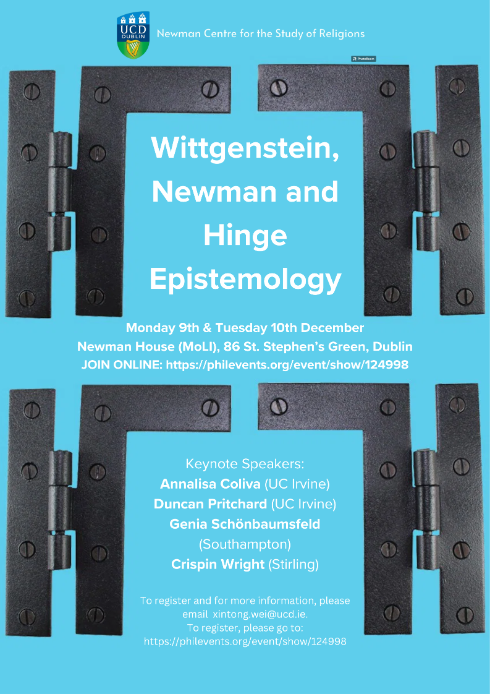
This project was launched in 2024 with a major two-day international philosophy conference in Dublin on the relationship between the epistemological theories of John Henry Newman and major 20th century philosopher Ludwig Wittgenstein, entitled Wittgenstein, Newman, and Hinge Epistemology. The conference was generously supported by UCD School of Philosophy and included presentations from over twenty Irish and international speakers (the full programme can be viewed here):
The project now includes over 25 senior and early-career researchers from around the world. In 2025, the project sought funding from the Templeton Foundation, and will continue to seek significant funding from external bodies. Future plans include the publication of an edited volume by an international press and a second international conference in 2027.
Theme: Religion and Society
This interdisciplinary theme is co-led by Prof. Maeve Cooke (UCD School of Philosophy) and Assoc. Prof. Daniel Esmonde Deasy (UCD School of Philosophy). The aim of the theme is to foster and support interdisciplinary research on religion and faith in Ireland, and in particular, research that addresses Ireland's future in relation to its cultural and religious past and present.
The theme is intended to bring together researchers from many different Schools in UCD, including Archaeology, Law, Sociology, Social Policy, Social Work and Social Justice, Philosophy, Politics and International Affairs, History, Education, and Classics.
The Centre currently hosts one major research project under this theme, Islam in Ireland:
Project: Islam in Ireland
Islam in Ireland is a joint project of the UCD Newman Centre, the Notre Dame Clingen Family Centre for the Study of Modern Ireland, and the Notre Dame Ansari Institute for Global Engagement with Religion. The project began in 2022 with a launch event at Newman House attended by then Minister for Higher Education Simon Harris TD, former President of Ireland Dr. Mary McAleese, and UK Labour MP Naz Shah. This was followed day-long workshop at the Royal Irish Academy featuring prominent Irish Muslims and Irish and international academics. For more details, see the project page here.
The event received significant media coverage, including from RTÉ (the Irish national broadcaster) and the Irish Times newspaper. For RTÉ coverage, see here. For Irish Times coverage, see here.

The next phase of this project involves the publication of a project report Islam in Ireland Today, co-authored by Prof. Roja Fazaeli (Irish Centre for Human Rights, University of Galway) and Assoc. Prof. James Carr (Dept. of Sociology, University of Limerick) and to be launched in 2026-27.
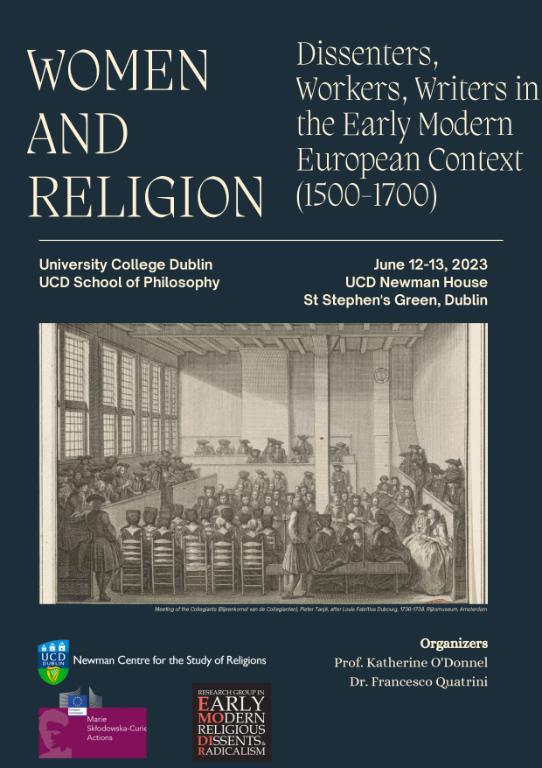
Religion and Society also provides support for various one-off conferences and lectures by international experts on the role of religion and faith in society across time and place. For example, in 2023 this theme supported a major international conference in Dublin organised by Dr. Francesco Quatrini (Amsterdam) and Prof. Katherine O'Donnell (UCD School of Philosophy) on the role of women in early modern European religious developments, entitled Woman and Religion: 1500-1700:
Theme: Religion and Science
This research theme aims to bring together researchers and academics from Ireland and around the world with an interest in the relations between religion, religious faith, and science.
The aim of the theme is not only to explore age-old questions concerning the compatibility of religious faith with scientific belief and practice, but to explore the complex history of the interaction between religion and science; sociological questions concerning the scientific background of religious practitioners and the faith background of many scientists; and philosophical and theological questions concerning the nature of the relationship between religious belief, practice and faith with scientific belief and practice.

The major research outputs of this theme so far have been:
A series of lunchtime lectures in 2023 and 2024 in UCD on Buddhism and Physics, organised by Sergey Katsuba (UCD School of Law) and Prof. Katherine O'Donnell (UCD School of Philosophy).
Two visiting speaker presentations, on Newman and evolutionary theory by Prof. Sarah Coakley (Prof. of Divinity Emerita, Cambridge) in 2025 and on the theological/cosmological question of the beginning of the universe by Prof. Dean Zimmerman (Rutgers) in 2024. See research theme page here for more information.
An international academic conference God and Time IV in 2022 on the relationship between God and time from a theological, philosophical and scientific standpoint (see here for full details):

Theme: Religion and Philosophy
This research theme aims to bring together researchers and academics from Ireland and around the world who are interested in the complex relations between religion, religious faith, and philosophical thought. It aims to support research which uses philosophical methodology to examine questions arising within religious belief and practice, while also supporting scholarship on the rich philosophical traditions that have developed within major world religions, including Judaism, Islam, Buddhism, Christianity, Hinduism, and others.
The Centre currently hosts two research project under this theme, Jewish Thought and Contemporary Philosophy and Medieval Philosophy:
Project: Jewish Thought and Contemporary Philosophy
This project is led by Assoc. Prof. Joseph Cohen (UCD School of Philosophy) and engages with various questions concerning the relationship between Jewish philosophy and contemporary philosophical and political thought, in order to offer a dialogical and critical platform on themes and questions affecting our contemporaneity. In this sense, the aim of the project is both academic and societal.

The project develops active and purposeful dialogue with other theological and religious traditions as well as engaging in contemporary questions emanating from political theory and governance, history and the humanities, science and technology, and art and aesthetics.
The project co-ordinates an annual international conference at University College Dublin, as well as various workshops and ateliers on specific themes. For more information, see the project page here.
International cooperation is actively sought with future partner institutions in Europe, North and South America, and the Middle and Far East, and funding for the project’s activities is sought both from within UCD and from international funding sources.
Project research themes include: Judaism in Ireland; Anti-judaism and Antisemitism in the History of Philosophy; Jewish Philosophy and Humanism; Jewish Philosophy and Ethics; Jewish Philosophy and Politics; Jewish Philosophy and the Problem of History; Jewish Philosophy and the Environmental Crisis; Jewish Philosophy and the Question of Technology; and Reason and Revelation – Autonomy and Heteronomy.
Project: Medieval Western Thought
This project is led by Dragos Calma (Associate Professor, UCD School of Philosophy), and supports a series of annual lectures in Medieval thought entitled the Eriugena Lectures in Medieval Philosophy, co-organised with UCD School of Philosophy and the Department of Philosophy at Maynooth University. The inaugural lectures were delivered in 2025 by Prof Wouter Goris from the University of Bonn:
Lecture 1: Absolute Indifference – From Hegel to Avicenna,and Back Again
Tuesday, September 23, from 4 to 6pm, UCD Newman Building G107-ART
Lecture 2: Unitive Containment – The Parisian Lectures of Duns Scotus
Thursday, September 25, from 4 to 6pm, Maynooth University TSI036
Lecture 3: Objective Reality and Concrete Totality – From Duns Scotusto Hegel Friday, September 26, from 4 to 6pm, UCD Newman Building G108-ART
The central aim of Wouter Goris' lectures is to show that both Duns Scotus (13th c.) and Hegel defend the assimilation of intellectual intuition within a single speculative science that grasps itself as a progressive articulation of the contents of self-knowledge of the Absolute. (i.) The starting point is the shift from the logic of being to the logic of essence in the Science of Logic.Hegel makes this transition through the concept of ‘absolute indifference’, which he ‘detaches’ from the concept of essence. (ii.) Then, we situate the problem of the absolute indifference of essence in the broader context of the history of philosophy. We focus notably on Avicenna’s fundamental interconnection between being, essence and unity, which raises the question of the possibility of a full conception of the singular. (iii.) The systematic thread between these two shifts, viz., from the logic of being to the logic of essence and, further, to the logic of the concept, is verified by the function of the ‘adequate concept’ in John Duns Scotus and Hegel’s Science of Logic. The individual concept is in no way opposed to the indifference of essence to existence and individuality. (iv.) The same notion of correspondence of concept and reality, with which Duns Scotus establishes a complete conceptual determination of the singular, concludes in the Science of Logic the immanent and continuous self-determination of the concept: “The idea is the adequate concept.” (GW 12, 173).

This project also continues some of the work of the successfully completed European Research Grant NeoplAT: A Comparative Analysis of the Middle East, Byzantium and the Latin West (9th-16th centuries) (ERC_CoG_771460), which ran from 2018-2023 and was jointly hosted by the UCD Newman Centre and the Academy of Sciences, Vienna.
NeoplAT offered a fresh and thoroughly documented account of the impact of Pagan Neoplatonism on the Abrahamic traditions. It focused mainly, but not exclusively, on the Elements of Theology of Proclus (fifth century), which occupies a unique place in the history of thought.
The project radically challenged these conservative narratives both by analysing invaluable, previously ignored resources and by developing an innovative comparative approach that embraces a variety of research methods and disciplines. Specialists in Arabic, Greek and Latin history of ideas, philology, palaeography and lexicography developed an intense interdisciplinary research laboratory investigating the influence of Proclus on the mutual exchanges between the scriptural monotheisms from the ninth to the sixteenth centuries.
Project Website: www.neoplat.eu

NeoplAT Members included: Dragos Calma (Project Leader); Elizabeth Curry (Project Administrator); Jonathan Grieg (Postdoctoral Fellow, Academy of Sciences, Vienna); Evan King (Postdoctoral Fellow, UCD School of Philosophy); Maria Evelina Malgieri (Postdoctoral Fellow, UCD School of Philosophy); Iulia Székely (Research Scientist, UCD School of Philosophy); Matthew Vanderkwaak (PhD Student, UCD School of Philosophy).
Finally, Religion and Philosophy also supports the THRESHOLDS reading group run by Dr. Max K. Feenan. THRESHOLDS is an informal fortnightly webinar for academics and graduate students who have an interest in the relation between philosophy and religion, whether from a philosophical, theological, historical, political or literary perspective. See here for more details.
