Wednesday, 28 January, 2026
Researcher: Dr Mark Pickering, UCD School of Medicine and UCD Earth Institute
Summary
Microscopy underpins much of modern science, from medicine and biology to environmental monitoring and materials research. Yet globally, access to advanced imaging remains highly unequal. Commercial microscopes are often prohibitively expensive and technically complex, excluding schools, community groups and researchers in resource-limited settings, particularly in low- and middle-income countries.
Research led by Dr Mark Pickering addresses this global challenge by reimagining how scientific tools are designed, built and shared. This work has expanded access to advanced imaging across Europe, Africa and the Americas through the development of low-cost, open-source microscopes including the FlexiScope, Incubot and (opens in a new window)EnderScope. By repurposing widely available consumer technologies such as 3D printers and combining them with open-hardware principles, the research enables scientific discovery in contexts where traditional infrastructure is unavailable.
Crucially, the approach is designed to scale internationally. Open designs, freely available build guides and community-led training allow tools to be adapted to local needs, resources and research priorities. This model positions the work not only as a technical innovation, but as a transferable framework for inclusive, global scientific participation.
Research description
Since 2018, Dr Pickering’s research has focused on reducing the cost, complexity and geographic concentration of advanced microscopy. The FlexiScope and Incubot provided early demonstrations that high-quality imaging could be achieved using modular, low-cost designs. These platforms are now used by researchers internationally who customise them for specific experimental needs without reliance on proprietary systems.
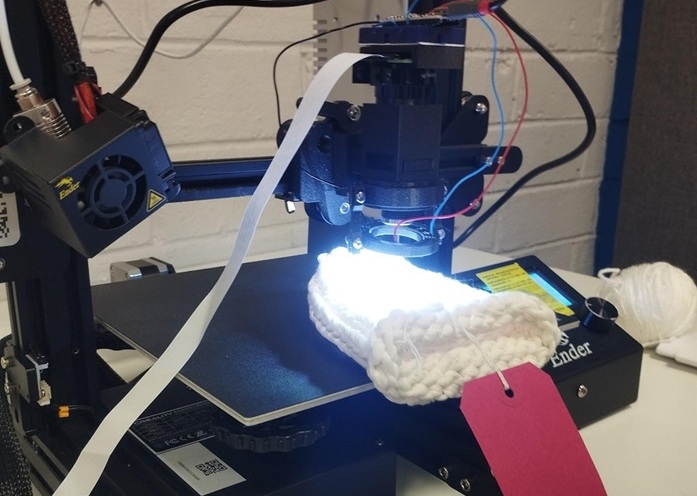
(opens in a new window)The EnderScope represents the most globally scalable outcome of the work. By converting a low-cost consumer 3D printer into an automated smart microscope, it enables laboratories, educators and community groups worldwide to build advanced imaging systems locally. For less than €500, the EnderScope can be assembled without requiring locally sourced components, making it particularly suited to settings where import costs, maintenance contracts and specialist servicing are prohibitive.
Applications already span continents, from microplastic detection in European and African water samples to plant biology research in the Americas, demonstrating both current and future potential for addressing globally shared scientific and environmental challenges.
Research impact
Increasing scientific capacity
The EnderScope provides access to scientific imaging across diverse geographic, economic and institutional contexts, while also generating strong and visible impact within Ireland. Researchers and non-specialist users in France, Germany, the Netherlands, Scotland, the USA, Mexico and Burundi have used the system for applications including environmental microplastic analysis, plant growth assessment and materials imaging. In many cases, these investigations would not have been possible using conventional commercial equipment.
National-level impact
At a national level, Ireland has acted as both a testbed and a hub for this work. Development, piloting and refinement of the EnderScope and related tools were led from UCD, with Irish researchers, educators and community partners playing a central role in shaping how the technology is used in practice. The DIY microscopy workshop hosted at UCD in 2024 introduced over 50 early-career researchers, technicians and students from across Ireland to open-microscopy approaches. Participants have since embedded these methods in their own laboratories and teaching, extending the impact across Irish institutions.
The EnderScope Community Project further strengthened Irish impact by placing open-scientific tools directly into the hands of communities. Ten organisations across Ireland, including further education colleges, Men’s Sheds, makerspaces and the National Parks and Wildlife Service, used EnderScopes to explore questions relevant to their own contexts. Examples include Transition Year students investigating microplastics in food containers, national park educators revealing microscopic biodiversity to visitors in Wicklow Mountains National Park, and creative and social groups using microscopy to support artistic practice and social connection. These activities demonstrate how access to scientific tools can support education, environmental awareness and community cohesion within Ireland.
We now have a new activity for Shed members to be involved with.
— Mens' Shed Participant
Global impact
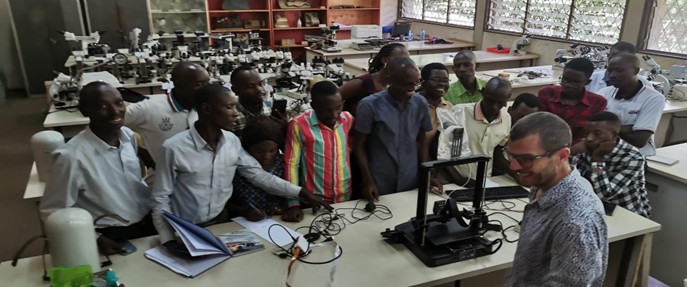
Internationally, capacity building has been a core feature of the project’s impact. Open microscopy workshops delivered in Germany, France, Burundi and the UK have trained hundreds of researchers and students, embedding open hardware skills within local research communities. Many participants have gone on to adapt the designs and contribute improvements back to the global EnderScope repository, creating a distributed international network.
The project also delivers environmental impact both in Ireland and abroad by promoting the re-use of consumer electronics and reducing e-waste, aligning scientific practice with sustainability goals. Through open-access publications, freely available build guides and an active online community, this work demonstrates how Irish research leadership can generate inclusive, scalable and globally relevant impact while remaining deeply connected to local communities.