Wednesday, 28 January, 2026
Researchers: Professor Patricia B Maguire and Research Scientist, Vanessa Carvalho, UCD School of Biomolecular and Biomedical Science
Summary
Behind every data point is a person, a life, a family, a story. This research harnesses the power of data and artificial intelligence to deliver critical decision support for doctors, enabling faster and earlier recognition of life-threatening conditions such as pneumonia and sepsis in intensive care settings. When every minute counts, timely decisions can save lives. While the research is still ongoing, it already holds significant promise for transforming how critical care is delivered, helping healthcare teams respond more quickly and precisely. This project is not just about technology, but about giving patients a fighting chance at survival and ensuring that no life is reduced to a series of numbers on a screen. The team believes that behind every line of code is a human story of fear, suffering, resilience and hope.
Research description
Transforming detection of infection in critical care
Sepsis is a serious and life-threatening condition that can develop rapidly, particularly in patients with pneumonia. If left undetected, it can lead to organ failure and death within hours. Early identification is critical, yet existing-detection tools are often slow or unreliable, forcing clinicians to rely on broad spectrum antibiotics. This approach increases the risk of antimicrobial resistance, making future infections harder to treat.
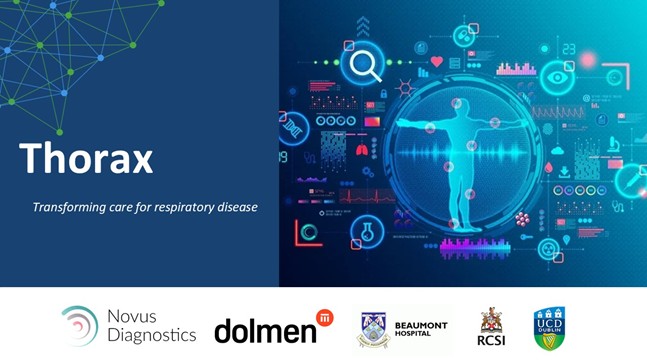
The THORAX project is using data and artificial intelligence to transform how infections such as sepsis are detected in critical care. By analysing vital signs and laboratory results from ICU patients receiving respiratory support, the AI model learns to identify subtle patterns that may indicate infection before clinical symptoms become obvious. Once the model is fully trained, with completion targeted for end Q2 2026, the tool would hopefully be able to be piloted in a hospital environment, where it would be able to continuously scan ICU patient data and flag those at highest risk, enabling earlier intervention.
The plan is that patients identified by this AI model would then be assessed using the (opens in a new window)SepTecTM test, a qualitative electrochemical impedance immunoassay developed by the Irish start-up NOVUS Diagnostics in partnership with experts in diagnostics, clinical care and design. SepTecTM could be used to detect and classify pathogens directly from whole blood within minutes, rather than hours using traditional culture-based methods. Although still in the research phase, such a combination of AI-driven risk stratification and rapid point-of-care diagnostics would represent a step change in future infection management.
Research insight: early detection through data-led intelligence
The central insight underpinning THORAX is that infection risk can be identified earlier by recognising complex patterns across multiple physiological signals. By combining machine learning with rapid diagnostics, the project moves clinical decision-making upstream, where interventions are more likely to improve outcomes and reduce unnecessary antibiotic use.
Research impact
Shaping practice in critical care
The THORAX project will influence how critically-ill patients are identified and prioritised for infection-related complications in intensive care units. By applying artificial intelligence to detect early signals of sepsis and pneumonia, the research will support more accurate interpretation of patient data and faster clinical responses. Although the system is still under development, it has prompted meaningful discussions among clinicians about early detection, risk stratification, and the role of decision support tools in ICU practice.
Frontline clinicians, ICU nurses, data scientists, and infection specialists have been closely involved in refining protocols and reviewing outputs. Patient and public involvement groups have also informed discussions around clinical relevance and ethical use of data. This collaborative process has strengthened clinical awareness and helped shape future digital-health strategies across participating hospitals.
The introduction of a novel AI risk stratification algorithm, used alongside a point-of-care diagnostic assay, represents a transformative step forward. This technology will enable earlier, more accurate identification of patients at high risk of pneumonia, supporting precision medicine from the outset and potentially improving survival rates.
— Dr Aisling McMahon, Consultant Intensivist, Mater Misericordiae Hospital
Building interdisciplinary bridges
A key impact of THORAX has been the strengthening of working relationships between clinical teams and data scientists. The project has fostered a shared understanding of how patient-centred perspectives can and should inform algorithm design. These interdisciplinary bridges support wider digital transformation in healthcare by ensuring that technological innovation remains grounded in lived clinical experience and patient need.
The project has also contributed to important conversations around the safe and responsible use of artificial intelligence in healthcare, including issues of data governance, transparency, and the role of real time information in supporting, rather than replacing, clinical judgement.
Laying the foundations for scalable impact
To date, over 3,000 ICU patient records have been included in the model’s training phase, with internal testing showing promising results in identifying high risk cases. Multiple AI models are being evaluated to identify the strongest performer, with plans to expand the dataset further. The aim is to have a pilot tool operational by the second half of 2026.
The primary beneficiaries of this research will include ICU patients, through earlier diagnosis and more targeted care; healthcare teams, through improved decision support and reduced cognitive burden; and the wider public, through reduced antimicrobial resistance and improved health outcomes. As the tool develops, its scalable design creates clear potential for national and international application.
Every data point we collect represents a real person, someone’s loved one, often in the fight of their life. Recognising the person behind the data enriches the quality and impact of our work and reminds us to interpret data with a compassionate understanding of lived experience.
— Michelle Smith, Clinical Research Nurse, Beaumont Hospital