Wednesday, 28 January, 2026
Researcher: Associate Professor Stefan Müller, UCD School of Politics and International Relations
Summary
The Irish Polling Indicator (IPI), a project launched in 2014 and maintained by Dr Stefan Müller, combines all Irish opinion polls for the Dáil Éireann into ranges of likely support. It has become Ireland’s most widely used polling aggregator, with over 40,000 website users annually and substantially wider reach through coverage in major Irish and international media outlets.
During the 2024 general election, RTÉ News published five articles based on IPI data that were among the most-read content on the site, informing national debate around turnout, voting behaviour, and forecasting challenges. The IPI’s emphasis on long-term trends over individual polls has improved how polling data is understood and used by journalists, policymakers, and the public. By making sophisticated statistical analysis accessible through open data and interactive visualisations, the IPI supports more informed political debate and decision-making.
[Embed video here when finalised]
Research description
Turning polls into insight
Public opinion and election coverage are vital to a healthy democracy, as it shapes how citizens engage with politics. The IPI has strengthened this process by making polling data more accessible, improving public understanding through media engagement, and fostering dialogue with policymakers.
Drawing on over 750 polls from 1987 to 2025, the Indicator uses a Bayesian statistical model to estimate party support while clearly communicating uncertainty. This approach allows journalists, policymakers, and the public to focus on broader trends rather than individual polls. Updated after each new poll, the IPI has become a vital resource for understanding Irish politics. RTÉ, The Financial Times, Reuters, The Sunday Independent, The Times, and The Business Post have relied on the IPI to inform coverage. The Guardian and BreakingNews.ie have also developed interactive visualisations using IPI data, reflecting the project’s growing influence.
During the 2024 Irish general election campaign, RTÉ News published five IPI-based articles analysing turnout, incumbency advantage, public opinion, and vote transfers. Findings were widely cited by media, radio, and television, including German and Spanish public broadcasters. The project also engaged in consulting with Irish and Swiss polling companies, exploring AI-driven analysis of open-ended survey responses. Overall, the IPI advances methodological innovation and supports evidence-based political decision-making.
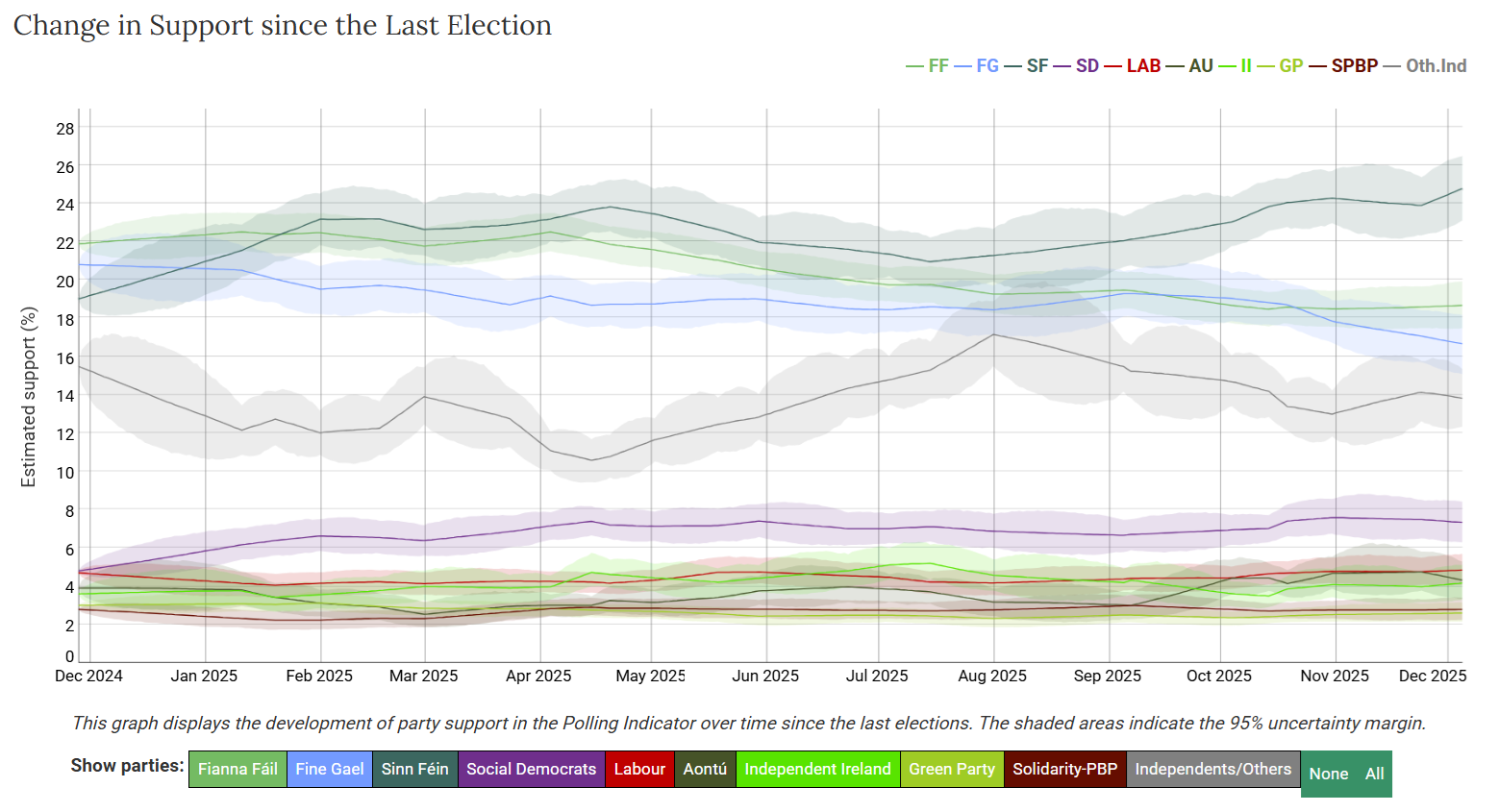
Image above: Irish Polling Indicator website – (opens in a new window)click (opens in a new window)here to view the most recent results.
Research impact
Influencing political debate and decision-making
The Irish Polling Indicator has facilitated direct engagement with officials from major political parties. A Fianna Fáil strategist described party insiders as “quasi-obsessive users” of the Indicator, while the Social Democrats’ Director of Strategy stated that “the Irish Polling Indicator website is hands down the best source for Irish polling data. It presents information in a way that is intuitive and interactive.” TDs and political advisers across the political spectrum report relying on the IPI to better understand long-term shifts in public opinion and electoral behaviour.
The project played a key role in highlighting the disconnect between general election polling and the outcomes of the 2024 local and European Parliament elections. Analysis of IPI data showed that since 1991, general election polls have consistently failed to predict results in “second-order” elections such as local and presidential elections. This finding, featured in the Sunday Independent and The Journal, prompted wider discussion about the strengths and limitations of polling. The IPI’s emphasis on uncertainty contributed to changes in polling industry practice, with RedC subsequently including confidence intervals in all published polls.
The Irish Polling Indicator website is hands down the best source for Irish polling data. […] Supporting material also conveys complex information in an accessible manner.
— Director of Strategy, Social Democrats
Improving public understanding of polling
The IPI has significantly improved how polling data is communicated to and understood by the public. Five RTÉ News articles based on IPI analysis were among the most read content on the site during the 2024 general election campaign. Radio and television coverage of evidence from these articles, including in RTÉ Six One News and podcasts such as Path to Power and Behind the Ballot, helped explain complex issues such as turnout, incumbency advantage, age-related voting patterns, and vote transfers in an accessible way. Broadcaster Áine Lawlor praised the work on air as “excellent” and “well worth checking out".
The research featured in seven radio interviews and six television appearances, including Today with Claire Byrne, RTÉ News at One, and The Anton Savage Show, reaching hundreds of thousands of listeners nationwide and supporting more informed public debate during a pivotal electoral period.
Academic and methodological impact
The Polling Indicator has evolved into a suite of additional publicly accessible dashboards incorporating 97 party manifestos and demographic data from over 100 polls. The project has resulted in four peer-reviewed academic publications and consultancy work with the Swiss polling firm LeeWas through ConsultUCD. AI-driven analyses of Irish voters’ views on cabinet reshuffles and the 2024 referenda were published in the Sunday Independent, providing deeper insight into voter motivations and supporting evidence-informed interpretation of referendum outcomes.