"Sustainability should not be an afterthought in the space sector."
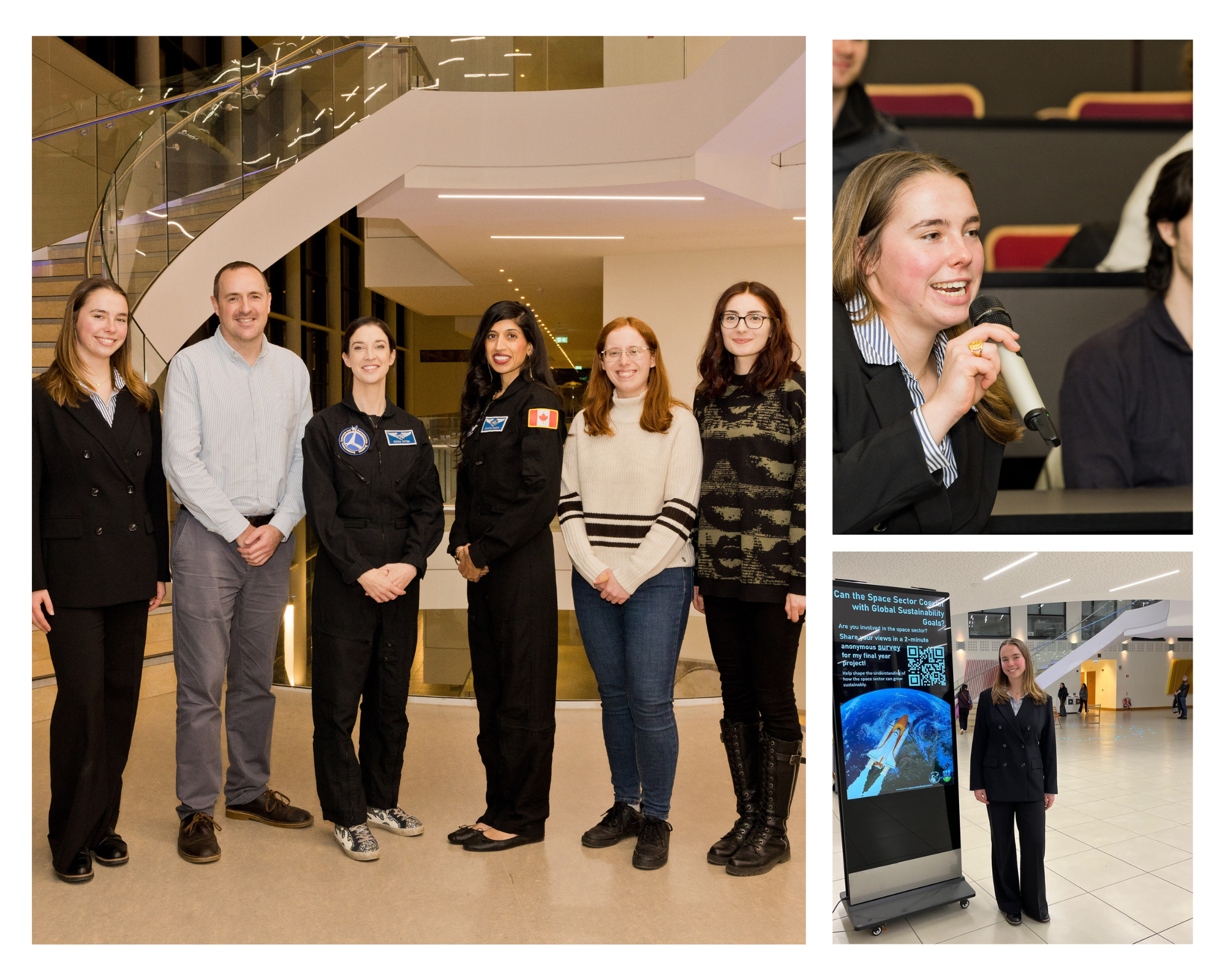 Pictured above left: Melora Costello, Dr Nicholas Brereton, Dr Norah Patten, Dr Shawna Pandya, Michaela Walsh and Stefania Sabau at UCD Space Event, November 2025. Top right: Melora during audience Q&A. Bottom right: Melora presents her research in UCD O'Brien Centre for Science.
Melora Costello could scarcely believe her eyes. The then 10-year-old was already alarmed by the amount of rubbish she and her classmates were picking up on a small patch of beach by the time she spotted the toy cow in the sand. Holy toy cow!
“I remember quite clearly holding it up and although it was funny, it was just astonishing too. I wasn’t even out there that long,” she says, of this school field trip to their local Nobbys beach in Newcastle, two hours north of Sydney, Australia. “It was a very quick pickup in one specific area and I picked up so much rubbish. I kept thinking, if this is here on this relatively clean-looking beach, what's out there in the world? What's in the Great Pacific Garbage Patch? What's in our rivers and waterways? From that moment on, I was like, ‘I need to study sustainability.’”
It would be many more years before Melora discovered that debris in space is another growing problem.
In the meantime, she and her family moved to Dublin, where in school she excelled across the curriculum and couldn’t imagine narrowing herself to just one discipline. Sustainability, with its blend of environmental science, chemistry, business and policy, offered the perfect fit.
“I loved that I could do a bit of everything but with a purpose,” she says. “Now my final year project is about sustainability and the space sector; where they overlap with each other and where there are policy gaps that need to be addressed.”
The space sector is rapidly expanding, especially in America with companies like SpaceX, which had 152 launches in 2024 - a number that keeps increasing.
“I'm looking at the environmental impacts of launch facilities globally and how those could apply to Ireland,” she explains. “What role could Ireland have in the space sector that is sustainable?”
Recently Melora participated in the UCD Space Event, organised by the Canadian Embassy and UCD College of Science, at which Canadian astronaut Shawna Pandya and Irish astronaut Norah Patten spoke ahead of their sub-orbital flight in 2026. Theirs will be the first all-female research spaceflight.
“There were people aged from eight to eighty in the audience, which was great to see and a lot of young girls with an interest in STEM, which is fabulous,” says Melora.
The astronauts sounded a note of caution on the issue of sustainability in the Irish space sector.
“They said that we need to start having the conversation now, because if you're having the conversation while launching, it is too late. Ten years out is a better time to have that conversation. We need to plan early. Our planet isn’t going to stop doing space exploration, so how do we manage it sustainably? How do we balance our climate goals with scientific innovation?”
Melora presented her research at the Space Event and carried out a survey that revealed something striking: sustainability is still widely seen as an afterthought in the space sector.
“A lot of respondents suggested private sector economic benefits are prioritised far above environmental concerns,” she says. “People feel sustainability only comes into the conversation after decisions are made.”
The sector’s sustainability balance sheet is complicated. On the positive side, satellites play a crucial role in climate monitoring, weather prediction, disaster response and even humanitarian relief.
“They can literally save lives by helping us predict what’s coming,” she says. “One of my survey questions is, ‘To what extent do you believe your country's participation in the space sector supports its climate and sustainability commitments?’ The majority answered ‘moderately supports’, which I think is really interesting. I think that a lot of people understand the potential benefits.”
But every satellite requires a launch, and launches bring emissions, local biodiversity disruption and long-term orbital debris. The more crowded Earth’s orbit becomes, the more risk is created too.
Ireland’s own space sector is just emerging. But it is a fast-growing, innovation-driven ecosystem of high-tech companies, researchers and startups developing advanced software, spacecraft components and Earth-observation solutions in partnership with the European Space Agency.
“If we’re only getting into this now, we can build in sustainability from the start and do it right,” says Melora. “Unlike places like the US, where the industry grew so fast that environmental concerns were left behind.”
Her project aims to map the gaps between current space activity and Ireland’s national and international sustainability commitments - and to highlight where policy needs to catch up.
Ultimately, Melora hopes her work will encourage decision-makers to embed environmental responsibility into every stage of space development.
“I want people to start having these conversations now,” she says. “If we’re talking about space, sustainability should be intertwined. Not added at the end.”