UCD Energy Analytics Symposium: How ready is Ireland for off-shore wind farms?
Wednesday, 14 January, 2026
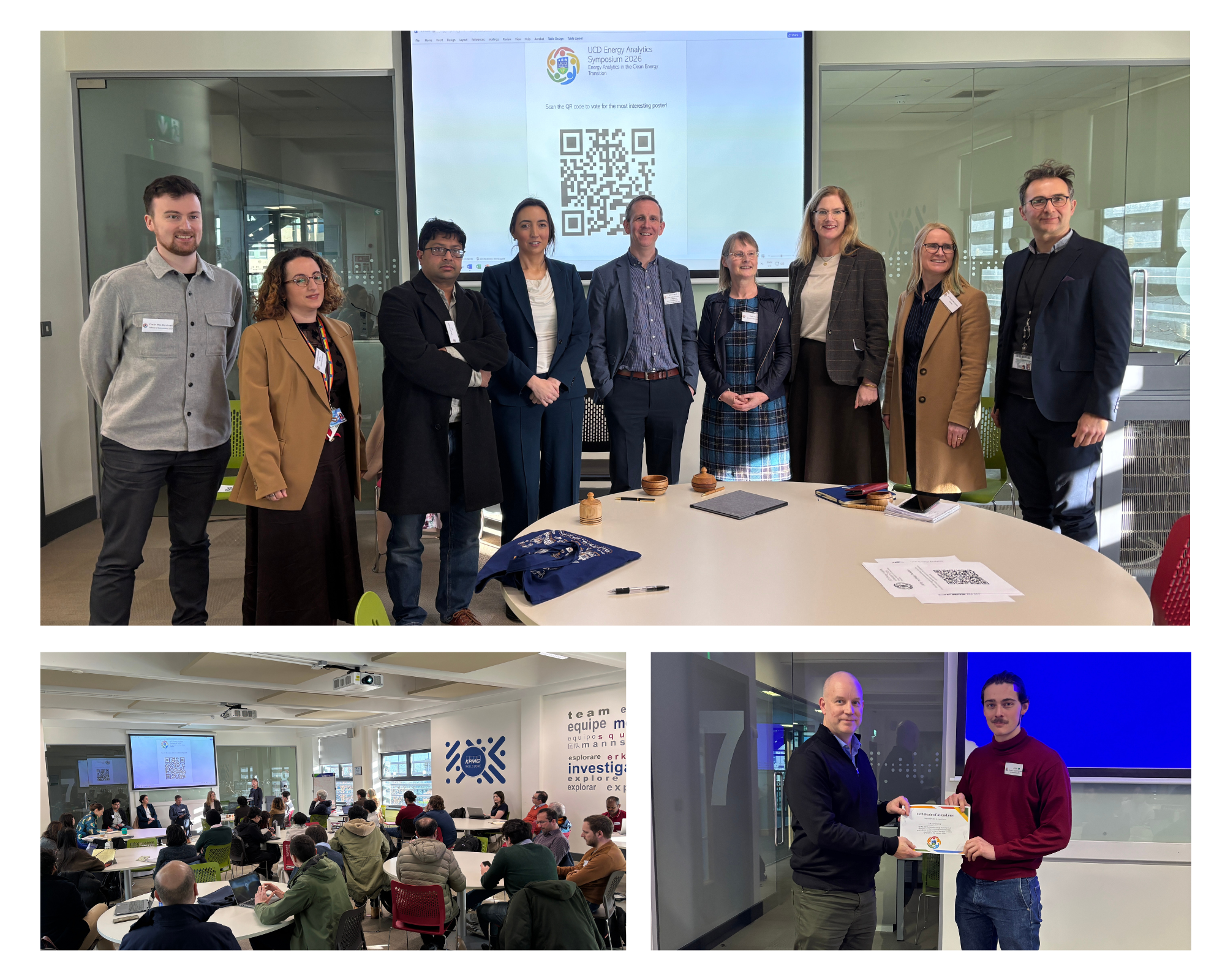 Fascinating discussions arose at Monday's UCD Energy Analytics Symposium, organised by UCD Sustainable Energy Community.
Speakers were Prof Fabiano Pallonetto (Maynooth University) and Dr Noelle Ameijenda (EirGrid Group). There was a panel on offshore wind with Prof Andrew Parnell, Prof Lisa Ryan, Dr Dr Michelle Carey and Assoc Prof Vikram Pakrashi Pashraki, moderated by Prof Paula Carroll. UCD Vice-President for Sustainability Prof Tasman Crowe awarded certificates of attendance and poster prizes to students.
Some cliff notes:
* The cost of electrifying homes, transport and heating in Ireland by 2050 is €50 billion.
* We still don’t have real-time data from energy providers, which hinders dynamic pricing and grid control.
* Ireland’s sea bed is six times its land mass and our Atlantic winds and waves are some of the strongest and highest in Europe. How are we going to install offshore floating wind farm equipment that can sustain this kind of force?
* The floating wind farm off Portugal may not be comparable as Ireland’s coastline is complex and we have stronger wind and rain. Can the estimated 25-year lifespan of wind turbines apply where wave height can be 32m?
* The fastest wind speed recorded in Portugal was 140kph - the fastest in Ireland was 190kph.
* The same way you would test locations for a well on your site when building a house is needed for testing the suitability of Ireland’s seabed for off-shore wind. Are there particular off-shore sites we should avoid and target? Where does the most extreme weather happen?
* The first step is increasing the number of offshore weather buoys collecting vital weather and ocean data. We currently have just two that far offshore. Without data we have no information.
* Although AI has transformed weather forecasting, the models are not good at forecasting extreme weather events (which they haven't been trained on). AI weather forecasting underestimated Storm Eowyn..
* There are currently no ports in the Republic of Ireland capable of facilitating the construction of floating wind projects.
* Other challenges include the intermittency of renewable energy and the need for efficient storage solutions.
* One potential storage power project is located at the former mine site Silvermines, Tipperary.
* Hydrogen is costly and has not created a convincing story that it is the right solution. Denmark is creating hydrogen infrastructure which could be ‘a white elephant’; Ireland is watching and waiting. Meanwhile the Netherlands have invested in floating solar rather than floating wind.