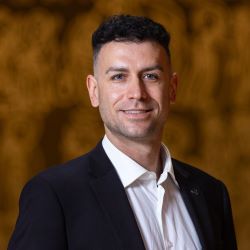
Dr. Luca Pistilli
MBA Programme Director, UCD College of Business
While AI is the subject of intense discussion in every office and boardroom, its true disruptive power has yet to be felt, says Luca Pistilli, our new MBA Programme Director at UCD Smurfit School.
“AI will permeate all domains of business,” he says, “and I’m trying my best to ensure it’s covered in any module so graduates can meet and make the most of it.
About Dr. Luca Pistilli
Luca’s approach to leading our MBA programme goes beyond further embedding AI. He’s also keen on inductive learning, teaching calculated risk-taking using game theory and showing students the delicate art of paradoxical thinking in business. “Being able to reconcile contrasting things, situations and dimensions is what makes an entrepreneur or any leader successful,” he says.
Overall, he wants to give students a perfect balance of theory and practice to maximise the value of their learning process.
He’s also keen to encourage MBA alumni to stay connected and involved with UCD Smurfit School. “Being part of this community is a huge advantage and a wonderful way to share ideas and get advice. Once you graduate, you’re part of our community forever. We’re always here for you if you have issues or questions.”
Academic experience in Europe and beyond
Many in our MBA community will know Luca, as he has been our Assistant Professor of Strategy and International Business since 2019, specialising in innovation, entrepreneurship, corporate social responsibility and more. His published work has covers a wide swathe of topics, from how accelerators help to foster scalability to gender effects in entrepreneurship.
Originally from Campobasso in the southern Italian region of Molise, he lectured previously at the prestigious Bocconi University in Milan, where he completed his PhD. He also studied in Denmark, where he completed a Masters in Management of Innovation and Business Development at Copenhagen Business School.
And in 2018, he was a visiting researcher at the Tuck School of Business in Dartmouth, New Hampshire, where he got to work with Professor Connie Helfat, a renowned scholar in the field of innovation and strategic change.
It’s Gianmario Verona, Professor of Innovation Management and former Rector at Bocconi, who has most influenced Luca’s approach, however. “He was my [PhD] advisor. He’s a visionary and his teaching style really helped shape mine. He often started most classes, as do I, with a case study of a concrete business framework. Then in class we try to develop a more generalisable theoretical framework that can be applied in different contexts.”
Empowering students to thrive in disruption
As someone whose research focuses on both organisational adaptation and entrepreneurial failure, Luca is uniquely positioned to understand the dynamics that see individuals and organisations either thrive or wither during periods of upheaval.
“We’re really only at the beginning,” he says of the AI revolution. “The impact we have seen so far is but a tiny percentage of what we’ll see in the next few years.”
AI progression and adoption are developing along a typical S-curve, he explains. That’s a typical pattern with new tech where there’s a slow start, then rapid growth, a slowing to maturity and an eventual, inevitable slowdown.
While many may fear change, Luca strongly encourages our MBA students to embrace disruption and to use the opportunities it brings with it to reshape their approach to challenges.
“Adaptation is the only action to take as resistance is always a path to failure,” he says. “It’s better to treat disruption as an ongoing process of experimentation, rather than a one-off shock,” he adds. “Our role is to help our students to master and exploit these new technologies effectively – envisioning opportunities where others see obstacles,” he says. “Doing this helps develop the leaders of tomorrow.
Evolving education to meet real-world challenges
With change so inevitable, it’s essential the nature of an MBA evolves in times of disruption. “AI, climate risk, and geopolitical uncertainty cannot sit on the margins of the curriculum; they must shape how we teach strategy, finance, operations, and leadership,” he says.
“I see business education as a bridge between rigorous thinking and real-world execution, and want our programme to reflect what leaders actually face. The emphasis has to be on data-literate, ethically grounded decision-making and learning by focusing on real problems,” he adds.
“We’re coming at things from a builder’s mindset, with students urged to experiment, find evidence to support their thesis’, respond to feedback proactively and make smart decisions,” he says.
A clear call for our MBA alumni
Anyone who has studied for an MBA knows the benefits it can bring and Luca encourages alumni to advise others who are considering this path. “If your career or industry is at an inflection point, consider whether the Smurfit MBA could be the structured reset and accelerator you need,” he says.
“An MBA is a chance to step back, rewire how you think, and then accelerate your career. At Smurfit, that happens through a curriculum that integrates technology, analytics, and sustainability with hands-on projects, international experiences, and access to an ecosystem of multinationals, scale-ups and public institutions.”
He’s also keen to ensure the wider ecosystem plays a role in preparing the next generation of leaders for success.
“To alumni and business leaders, we want you to continue to partner with us by mentoring students and bringing us live projects. And we want you to share your knowledge and experience, so we can continue to ensure the programme stays abreast of real-world challenges,” he said.
The MBA Programme Office is currently preparing the Capstone module for the Full-Time MBA students and would welcome alumni projects for consideration.
UCD MBA Capstone Project Expression of Interest
December 2025