Taking control of cancer by metastasis prevention
Share
UCD Research Impact Case Study
by Associate Professor Margaret Mc Gee, UCD School of Biomolecular & Biomedical Science, UCD Conway Institute of Biomolecular and Biomedical Research
Summary
Some 90% of cancer deaths occur due to metastatic growth. Preventing cancer spread from the primary site to a distant location in the body remains one of the greatest medical challenges today. Cancer such as breast and prostate often metastasise to the bone, whereas cancer of the colon, kidney and melanoma preferentially metastasise to the brain.
Despite the fact that metastasis accounts for the majority of cancer death, there is currently no treatment that specifically targets metastatic tumours. Targeting the factors that control the movement of cancer cells from the primary site to a distant location provides a new opportunity to specifically block cancer metastasis that will significantly impact on patient care and survival.
UCD researcher Margaret Mc Gee is investigating factors within our circulatory system that contributes to bone metastasis. Preventing cancer metastasis represents a major challenge in cancer research and development of drugs that prevent metastatic growth could have a dramatic impact on cancer mortality rates worldwide.
“Only by understanding the communication signals between normal and cancer cells will we be able to therapeutically exploit this new knowledge for the benefit of cancer patients”
Research
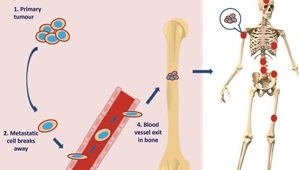
Cancer metastasis occurs when cancer cells break away from the original tumour and travel through the body to a new
location where they begin to grow (Fig 1). Bone metastasis is the most common site of prostate metastasis, while it is also a common site for breast, renal, lung and thyroid metastasis.
Furthermore, blood cancer such as myeloma is dependent on bone marrow components for growth and survival (Fig 2).
Primary tumours secrete signals that travel through the bloodstream to a distant site and prompt normal cells at a predetermined location to support the growth of cancer cells when they arrive through the release of a multitude of factors including chemokines, cytokines and adhesion molecules that provide a perfect environment for cancer cells to deposit and expand; a process known as “pre-metastatic niche” formation. Thus normal cells play a significant role in metastatic growth.
Research within the Mc Gee group is focused on the understanding cell-cell signals that influence pre-metastatic
niche formation. “Only by understanding the communication signals between normal and cancer cells will we be able to therapeutically exploit this new knowledge for the benefit of cancer patients”.
The group is researching how normal cells coax the disseminated cancer cells to a new site where they continue to
grow. Together with collaborators in the Conway Institute, and St. James’s Hospital Dublin, the researchers have demonstrated that targeting a single pathway can significantly inhibit tumor cell migration and metastasis formation.
Dr Mc Gee is now working with Pfizer scientists in Ireland and the US for the development of novel anti-cancer drugs. “The benefit of working with Pfizer is that we can avail of very specific expertise and state-of-the-art technologies that will accelerate our ability to convert our laboratory findings into the generation of new drugs that can be used to treat cancer patients, which is termed translational research”.
Research Impact
Health impacts
Often described as incurable, metastatic cancer differs significantly from primary cancer in both growth rate and
response to therapy. 50 - 80% of carcinoma patients will have metastasis in the bone at the time of their death.
Conventional chemotherapeutics cannot accumulate in the bone at high quantities meaning patients become unresponsive to therapy. When cancer cells metastasise to the bone, they cause damage leading to small holes referred to as osteolytic lesions that increase the risk of breakage.
Cancer growth in the spinal bones can lead to spinal cord compression causing numbness, weakness and possibly
paralysis. New cancer treatment, such as those being developed by the Mc Gee group, that could prevent or reduce bone metastasis has the potential to dramatically improve patient care and their overall survival.
Economic Impact
Cancer places a substantial economic impact on the world’s economy and The World Cancer Report reveals that cancer
rates are set to increase at an alarming rate globally (www.WHO.gov). Within Ireland, it is projected that cancer
incidence will double by 2040 which will have significant knock-on effects on the demand for cancer services
(www.ncri.ie). Metastasis is responsible for 90% of cancer mortality, thus, the development of specific treatments that prevent or reduce metastasis is critically important in easing the economic burden.
Social Impact
The impact of cancer diagnosis can have a devastating effect on a patient and their families, in particular when diagnosis is at an advanced stage, where prognosis is poor and treatment choices are limited and often accompanied by severe side effects. By developing new treatments to prevent or slow progression of cancer to an advanced metastatic stage, patients’ lives will be dramatically improved as well as their changes of long term survival.
Training
This research involves the training and mentoring of highly skilled post-graduate and post-doctoral translational cancer researchers who are highly sought after in academia and industry nationally and internationally. Communication of the work through scientific manuscripts, conference presentations and directly to cancer patients has contributed to the international reputation of UCD as a research intensive university.
Research References
Obenauf AC, Massagué J.Surviving at a distance: organ specific metastasis.
Trends Cancer. 2015 Sep 1;1(1):76-91 PMID: 26693180
Lavin PT, Mc Gee MM, Cyclophilin function in Cancer; lessons from virus replication.
Curr Mol Pharmacol. 2015;9(2):148-64. Review. PMID: 25986562
Bannon JH, O'Donovan DS, Kennelly SM, Mc Gee MM. The peptidyl prolyl isomerase cyclophilin A localizes at the centrosome and the midbody and is required for cytokinesis.
Cell Cycle. 2012 Apr 1;11(7):1340-53. doi: 10.4161/cc.19711.PMID: 22421161
Bane FT, Bannon JH, Pennington SR, Campiani G, Williams DC, Zisterer DM, Mc Gee MM. The microtubule-targeting agents, PBOX-6 [pyrrolobenzoxazepine 7-[(dimethylcarbamoyl)oxy]-6-(2-naphthyl)pyrrolo-[2,1-d] (1,5)-benzoxazepine] and paclitaxel, induce nucleocytoplasmic redistribution of the peptidyl-prolyl isomerases, cyclophilin A and pin1, in malignant hematopoietic cells.
J Pharmacol Exp Ther. 2009 Apr;329(1):38-47. doi: 10.1124/jpet.108.148130. PMID: 19131583