Unlocking new treatments for MND inside fruit fly DNA
Share
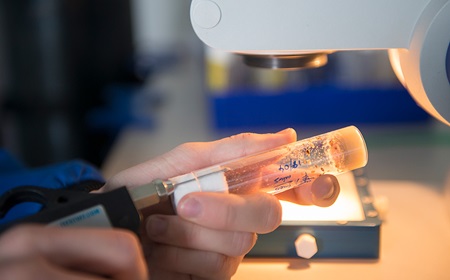
New treatments for motor neuron diseases (MNDs), debilitating, neurological diseases affecting hundreds in Ireland, and tens of thousands globally, could be revealed by studies in fruit flies.
That is the hope of Conway Fellow, (opens in a new window)Dr Niamh O’Sullivan, a geneticist creating the mutations in lab fruit flies - Drosophila melanogaster – that are known to cause severe MND. The idea is to then to test drugs to see how well they will treat disease-like symptoms in the flies.
There are about 400 people living with MND in the Republic of Ireland at any one time, with some 150 newly diagnosed every year. It affects all ages, including children, but mostly over 50s.
The disease happens when nerve cells in the brain and spinal cord, called motor neurons, stop working properly, then die. The neurons control muscle activity, like gripping items or walking.
Mutation
Dr O’Sullivan is interested the mutations causing MND in children and works closely with patient groups to communicate findings and research progress.
Even as a child, Dr O'Sullivan was fascinated by how genetic traits like eye colour or quirks of personality pass through families.
That curiosity pushed her towards an academic career, which began with undergraduate studies in genetics, coinciding with the genome mapping revolution of the early 2000s.
When she began her research, she used traditional rodent experimental models, but ethical considerations led her to begin working with Drosophila melanogaster, the common fruit fly. She was more comfortable working with fly models of disease and it was also a scientifically fruitful decision.
“There’s hundreds of years of genetics embedded in the fruit fly model. It’s a system with remarkable parallels to human neurology, particularly when you’re examining gene function.”
Dr O’Sullivan and her team are delving into the mechanics of mutations in several different genes that cause disease. While each of the mutations that she works on are rare, they all lead to severe disruption of the nervous system and early onset MND.
Family case
In collaboration with researchers and patient groups in the USA, Dr O’Sullivan is investigating cases where children have genetic mutations causing early onset MND.
MND is most often associated with adults, but it can also strike in childhood in rare cases that tragically rob children of movement, speech, and, eventually, prove fatal.
In the cases being studied by the O'Sullivan group, scientists know which genetic mutations are causing disease in the affected children, but they don't yet understand how these mutations damage neurons - or how to treat the damage.
Dr O’Sullivan’s scientific strategy is to genetically engineer fruit flies to have the precise genetic defect that causes MND in these children, and to study the progression of the disease in real-time.
She is observing the flies’ ageing and movement while also dissecting the neurons in their brains for signs of degeneration.
“In a recent study, a PhD student in my lab spent eight months generating and confirming the mutation,” said Dr O’Sullivan. “Now, we’re watching these flies age, to see when and how their motor systems begin to fail.”
The early findings have proved promising with the mutated flies showing movement patterns that are reminiscent of human MND, which is validation that the Drosophila disease model is working.
Treatments
In another project, Dr O’Sullivan is also aiming to explore new MND treatments using so-called antisense oligonucleotides (ASOs). These are short strands of genetic material designed to silence harmful genes.
ASOs are already treating rare diseases like spinal muscular atrophy, but Dr O’Sullivan believes that, in MND cases, they could be used to ‘switch off’ the defective gene before it does irreparable harm.
“This is where precision medicine really shows its promise,” said Dr O’Sullivan.
“Rather than treating everyone with the same broad-spectrum drug, we tailor the treatment to the patient’s unique genetic mutation.”
“It’s more effective and, potentially, more economical over time.”
Economics
An economic model based on precision medicine remains a ‘hard sell’ in the pharmaceutical world, Dr O’Sullivan accepts, as the experts debate if it’s financially viable to develop drugs for small patient populations, even when it might be a population of one.
Dr O’Sullivan suggests that precision medicine can be commercially viable when the cost of failed treatments, long-term care for people, and trial and error medication are factors that are all considered.
Engagement
Dr O’Sullivan is deeply engaged with the patient communities that will be potentially impacted by her research, and that, she said, brings emotional and communication challenges.
“These families are often desperate for answers. It’s difficult to explain genetic mechanisms and research timelines to someone watching their child deteriorate.”
To bridge that communication gap, she and her team work on engaging the public in their science by creating plain language summaries of research, telling their research story in digital media and even holding lab open days.
“It’s not just about transparency. When patients get involved, it pushes us to do better science. It keeps the 'bigger picture' about why we do what we do at the forefront of researcher's minds.”
Dr O'Sullivan is hoping that the DNA of fruit flies can, one day, give a child, and their family, a future they never dared dream of.
“These are tiny creatures, but the questions we are asking – how do neurons fail, how to fix them – they’re massive.”
In conversation with journalist, Sean Duke