Inflammatory bowel disease
Share
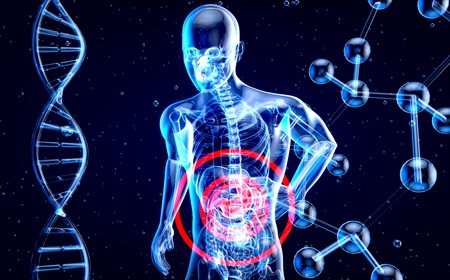
The health of the GI tract, particularly its outer protective layer of cells has been central to (opens in a new window)Professor Cormac Taylor’s research efforts since he completed a doctorate in pharmacology in 1996. When something goes awry there, it spells trouble.
The gastrointestinal (GI) tract is a nine metres long muscular tube running from the mouth through to the anus, that processes our food and absorbs nutrients. Its health is very much dependent on its single outer layer of epithelial cells, covering about the same area as a doubles tennis court.
“This barrier, this epithelial barrier, has always been of prime importance to us because in patients who have inflammatory bowel disease like Crohn’s disease or ulcerative colitis, that barrier becomes leaky.” said Prof. Taylor.
“Then bacteria start leaking into the underlying space, causing inflammation, which causes further leakiness, causing symptoms of these awful diseases.”
Prof. Taylor’s research aims to develop new drug treatments that reinforce the epithelial layer, halting a cascade of harmful inflammatory responses. In this way, diseases like IBD can be prevented before they become symptomatic.
Hypoxia and disease
Prof. Taylor is interested in hypoxia – a condition where the body, or part of the body is deprived of a sufficient supply of oxygen - and its connection to a number of diseases, and interest that began when doing postdoctoral research at (opens in a new window)Harvard University.
There are many examples of diseases linked with hypoxia, said Prof. Taylor, including a stroke, which happens because of a lack of oxygen to the brain, or a heart attack, where a blocked blood vessel reduces oxygen in the heart.
He has investigated hypoxia inducible factor (HIF) – a protein that controls which genes are turned on and off in a cell and is thought to play a crucial role in enabling cells to adapt and survive to oxygen-deprived conditions.
Prof. Taylor cited a case in point about how mountaineers produced more red blood cells in order to increase the oxygen-carrying capacity of their blood, as they reach higher altitudes, where oxygen levels start to fall.
This is a process that is driven by HIF, he said.
“You'll be aware that if somebody is going to go to climb to the top of Mount Everest, for example, they don't just go straight to the top,” said Prof. Taylor.
“They stop at base camp and they wait for a couple of weeks and they allow their body to adapt to a relative drop in oxygen concentration so that they can then, ascend to further higher altitudes following this adaptation.”
The body’s adaption to high altitude is beneficial for climbers, but the same response to low oxygen conditions is one cancer tumours exploit. The fact tumours can thrive in low oxygen conditions, hampers cancer treatments.
“When a cancer grows, it gets bigger and becomes hypoxic, by virtue of the fact that it grows away from the local blood supply,” said Prof. Taylor.
“In these disease conditions, just like the mountain climber, the tissue can adapt to that hypoxia and survive that hypoxia.”
“That’s a good thing if it's a stroke or a heart attack because the tissue is becoming stronger but it's a bad thing if it's a tumour because the tumour is then surviving the low oxygen.”
“This really focused our attention a lot on how we could potentially interfere with this hypoxic response, either to promote it when it would be a good thing, or to inhibit it when it would be a bad thing.
Inflammatory bowel disease
Prof. Taylor has brought his hypoxia research together with his inflammatory bowel disease (IBD) research and found oxygen levels drop in IBD patients.
“The inflammation uses a lot of oxygen so it caused the damaged tissue to become oxygen deprived.”
“We have found that if we boost the adaptive response to hypoxia with a drug, we can help seal the leaky barrier that is the problem with IBD. This is very exciting because most of the drugs used for IBD have tried to control or clear the inflammation.”
“It’s like if it is raining very heavily and you have a leak in your roof. You can either sit there in the kitchen with a bucket and empty each full bucket of water out the door to keep your house dry or get up and fix the hole in the roof.”
“Or you could do both, which is the ideal situation – a combination therapy of controlling the inflammation and sealing the barrier.”
Prof. Taylor’s group has also found in IBD that epithelial cells survive hypoxia by changing their metabolism to make more use of glucose, via the Warburg effect. This effect is also linked to tumours, metastasis and drug resistance.
Several enzymes facilitate the Warburg effect, said Prof. Taylor. “If we can understand how these cells switch to consuming glucose, perhaps we can inhibit that with a drug, and treat cancer cells in hypoxia by preventing them getting oxygen.”
In conversation with journalist, Sean Duke. Photo by Julien Tromeur on Unsplash