Motherhood comes with a cost, but not for all, new study suggests
3 December 2025
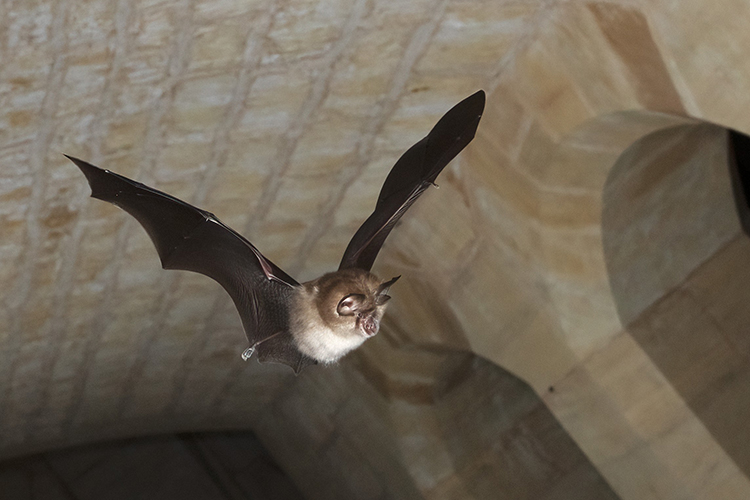
A Greater horseshoe bat, the largest of the horseshoe bats in Europe Credit: Hetty Metcalfe
Is it better to have children early or later in life, and does parenthood accelerate ageing? Researchers at University College Dublin and the University of Bristol have tackled these questions by studying an exceptional population of long-lived Greater horseshoe bats.
Their study, (opens in a new window)published in Proceedings of the National Academy of Sciences (PNAS), shows reproducing early in life carries measurable costs.
However, some individuals appear able to circumvent these effects, living long lives and producing many offspring without suffering any ill effects.
The team assessed the cost of reproduction by measuring telomere length, a biomarker of ageing and stress, in 200 female bats over a five-year period from a colony at Woodchester Mansion in Gloucestershire, monitored continuously since 1959.
Telomeres are pieces of DNA which act as protective caps at the end of chromosomes. They shorten each time a cell divides and are considered a key marker of cellular health.
By tracking telomeres alongside each individual’s breeding history, the team uncovered the short-term costs of reproduction.
“Females that start breeding younger tend to have shorter telomeres, and those with shorter telomeres are less likely to survive to the next year,” said lead author (opens in a new window)Dr Megan Power, from the UCD School of Biology and Environmental Science.
“This is a clear sign that reproduction comes with costs, even in a species renowned for its longevity.”
“There appears to be no lasting penalty, if you survive to the next breeding season,” Dr Power added. “Some bats must buffer or repair the damage, showing how remarkably flexible they are in managing the costs of reproduction”.
Senior author (opens in a new window)Professor Emma Teeling, who leads UCD’s (opens in a new window)Laboratory of Molecular Evolution and Mammalian Phylogenetics, said “bats bend the usual rules of ageing”.
“By pairing molecular biomarkers with this exceptional long-term field study, we can see how mothers balance investment in offspring with their own survival.”
Senior author Professor Gareth Jones, from the University of Bristol, added: “Following the same colony across generations gives a rare window into individual lives, letting us disentangle short-term costs from longer term resilience”.
The study pinpoints lactation as the most demanding period during reproduction.
Moving forward the team plans to understand how some bats sustain extraordinary lifespans while raising multiple offspring without the expected costs of reproduction.
“These ‘super-mothers’ have achieved the evolutionary jack-pot, living long healthy lives with lots of offspring. These are the individuals we need to study to uncover their longevity secrets,” said Professor Teeling.
This study was only possible given the lifetime dedication of co-author Dr Roger Ransome, who established the long-term mark-recapture project in Woodchester Mansion and has monitored the bats there for over 60 years.
Dr Ransome was awarded the British Empire Medal (BEM) in the King’s New Year Honours for services to bat conservation earlier this year.
By: David Kearns, Digital Journalist / Media Officer, UCD University Relations
To contact the UCD News & Content Team, email: newsdesk@ucd.ie