Honeybee activity linked to smaller bumblebees in heather habitats
11 December 2025
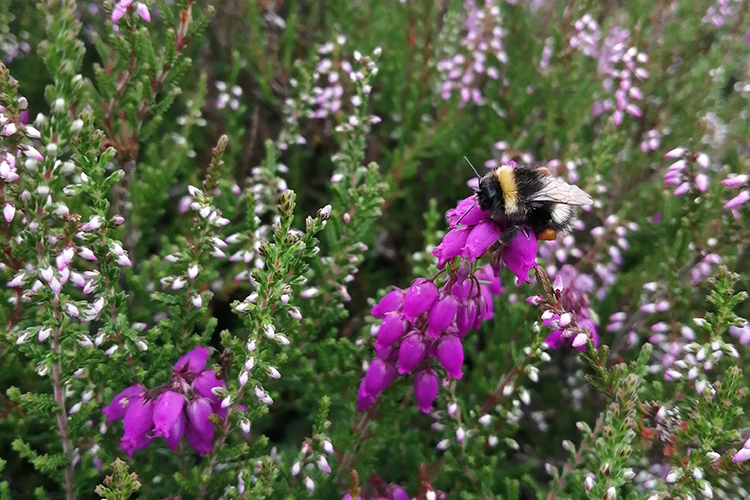
The study shows that beekeeping on heathlands affects bumblebees Credit: Katherine Burns
A new study has revealed bumblebee workers are getting smaller in areas with high honeybee activity.
The research, carried out in the Dublin and Wicklow Mountains, found that managed honeybee colonies can alter the behaviour and physical traits of wild bumblebees, even in flower-rich environments.
(opens in a new window)Publishing their findings in Proceedings of the Royal Society B, researchers from University College Dublin and (opens in a new window)Lund University examined how different numbers of honeybee hives affected forage availability and bumblebee activity across late summer sites dominated by blooming heather.
While monitoring honeybee numbers, floral resources, and multiple bumblebee traits it was observed that bumblebee workers were smaller in areas where honeybees were present in large numbers.
“As honeybees were only brought to heather areas just before our study, we think smaller bumblebees in areas with more honeybees are due to changes in colony behaviour rather than bees getting less food as larvae,” said (opens in a new window)Dr Dara Anne Stanley, UCD School of Agriculture and Food Science.
“We think that in areas with more honeybees, bumblebee colonies have to send out smaller workers to forage or that bigger bees have to fly further away to collect what they need. The bottom line is that bumblebee behaviour is changing.”
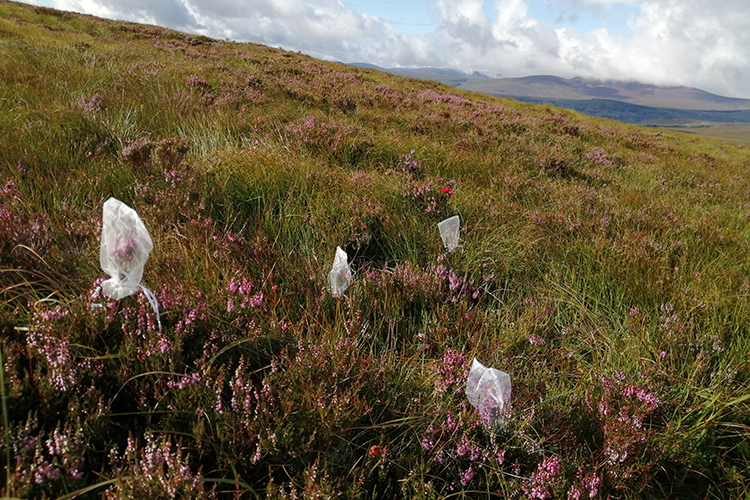
The study found several behavioural changes were detected among bumblebees in areas with high honeybee hive densities.
Bumblebee workers were smaller, spent less time on each flower, and showed an increased likelihood of collecting pollen.
This, the authors suggest, could point to competitive pressures, with bumblebees adjusting their foraging strategies due to reduced resource availability or increased competition.
Despite this, nectar availability in heather flowers did not show clear signs of depletion, and in areas with more honeybee hives, attracting significantly higher numbers of honeybees, overall bumblebee numbers remained stable.
Still, the findings highlight that even in landscapes rich in floral resources, the introduction of managed honeybee colonies can influence wild pollinators.
“We don’t know whether these changes in bumblebee behaviour have knocked on impacts on their colonies or populations. We really need to learn more about these interactions to provide the best possible advice to beekeepers and conservationists to ensure both healthy pollinator populations and profitable honey production,” added Dr Stanley.
(opens in a new window)The study underscores the importance of considering interactions between managed and wild bees when planning beekeeping activities, especially near protected habitats.
By: David Kearns, Digital Journalist / Media Officer, UCD University Relations
To contact the UCD News & Content Team, email: newsdesk@ucd.ie