Researcher: Professor Ainhoa Gonzalez Del Campo, UCD School of Geography
Summary
Sustainable development involves including environmental considerations in decisions about land-use. To facilitate this, Associate Professor Ainhoa González and her team have developed a new Environmental Sensitivity Mapping tool, supporting informed and sustainable land-use planning in Ireland.
Planning departments in the government and local authorities, as well as environmental consultancies and NGOs, routinely use the tool to examine and understand various environmental, societal and economic issues, informing the preparation of national, regional and local land-use plans. This freely available tool saves weeks of effort by dedicated planning teams. By improving decision-making around sustainable development, the tool has helped protect the environment and reduce land-use conflicts.
Research description
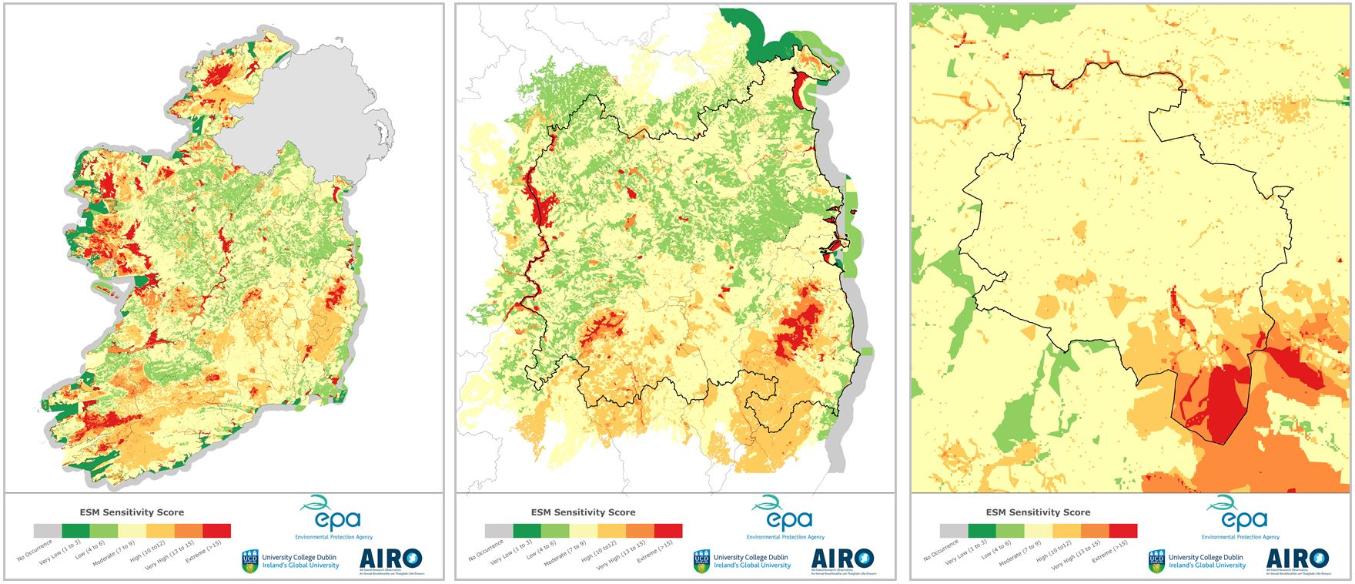
Environmental sensitivity maps, such as those in the images below, show how vulnerable different areas are to change. An area’s vulnerability is calculated by examining various factors:
- Natural assets, such as protected habitats and sources of drinking water
- Risks, such as flooding
- Public opinion, such as the value placed on protected habitats, or concerns around drinking water quality and flooding
Ultimately, environmental sensitivity maps highlight areas where development (e.g. urban or industrial expansion) will likely result in significant adverse effects on the environment. They provide the basis for informed decisions in support of sustainable development, guiding development to the right location and helping reduce land-use conflicts and environmental impacts.
Dr González’s research looked at opportunities for a more proactive and participative integration of environmental considerations into land-use planning using Geographic Information Systems (GIS). Through this work, Dr González created a new way of mapping environmental sensitivity. This approach responds to the requirements of European legislation to assess the environmental impacts of development actions, in order to avoid or mitigate them.
To help ensure the tool is actually used to inform decisions about land-use, Dr González and her team developed a publicly accessible online mapping tool ((opens in a new window)www.enviromap.ie), supported by funding from the Environmental Protection Agency. The user-friendly and interactive tool has been incorporated into the national data web portal GeoHive. Anyone, not just planners, can now examine environmental, societal and economic considerations at local and regional levels, and create environmental sensitivity maps that incorporate their concerns and opinion. This supports transparent and accountable decisions across the Irish planning system.
I would consider the ESM tool to be one of the most notable innovations in recent years in upskilling planners to properly and thoroughly embrace environmental considerations at the heart of the planning process, building more sustainable and more robust planning policies for the future.
— Niall Cussen, Planning Regulator & Chief Executive, Office of the Planning Regulator
Research impact
The environmental sensitivity mapping approach developed by Dr González and her team has changed environmental assessment and planning practices in Ireland. The methodology and associated online tool are routinely used to incorporate environmental considerations into the preparation of land-use development plans. Many practitioners across the country have benefited from the tool (see testimonials below).
Policy impact
The methodology was published as guidance by the EPA in 2009. Since then, planning departments in the government and local authorities, as well as environmental consultancies, have used it when preparing more than 40 land-use, energy and tourism plans (such as the Wild Atlantic Way, the Offshore Renewable Energy Action Plan, and the Clare County Development Plan).
The related online tool was launched in October 2019, and has been used by policymakers when preparing Project Ireland 2040 – National Planning Framework, and the Regional Spatial and Economic Strategies, that guide development at county and local levels. Currently, the tool is being used by local authority planning departments in the review of county development plans. The National Planning Framework acknowledges how the web tool was used to support informed planning:
“In preparing the NPF, an Environmental Sensitivity Mapping (ESM) tool was used in the SEA and environmental assessments. ESM is a method for identifying at a strategic level, environmentally sensitive areas and to help inform cumulative and in-combination effects on the environment. It also provides a visual overview of the relative sensitivity of areas, particularly where they overlap, in order to provide a more strategic and informed approach to planning”
— National Planning Framework, Government of Ireland, p. 155
Environmental impact
By highlighting the location of natural assets, their overlap and vulnerability, the tool provides immediate and objective information to guide development to suitable areas for environmental protection. In doing so, it places the environment at the centre of decision-making and prevents land with significant natural value from being zoned for development.
Technological impact
Before the online tool was published, environmental sensitivity mapping required GIS skills and expertise, and weeks of time and effort by a dedicated team, to gather and analyse data from a wide range of sources. This made it difficult for planners, stakeholders and the general public to scrutinise the information.
The tool overcomes these technological barriers by enabling centralised, interactive and user-friendly access to over 120 national spatial datasets. Anyone can examine environmental and socio-economic considerations, and map environmentally sensitive areas to inform decisions as to what development should happen where. The tool saves time, resources and money by making relevant data readily available to all, and producing sensitivity maps in a matter of minutes.
Social impact
The tool raises environmental awareness (for example by providing easy access to local information about natural resources), and fosters participatory planning. Users can define environmental criteria, and incorporate public concerns in the form of weights that emphasize the relative importance of selected criteria, to create context-specific sensitivity maps. In this way, it enables more environmentally inclusive, participative and transparent planning and decision-making.
Educational impact
The project team has trained over 120 Irish planners and environmental consultants in the use of the environmental sensitivity mapping approach. Capacity building workshops will continue over the coming months. The tool is also used by students across UCD Schools (including Agriculture and Food Science; Architecture, Planning and Environmental Policy; and Geography) to learn about environmental assessment.
Academic impact
The methodology has influenced environmental assessment research and practice around the world. The tool – first of its kind – has been called “a great reference in the field of online geodatabases supporting decision-making and environmental assessment” (international reviewer, Environmental Impact Assessment Review).