Human–computer interaction (HCI) sits at the front line of today’s biggest societal challenges, shaping how people live, work, learn, and connect. As technology saturates daily life, HCI research tackles issues of accessibility and inclusion and addresses the digital divide, supporting equitable participation in education, healthcare, and civic life. By designing technology that is intuitive, ethical, and human-centered, HCI innovation helps create digital experiences that enhance wellbeing rather than overwhelm or exclude.
Making AI work for people
Share

Artificial intelligence will reshape the way economies and communities function, and how people live and work. Guiding this transformation, UCD's leaders in digital policy and other areas of social sciences are asking the deeper questions that will define AI’s role in our shared future, testing its promises and ensuring its applications benefit all society, respect human dignity, and support a sustainable planet.
From climate resilience and energy transition to gender fairness, equality, labour rights and the future of work, UCD approaches AI as a societal project as much as a technological one. Its interdisciplinary collaborations bring computer scientists together with social scientists, ethicists, legal scholars, business leaders and cultural researchers to ensure that innovation is guided by values as well as by data.
Building digital policy capability in Ireland and the EU
Digital technologies now shape every aspect of life, yet the pace of innovation outstrips our ability to govern it fairly. Legislators, policymakers, and industry must balance opportunity with citizens’ rights while new tools continually generate new risks. Technical experts often build systems without seeing broader societal impacts, while policymakers grapple with technologies they did not design.
At (opens in a new window)UCD Centre for Digital Policy, our researchers ask not what AI can do but how, and if, it should be used to address society’s biggest challenges. Co-director Dr Elizabeth Farries says that means identifying real problems first, framing them clearly, and asking whether or not AI is the right tool at all.
Through interdisciplinary research grounded in human rights, sustainability, and equity, UCD CDP works with stakeholders to design, evaluate, and maintain evidence-based digital policy. Its mission is deliberative and iterative: to ensure technology serves people, including the most vulnerable, rather than the other way around.
Elizabeth is Principal Investigator on Horizon Europe consortium project FORSEEwhich explores the risks and benefits of AI from a societal perspective, in order to enhance AI capabilities and EU regulatory frameworks.

Empowering citizens in the AI era
Also a member of UCD Centre for Digital Policy, Prof (opens in a new window)Aphra Kerr is at the forefront of shaping how societies understand and govern AI. As co-PI at the (opens in a new window)Research Ireland ADAPT Centre for AI-Driven Digital Content Technology, she leads work on transparent digital governance, autonomy and responsibility, advancing practical approaches to AI ethics, public participation and engagement. Her research spans collaborations with Dublin City Council and Smart Dublin on the ethical use of emerging technologies in the public sector, investigations into the political economy and culture of the digital games industry, and the Creative Europe–funded (opens in a new window)ALGOWATCH project, which is developing a digital game to build algorithmic and AI literacy across Europe.
At the 2025 Library Association of Ireland and CILIP Ireland Joint Annual Conference, (opens in a new window)Aphra’s keynote, 'Expertise and Literacy in the AI Era,' outlined how information professionals can meet the opportunities and risks of AI through a competency-based approach grounded in the European Digital Competency Framework. Emphasising the political economy of AI, skills for recognising and using AI, and ethical awareness, she highlighted how libraries, educators and media literacy practitioners can empower citizens to navigate misinformation and AI-driven environments with confidence.

Designing technology for people
(opens in a new window)HCI@UCD is the interdisciplinary research group based in UCD School of Information and Communication Studies (SICS) and UCD School of Computer Science - one of the largest HCI groups in Ireland.
For instance, co-founder and co-director of the HCI@UCD group from UCD SICS, (opens in a new window)Prof Ben Cowan's research lies at the juncture between psychology, human-computer interaction and communication systems, investigating how people interact with collaborative conversational Al. He is also co-founder of the (opens in a new window)D-REAL Centre for Research Training.
Also from UCD SICS, (opens in a new window)Associate Prof Marguerite Barry focuses on ethical design and positive experiences with technology in policy and practice. She leads the Transparent Digital Governance strand at the (opens in a new window)ADAPT centre, working on issues around autonomy and responsibility in the design and deployment of AI.
Learn more about HCI research at UCD (opens in a new window)hci.ucd.ie/research/
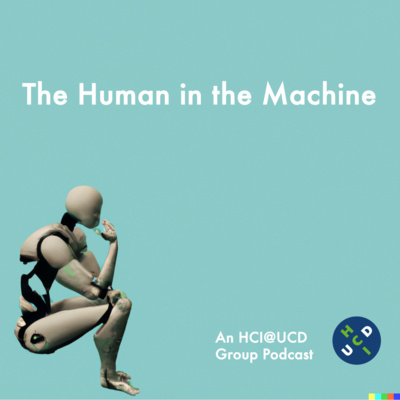
HCI podcast: The Human in the Machine
This podcast from the HCI@UCD research group explores the world of human-computer interaction. Episodes include talks, interviews and discussions with leading experts around key ideas in how humans shape and are shaped by the digital world we live in, including:
(opens in a new window)Designing sound for human-robot coordination, with Dr Hannah Pelikan
(opens in a new window)Technology acceptance in mental healthcare, with Dr Camille Nadal
(opens in a new window)Humans and Technology: From tools to partnership, with Prof Lewis Chaung
Find the (opens in a new window)podcast on Spotify to hear more episodes.

AI’s promise in education
Research at UCD School of Education has produced transformative educational programmes and AI-driven eduction innovation.
Specialising in philosophy of education, applied ethics and philosophy of technology, (opens in a new window)Dr Michał Wieczorek explores how new technologies shape the goals, values and practices of education at all levels, particularly through his project 'AI in Primary and Secondary Education: An Anticipatory Ethical Analysis.'
(opens in a new window)Dr Rachel Farrell has delivered transformational programmes at the school including via Erasmus+, collaborating with European partners to develop cutting-edge resources and methodologies for teacher education. Her research interests include virtual and augmented reality (VR/AR), sustainability education, and cybersecurity education, co-authoring numerous studies and projects on the use of XR technologies in teaching. Rachel is also founder of the (opens in a new window)UCD Centre for Cyber Resilience Education (Cyberwise), an initiative aimed at promoting Al and digital literacy and resilience across the continuum of education.
Learn more about the consortium project (opens in a new window)Alliance4XR.

Environmental politics and values
The FORSEE project (Forging Successful AI Applications for European Economy and Society) examines the environmental implications of AI across its supply chain. The project's Sustainability lead, political ecologist of digital infrastructures (opens in a new window)Dr Patrick Brodie, has found that the balance between sustainability and digitalisation in EU "twin transition" policies (digitalisation and decarbonisation, led by AI) has been tipped towards digital growth, potentially at the expense of environmental health and climate goals.
"Only by understanding these basic facets of AI supply chains can the EU's AI policies and assessments of the "success" of its sustainable AI strategies be adequately measured," he says. "In order to succeed, first we have to re-centre discussions of AI's infrastructures and supply chains in order to understand how to develop it with true commitments to sustainability, environmental health, and social good at a global scale."
Read Patrick's full (opens in a new window)blog post.

Applying AI to environmental and urban challenges
AI can also be part of the solution to tackle pressing environmental problems. At UCD School of Geography, (opens in a new window)Dr Srikanta Sannigrahi’s work centres on applying AI and machine learning to environmental and urban challenges, contributing to several major projects that use advanced data processing and intelligent systems to enhance environmental management.
In the now completed CAMEO (Creating an Architecture for Manipulating Earth Observation Data) project, he helped develop AI-enabled methods for processing Earth observation data, improving access to geospatial information. Through the (opens in a new window)OPERANDUM project (Open-air laboratories for nature based solutions to manage hydro-meteo risks), Srikanta supported the use of smart, nature-based solutions to address weather-related risks in urban environments. He also contributed to the (opens in a new window)Plastic Raiders National Challenge project, creating AI-driven tools to detect marine plastic pollution.
Srikanta now leads the Research Ireland (opens in a new window)INTERVAL project, which uses remote sensing, citizen science and AI to build a digital urban tree inventory for Dublin. His research highlights how intelligent technologies can support sustainable planning and community-centred environmental stewardship.
UCD: Delivering tangible societal impact
UCD College of Social Sciences and Law is a hub of internationally excellent research that addresses society’s most pressing challenges. Through rigorous scholarship, innovation, interdisciplinary collaboration, and meaningful engagement with policymakers, communities, and global partners, the college generates research with real-world impact, particularly around its research themes:
- AI, Data Science and Society: values-led technologies and innovation;
- Democracy, Governance Justice, and Practical Reason: institutions, frameworks, and ethical social lives;
- Sustainable Futures - Climate, Environment and Place: people-centred solutions for a just transition;
- Health, Wellbeing and Human Flourishing: living a good life and ageing well;
- Inclusive Prosperity - Economies, Work and Inequalities: equity and opportunities in transforming societies
Visit UCD College of Social Sciences and Law to learn about the researchers, programmes and centres in this field.