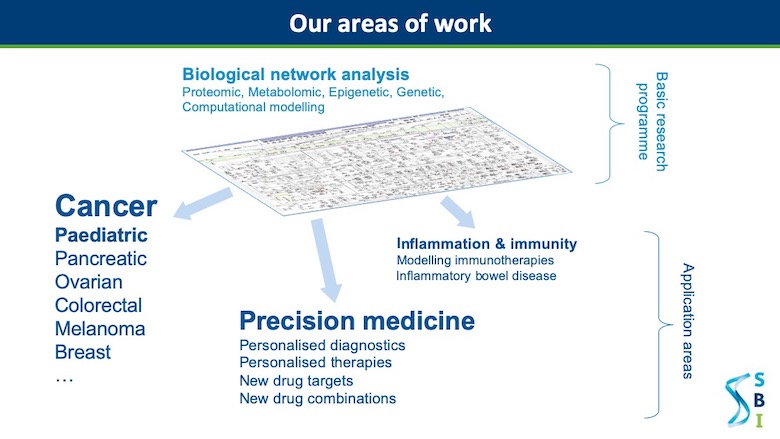
Systems Biology Ireland investigators use a combination of multi-omics, wet-lab experimental analyses (e.g. cell, animal and human studies) and computational modelling and simulation. This combined approach allows us to identify important nodes in signalling networks and to reconstruct the architecture and biological function of these networks. The approach also allows us to obtain an integrated and holistic view of how genes, proteins, and metabolites interact, and what goes wrong in a disease setting; unlocking potential for personalized approaches in medicine.
Computational Modelling
In biology, things seldom work in isolation. Individual molecular structures - genes, proteins and carbohydrates - work together to get things done. In turn, cells function as part of a wider tissue, organ or system in the body. And organisms generally interact with each other in ecosystems and societies. SBI uses mathematical and computer modelling to help make sense of this complexity.
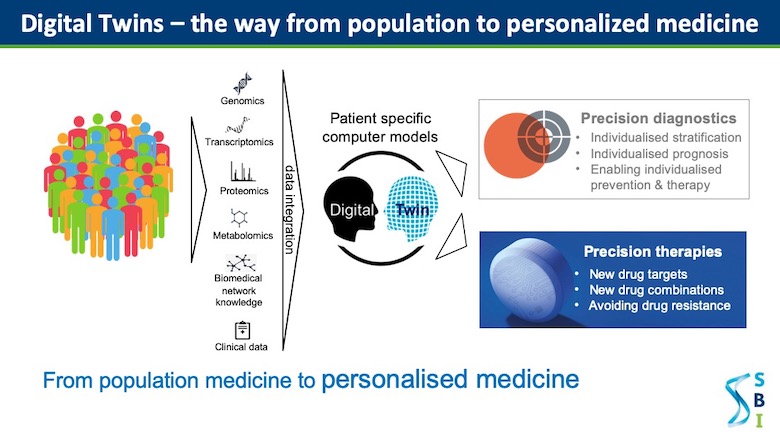
In collaboration with SBI wet-lab scientists, our dry-lab researchers take a series of observations or measurements from biological samples, and build that data into a computer model which shows how biological molecules are interacting. We use differeing modelling methods ranging from biophysical, mechanistic models to machine learning and artificial intelligence (AI) driven models to predict how molecular interactions might change in disease settings, and can also integrate data from smaller systems (e.g., cells) into larger systems such as tissues, organs and eventually, the body as a whole. In turn this informs what wet-lab experiments should be done next, and the iterative cycle between wet and dry lab continues. Our vision is to build Digital Twins, computer models of patients that allow us to simulate disease and treatment in silico in order to find the optimal and personalised treatment for each individual patient.
Cancer
In cancer, tumour cells in the body go rogue (i.e., they stop listening to the body’s signals in the way that healthy cells do). This is due to rewiring of the cells internal signalling networks; changing how they communicate and grow. SBI looks to understand these changes so that we can identify more effective combinations of existing anti-cancer drugs for patients and help to design future drugs to silence tumours.
SBI is working on various types of cancer, including melanoma, ovarian, pancreatic, colorectal, breast and childhood cancers to identify the communications mechanisms that make them cancers and also the signalling qualities that could make them unique.
SBI strives to both improve current drug treatments (i.e., developing combinations of existing drugs that are more efficacious with less toxic side effects), and also to develop new anti-cancer drugs by identifying new targets that are based on their biological network context. To tailor such treatments to individual patients we are also constructing Digital Twins of cancer patients.
VIDEO: We asked the SBI Community - Why are digital twins important for the future of Paediatric Oncology?
Clinical Trials
We have proof-of-principle for our digital twin models. One model is in a clinical trial in the US, where we have used a mathematical modelling system developed by SBI researchers as a basis for treating pancreatic cancer patients. This clinical trial is now in Phase II and is reportedly the first ever clinical trial based on a mathematical model of signal processing. If proven successful against pancreatic cancer, this trial could lead to extensive applications in other RAS-mutant cancers, such as colorectal and lung cancer.
SBI is also pursuing another clinical study in Ireland which is scheduled to commence in 2023-2024. Our overall goal with these trials is to test drive digital twin models in the clinic to show their value in enabling precision medicine, but also to make digital twin models available for the pharmaceutical industry to find better drug targets with faster and cheaper methods.