The Una Europa Winter School for Doctoral Students in Cultural Heritage was hosted by Jagiellonian University in Kraków (Poland) in December 2025. Una Europa is an alliance of 11 research-intensive European universities, including UCD.
PhD student Samantha Tobiáš, from UCD’s School of Archaeology, was in attendance. In this guest blog post, Samantha reflects on her experience, and offers an unusual, creative perspective alongside her own thoughts.
Samantha writes:
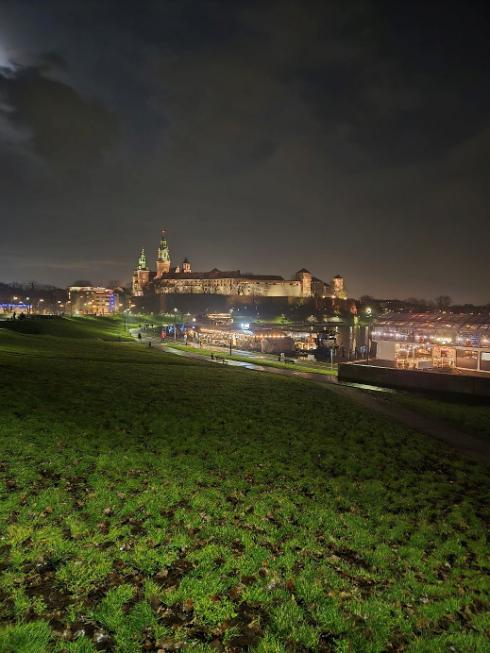
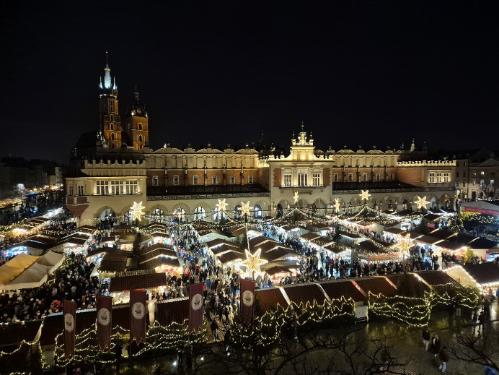
I travelled to foggy Kraków in early December 2025 for the Una Europa Winter School: four days of lectures, workshops, and activities centred on multimodal encounters with Cultural Heritage.
The school brought together PhD students working on heritage across the Una Europa universities alliance, opening up a dialogue on topics such as multisensorial perception, accessibility, and the digitalisation of heritage. We explored how touch, smell, taste, or digital collections can offer alternative perspectives on heritage, sometimes learning about Kraków through these approaches ourselves.
One afternoon, for example, we visited a museum where we baked an obwarzanek, Kraków’s famous ring-shaped bread. We touched and smelled the dough, and of course tasted the result. Intangible heritage such as food or music is closely tied to experience: we do not aim to conserve only the recipe of a regionally important food like the obwarzanek, but the lived tradition of making it, selling it, and eating it on Kraków’s streets.
As a researcher of cultural landscapes from a post-human perspective, I found myself thinking beyond human sensory encounters. I began to notice the pigeons. Ubiquitous in cities, yet rarely centred, they pecked at half-eaten obwarzanki, perched on the spires of St Mary’s Basilica, and scattered every hour when the trumpet call rang out from the tower. While tourists looked up to film, the pigeons took flight. It made me wonder what Kraków’s heritage might look like from their perspective.
As part of the school, we were encouraged to respond creatively to these ideas. The following is a piece of flash fiction exploring how a pigeon might experience Kraków.
I lift off from the spire of St. Mary’s Basilica, taking in the views below me as I glide north.
The green ring that Planty Park forms around the old town is an enticing space, but it is also a favourite spot for magpies, blackbirds, and those big, bold ravens that never share. Better to avoid them altogether!
So I bank towards an easier place: The Old Kleparz Market. I flap my wings and land in front of the big gate. The roof blocks easy access from above, so I have to take the human entrance, sailing towards a wooden box full of green vegetables.
I take in the noises and smells that are concentrated here: dust, vegetables, warm baked goods… The greens aren’t my kind of feast, but the beans and lentils nearby look promising. If only they weren’t trapped behind the wrinkly, shiny translucent skin that never breaks, no matter how hard you peck at it! I learned that the hard way.
Better to hop off my perch, down onto the stone floor, my talons clacking against the slabs worn smooth by feet bigger than mine. I must take care, bobbing my head and walking between tourist legs and local shoppers, weaving in and out between them.
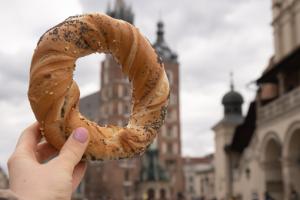
Tilting my head left, right, left again, I am on the watch for a half-eaten obwarzanek. And there it is! What luck! Behind the beautifully red apples and the juicy tomatoes, peeking out of its paper bag: A round pastry, its dough interwoven into a braided pattern, crunchy on the outside and soft on the inside.
I take flight again and approach my treasure, pecking at the golden deliciousness. Hidden from sight beneath a stall, I am safe to peck at my feast without hurry, fondly remembering the day a human held an obwarzanek high for me, waiting while I ate mid-flight. That was a rare kindness, but today’s crumbs are enough: I’m ready to take off again!
* * *
For more information on Una Europa and to learn of similar opportunities for UCD students and researchers, check out UCD.ie/unaeuropa.