Professor Calvin Chung: Critical Reflections on the Green Transition and New Urban Patterns
Thursday, 30 October, 2025
Share
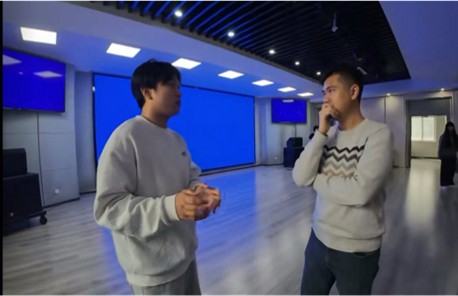
Written by: Plan 4007 Student Group 8, Pengyu Mu, Qixuan Qiu, Fuxin Liu, Jingyang Cao, Sirui Min, Zijing Cheng ,Yuhan Xia, Jialin Bai, Mingxian Wen ,Haoyue Huang, Yiran Wang, Ningxuan Li, Enxiang Zhao, Zhengchen Guo, Jiabi Lin
About the TCPEP Lecture Series 2025 ‘Transport, Development and Society’
Organised by Dr. Yunpeng Zhang and Dr. Caterina Villani, the CDIC-TCPEP Lecture Series brings together leading academics and practitioners to explore critical issues at the intersection of urban planning, development, and transport. Now in its second edition, Transport, Development and Society, the series gives undergraduate students a unique opportunity to engage with current research and professional practice, while also fostering research dialogue among CDIC TCPEP faculty and PhD students. Delivered as part of the PLAN4007W Smart Cities and Transport module, each lecture encourages students to reflect on emerging themes such as mobility, land use, and sustainability. Student groups then prepare a blogpost linking the speaker’s insights to course discussions and wider urban debates.
On the morning of October 29, 2025, Professor Calvin Chung from The Chinese University of Hong Kong delivered a special lecture titled “Critical Approaches to Green Transitions” at the Chang'an Dublin International College of Transportation. Professor Chung is an established scholar whose research has made significant contributions to critical urban studies, environmental governance, and sustainable development. His work focuses on the social and political factors behind technology and smart city plans. He investigates the essential roles of governance structures, institutional reform, and public engagement in steering urban transitions toward greater equity and sustainability. Professor Chung's research shows that true environmental progress goes beyond technical solutions to require fundamental policy reforms and public participation. His influential frameworks offer new approaches for building more sustainable and resilient cities.
During the discussion session, the group 8 discussed with Professor Chung about whom should define the green standards of industries. Professor Chung pointed out that many roles can be involved in the process of establishing green standards. For instance, in China, the main decision-makers are the government.
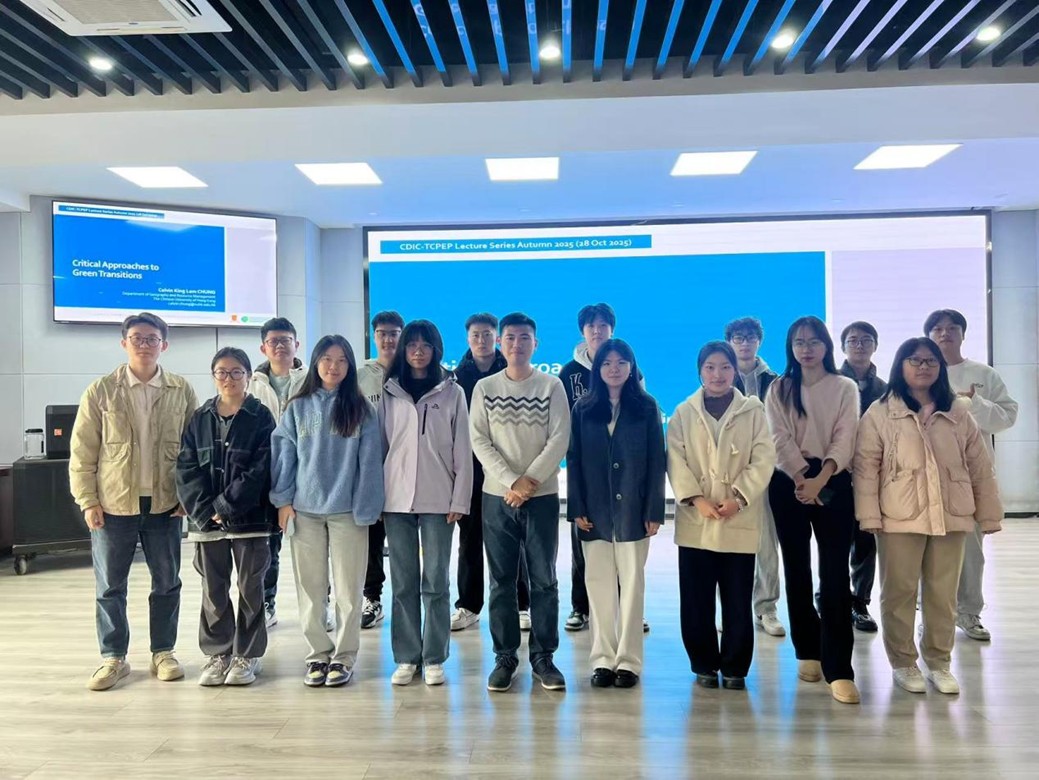 A group photo of Calvin Chung and Group 8
When students asked whether a company can be truly considered green industries if people think it's not green enough, Professor Chung cited an example of a leading domestic battery recycling company encountering obstacles when trying to set up a factory in a given city in southern China: despite the company's advanced technology and compliance, it was ultimately relocated elsewhere due to strong opposition sentiment from local residents. Professor Chung pointed out that this incident reflects that 'green' is not a 'single-choice question' of the administration, but a 'multiple-choice question' requiring continuous negotiation among government, enterprises, and residents.
Professor Chung concluded green industries need to break away from traditional high-carbon locks while also relying on existing infrastructure and institutional frameworks. Professor Chung urged that future policy design should establish an 'interactive decision-making' mechanism, bringing the government, businesses, and communities to the negotiation table to avoid the situations of 'elites making decisions for people.
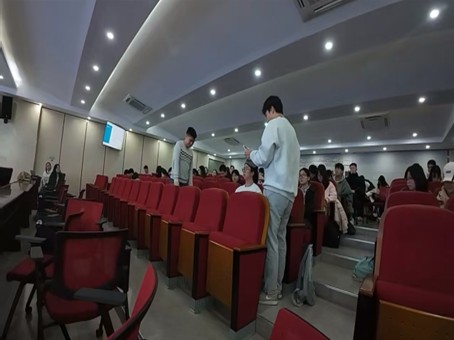
Discussion about the lecture content
Following the lecture, the group 8 conducted a brief interview with Professor Chung. When asked about his first impression of Xi’an’s transport, Professor Chung noted that his arrival time avoided peak hours, allowing for a smooth 20-minute journey from the airport to campus. Regarding regional disparities between northern and southern cities, he emphasized that traffic conditions cannot be simply categorized by geography, but are primarily influenced by factors such as urban planning, population density, and new district development. Professor Chung further noted that differences between northern and southern cities often stem from policy-driven geographical variations rather than inherent natural conditions. This lecture enabled students to understand urban development from the perspective of green transformation, stimulating their research interest. The on-site response was intense and the interaction was active.
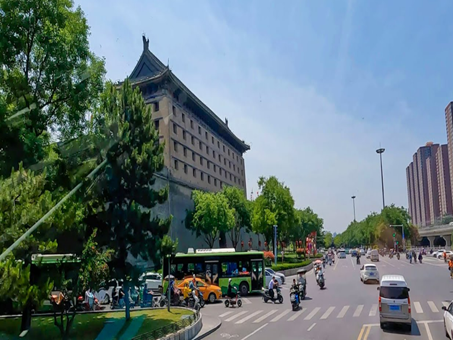
Street view of Xi'an