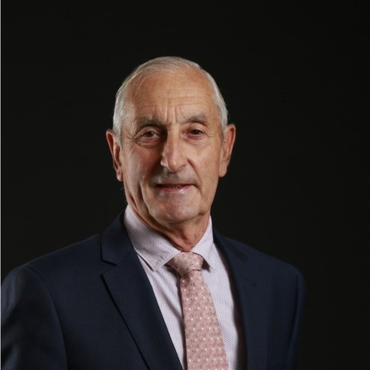
 Dr Patrick Condon graduated from UCD School of Medicine in 1960. He went on to train as an ophthalmic surgeon with the St. Thomas’ Hospital Group in London, like his father before him. Patrick returned to Ireland in the early 1970s, and took up the post of Consultant Ophthalmic Surgeon at University Hospital Waterford. He was instrumental in the advancement of modern eye surgery in Ireland, and brought phacoemulsification cataract surgery and other key developments to this country. Patrick has recently launched his new book Eye Healthcare – A 90 Year History of Progress, which documents the training and careers of successive generations of Irish ophthalmic surgeons from the 1930s to the present day.
All profits from the sale of the (opens in a new window)book go towards the (opens in a new window)Ridley Eye Foundation.
What inspired you to pursue a career in Medicine?
It runs in the family! My grandfather was in General Practice, and my father was a consultant ophthalmic surgeon in Waterford Ardkeen Hospital. He started his ophthalmic training in the 1930s, at the Royal Eye Hospital in London, and was at the forefront of developments in the field of eye healthcare. It felt natural to follow in his footsteps. Both of my sisters also became doctors.
What was your favourite part of studying Medicine at UCD, and why?
I really enjoyed Clinical Pathology with Professor Harman, and also the Clinical Teaching module in St. Vincent’s University Hospital.
What advice would you give to someone considering a career in Medicine?
My new book Eye Healthcare – A 90 Year History of Progress, charts my own journey as well as the history of eye healthcare in Ireland. I think it gives a good account of my experiences, and could help someone decide whether a career in Medicine is ‘for’ them or not.
What were some of the highlights of your time at UCD?
I played for the UCD Thirds Rugby team while I was a student, and I have wonderful memories of those days! I highly recommend getting involved in a sport, a club or a society while you’re in college – it really enhances the experience!
Tell us more about your new book Eye Healthcare – A 90 Year History of Progress.
My father, Dr Richard Condon, was a contemporary of Sir Harold Ridley, who implanted the first artificial intraocular lens in a human eye, in St. Thomas’ Hospital in London in 1949. The progress since then, driven by pioneers like Ridley, prompted me to put together a first-hand account of the major changes, and the people that made them happen. As both my father and I were ophthalmic surgeons, our experience spans two generations working in the same area. The book is based, in part, on the major advances in eye healthcare experiences in the UK and Ireland, and concentrates on the training and instrumentation involved in cataract and lens implant surgery, and in providing a service to the public. If you’d like to hear more, I was fortunate to be invited to speak at the Irish College of Ophthalmology Conference in October. The interview was recorded as a podcast for the series ‘Eyes on Tomorrow’ with J Ferris and D Morgan, and you can listen back (opens in a new window)here.
What’s the proudest moment of your career to date?
I have been privileged to be part of some major innovations in the field of eyecare, and to have initiated new surgeries and procedures over the years.
Some highlights include:
- Introducing intraocular lens implantation for cataract to Ireland in 1982, followed closely by keyhole cataract surgery using ultrasound small incision phacoemulsification, with smaller foldable intraocular lens technology.
- First Lasik refractive surgical operation in Ireland and UK, with Professor Michael O’Keefe (Mater Hospital, Dublin – March 1990).
- Organising Chairperson of European Intraocular Implant Council Conference (Trinity College Dublin, 1990).
- Founding member of the European Society of Cataract and Refractive Surgeons (ESCRS).
Who have been the most inspiring mentors or advisors throughout your career, and how have they influenced you?
Dermot Pierse at the Croydon Eye Unit was a great influence. He is an active member of the Intraocular Microsurgery Study Group (IOMSG), in Instrument and Suture Design. Also David Hill, a Research Professor of Ophthalmology at the RCS in London. He is a leading figure in Wound Healing research.
What do you think will be the biggest challenge for doctors in the future?
I think the whole area of AI is going to be hugely challenging for all healthcare professionals. We need to be mindful of the ethics around this issue, and ensure it is monitored and regulated properly.
What’s the best piece of advice you’ve ever been given?
I have always adhered to strict medical ethical behaviour with patients and colleagues, and it has served me well.