Download the Protocol here
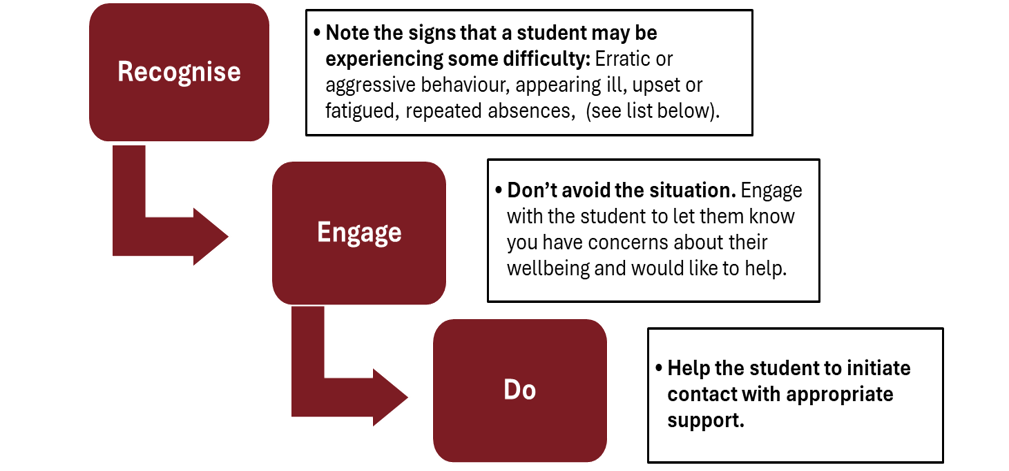
R.E.D: Recognise - Engage – Do
Any member of the University community can be a trusted person for a student or may be well positioned to spot when a student is in distress. You may be the first point of contact for a student experiencing difficulty or you may come into contact with an obviously distressed student who needs your help. This protocol will help you to respond through the following three steps:
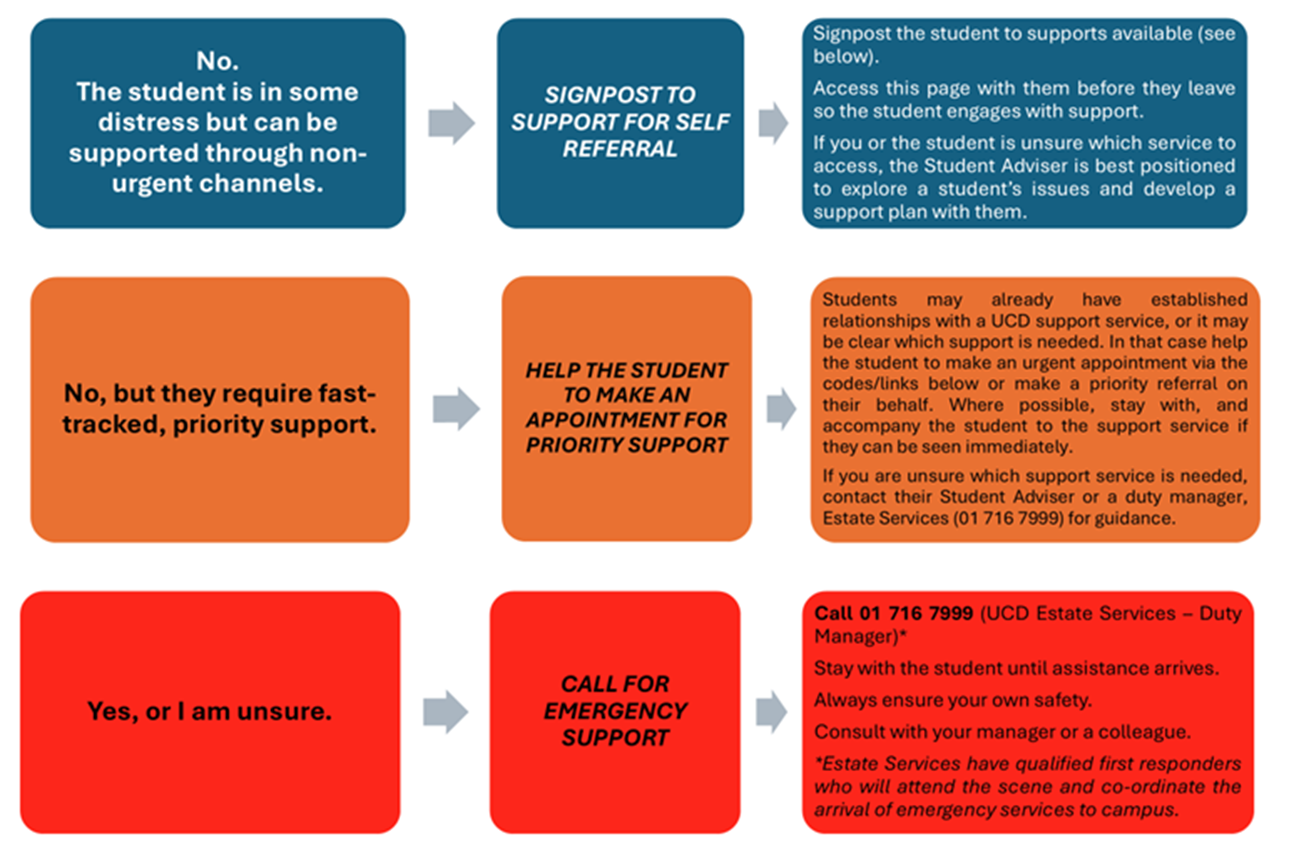
Is there an immediate danger to the student or others?
Recognising Signs of Distress
*This list is not exhaustive. If you feel there may be something wrong, trust your instinct.
Academic
- Unexpected change in academic performance e.g. lower grades, unexplained absences from classes, loss of motivation for academic work or participation in class
- Essays or creative work that include disturbing content and/or themes of despair, hopelessness, suicide, violence, death, or aggression
- Multiple requests for extensions and/or extenuating circumstances
Physical
- Marked changes in physical appearance
- Appears to be physically unwell for a period of time
- Marked or noticeable change in mood or behaviour
- Appears to be intoxicated or under the influence of substances.
Inter/Intrapersonal
- Direct comments about distress, feelings of overwhelm, family problems etc.
- Signs/expressions of hopelessness, worthlessness or shame.
- Sudden changes in emotions, e.g. tearfullness, irritability, acute anxiety, expression of hopelessness about the future, exaggerated emotional responses.
- Behaviour that is unusual or unpredictable
- Concern expressed by friends about a student
- Implied or direct threats of harm to self/others/
Engaging with a student when you’re concerned about their wellbeing:
Engaging with a student when you're concerned about their wellbeing
SAY what you see & SHOW you care:
Say what you have noticed – avoid making assumptions or judgements. Let the student know that their wellbeing is important to you and that you want to help.
Example:
“Hi ______, I just wanted to check in with you. I’ve noticed ____ and wanted to see if you’d like to talk.”
“Your wellbeing is important to me so I’d like to know how I can best support you at the moment”
HEAR them out
Be there to listen. Listen patiently as you try to understand where they are coming from. Acknowledge their difficulty and instill hope that, with help, things can get better.
Example:
“I’m sorry that you are going through this. Thank you for speaking to me about it, I know that can be hard.”
“It sounds like a very difficult situation, what has that been like for you?”
KNOW YOUR ROLE
Staff should be ready to be a supportive presence for a student but are not expected to assume responsibilities outside the parameters of their role and should be aware of their personal limitations.
Example:
“I can put you in touch with supports that we have in place specifically to help students who are experiencing the kind of thing you are describing.”
Connect to Help
Connecting students with supports.
Help the student connect to supports. The student is now engaged with a supportive network – arrange the next step in that engagement before the end of the conversation.
Example:
“I’d like to make sure that you are getting the kind of support you need. Could I make a call on your behalf now?/Could we look at setting up an appointment with someone now?”
On occasions, students may be reluctant to seek help. In such circumstances, it is best to advise the student of the services on offer and let them know that they may want to think it over and contact the service directly or come back to you for a referral.
Example:
“I understand that you may find it difficult to reach out to the supports that are available now. You might want to think over it and look at the website of the service to understand better what services they offer. All of the services remain open throughout the year, and you can come back to me or contact them directly or your Student Adviser can make a referral.”
Check back in
Take an opportunity to check back in with the student.
Example:
“Good to see you again – how have you been getting on? I’m here for you if I can help with anything further.”
Supports for Students in Distress
In an emergency, call 01 716 7999
| UCD on-campus supports: |
|||
| UCD Student Advisers |
Offers assistance when personal, financial or social difficulties arise, including ● Support with college life ● Advice on policies and procedures ● Referral to other UCD supports ● Support with financial concerns. |
10am - 4pm (Core Hours) |
|
| UCD Student Counselling Service |
Provides support when personal issues arise which affect happiness, well-being, capacity to cope, relationships or learning. |
|
|
| UCD Health Service |
Provides on-campus medical & psychiatric care, including where there is a concern for the health and wellbeing of a student. |
|
|
| UCD Chaplaincy |
Provides pastoral care, emotional support & spiritual accompaniment for students of all faiths and none |
|
|
|
|
Offers advice & supports to widen access & ensure participation by diverse student cohorts and supports students who require disability support, temporary exam accommodations, financial support, academic support & social support. |
|
|
| Digital, telephone and out of hours supports and resources: |
|||
| Text About It |
Talk at 50808 provides a safe space where you’re listened to by a trained Crisis Volunteer. You’ll text back and forth, only sharing what you feel comfortable with. |
||
| Togetherall |
Togetherall is a safe, anonymous, online community for mental health support which is free to all UCD students. |
||
| SilverCloud |
SilverCloud is a flexible, effective and easy to use online mental health support system that all UCD students have access to. SilverCloud grants students secure and immediate access to self-led Cognitive Behavioral Therapy (CBT) |
||
| Niteline |
Niteline is an anonymous confidential listening service providing information and support for UCD students on a 1-2-1 basis over the phone. The service is facilitated by trained student volunteers, supervised by qualified counsellors. Lines open 9pm - 2.30am. |
1800 793 793 |
|
| EDOC |
Out of Hours Urgent Medical Care 6pm to 8am Monday to Friday or at any time (24 Hours) during weekends |
01 22 34 500 |
|
| HSE Mental Health Supports and Services |
There are different types of support available for people with mental health difficulties. Many of the supports listed here are provided by agencies with the support of the HSE. You can access most of the services without a referral. |
(opens in a new window)See hse.ie for mental health supports and services |
|