20 November 2024 | TNH Event: "Becoming an Author: From Proposal to Publication" Workshop
Date: Wednesday, 20th November 2024 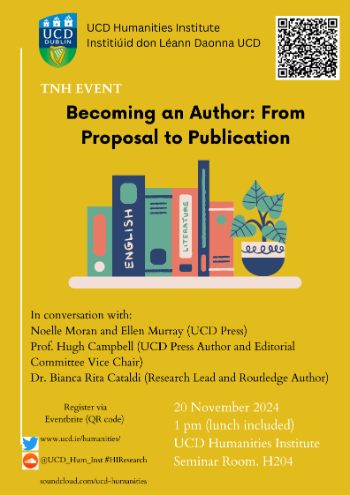
Venue: HI Seminar Room (H204 / top floor)
UCD Press executive editor Noelle Moran, editorial assistant Ellen Murray,Professor Hugh Campbell(author and Vice Chair of the UCD Press editorial committee) and Dr. Bianca Rita Cataldi (UCD Humanities Institute Research Lead and Routledge author) delivered an in-depth workshop on crafting successful book proposals for academic publishers and on the process from proposal to publication.
This event offered a unique opportunity to learn directly from publishing insiders and authors about what academic presses look for, how to structure a proposal, and tips for navigating the review process. It was aimed at early-career researchers and seasoned academics alike, this session offered a guide to refining your pitch and aligning it with the expectations of an academic press.
18 October 2024| TNH Event: Bilingual Conversation and Readings | From Réunion to Ireland: Gaëlle Bélem in Translation
Date: Friday, 18th October 2024 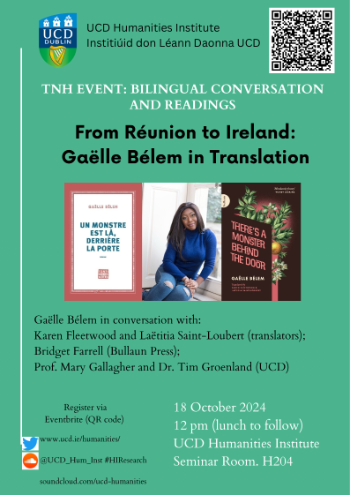
Venue: Humanities Institute (H204 / top floor)
Gaëlle Bélem’s There’s a Monster Behind the Door (published October 2024) is a picaresque, brutal, and mordantly funny tale of one little girl’s attempt to escape her sadistic parents’ reign of terror in Réunion in the 1980s. It is the first of two novels by the Réunionese author to be published by the Sligo-based Bullaun Press, the first Irish publisher to take literature in translation as its focus.
In this event, Bélem appeared in conversation with her translators Karen Fleetwood and Laëtitia Saint-Loubert as well as publisher Bridget Farrell (Bullaun Press) to discuss the novel itself (originally published by Gallimard as Un monstre est là, derrière la porte, in 2020), the story of its translation, and how it came to be published in Ireland.
The conversation was chaired by (opens in a new window)Prof. Mary Gallagher (School of Languages, Cultures and Linguistics) and Dr. Tim Groenland (School of English, Drama and Film & HI resident scholar).
14 October 2024 | TNH Workshop: ‘Un/Successful Funding Applications’
Date: Monday, 14th October 2024 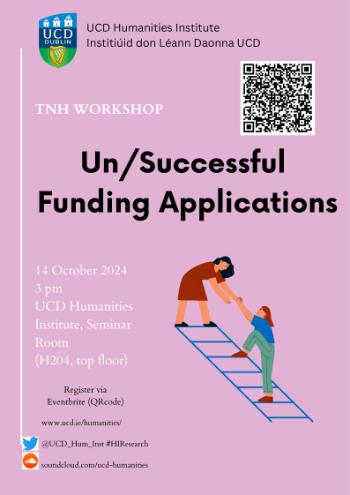
Venue: Humanities Institute Seminar Room H204 (top floor)
Applying for funding applications is one of the crucial aspects of any academic career, both in the Humanities and in STEM. This workshop aimed to tackle the most difficult tasks of this process, while recounting stories and experiences of both successful and unsuccessful applications at different career stages, all the while showing what we can learn from both success and rejection.
Confirmed speakers:
- Dr Francesco Milella | Postdoctoral Research Fellow, UCD School of Music and HI Resident Scholar
- Dr Matt Prout | Postdoctoral Research Fellow, UCD School of English, Drama and Film, and HI Resident Scholar
- Teddy Power | PhD Candidate, UCD School of English, Drama and Film, and HI Resident Scholar
- Additional speakers TBC
Event Organiser:Dr Bianca Cataldi (UCD Humanities Institute TNH Research Project Lead)
25-26 July 2024 | 'Can CEE Lesbians Speak? Towards Central and Eastern European Lesbian Studies' Symposium
Date:Thursday, 25th July & Friday, 26th July 2024 
Venue: Humanities Institute, H204
The purpose of the symposium was to think broadly and collectively about lesbians and lesbian studies in Central and Eastern Europe, particularly in the context of art, literature, history, community, affect, sex, post- and decoloniality, and East/West connections and their inherent problems. While there is, of course, lesbian scholarship in existence across the region, it seems we have rarely spoken collectively, in dialogic form, or transnationally. In short, “lesbian studies” as a discipline has not yet been outlined or conceptualised in the region, unlike the more established investigations of gay masculinities and queerness.
This event was a methodologies-oriented workshop, to discuss the current state of the field, different approaches to the subject, and opportunities and concerns of working with the knowledge we have thus far, as well as the obvious archival absences and gaps. This symposium was a way to look for connections, common methodologies and theorisations, and consider collective approaches to “lesbian” in the region and their challenges and shortcomings.
Event organiser:Dr Aleksandra Gajowy (UCD School of Art History & Cultural Policy, and HI member)
This symposium was generously supported by the National University of Ireland Early Career Research Grant, the UCD Humanities Institute Research Grant, the UCD Research Seed Fund Award, and the UCD EDI Committee Grant. Special thanks for support to Professor Kathleen James-Chakraborty and Dr Sean Leatherbury, UCD School of Art History and Cultural Policy.
12-13 July 2024 | Artistic Residency: A Conference to Mark the 50th Anniversary of the Anwerbestopp
Date: Wednesday, 26th June & Thursday, 27th June 2024
Venue: Humanities Institute (H204 / top floor) & Goethe Institut (Film screening)
2021 saw numerous events take place across Germany to mark the 60th anniversary of the Anwerbeabkommen [bilateral recruitment agreement] between the Federal Republic of Germany and Turkey, signalling its importance within Germany’s post-war history. As historians such as Rita Chin (2007) have shown, however, it was the Anwerbestopp, the German government’s decision to unilaterally end its guest worker programmes on 23rd November 1973, that paradoxically led to greater pressure on individual foreign workers and their families to settle in West Germany. Despite restrictive citizenship laws, this resulted in longer term diasporic residency, which has significantly shaped and been shaped by the FRG today.
This two-day conference marked the 50th Anniversary of this turning point by exploring the cultural political implications of ‘residency’. Residency as a legal status can both precede and preclude citizenship. Its ambivalent relationship to twentieth-century assumptions of a singular national identity invites alternative ideas about what it means to be at home in and to access the state in transnational times. Its temporal aspect calls teleologies of integration and assimilation into question. These ambivalences are reflected not only in artistic work which situates itself in relation to experiences and practices of residency in Germany, but also in the use of artistic residencies within the cultural sector (programmes in which artists have the opportunity to work in a different institutional environment for a time limited period).
This two-day event included a public screening of the film(opens in a new window) Liebe, D-Mark und Tod(2022) by Cem Kaya,and a keynote by Prof. Onur Suzan Nobrega. 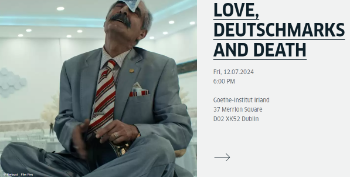
We are grateful to the UCD Humanities Institute, the UCD College of Arts and Humanities, the Goethe Institut, and King's College London for their support.
Conference organisers: Maria Roca Lizarazu, Leila Mukhida, Lizzie Stewart, Joseph Twist
26-27 June 2024 | 'Measuring Eurasia' | A Conference on Survey Sciences at the Edges of Empire
Date:Wednesday, 26th June & Thursday, 27th June 2024 -350x496.png)
Venue:HI Seminar Room H204
This conference analysed attempts to survey the edges of the Russian Empire, from the Baltic and Black seas to the Bering Strait. Historians and geographers have used “survey science” to study global enterprises of astronomy and physics in the early nineteenth century, focusing on their coordination across the British Empire. Measuring Eurasia reorients this field of research to develop new histories of science and surveillance in the Russian imperial world. It emphasizes diverse surveys carried out across disparate borderlands—ethnographic as well as geodetic surveys, expeditions of land and sea, and sciences of ice, plants, and peat.
Recent research points to an emerging study of Eurasian survey sciences not as self-evident acts of expansion and modernization, but as social and cultural endeavors that need to be explained. The production of space is complex terrain: surveillance projects often enrolled diverse artists, brokers, and servitors. Maps might therefore be used to negotiate or subvert indigenous claims to land, nation, or dynasty. Contest over survey technique and nomenclature could similarly magnify questions of social and political (dis)order.
26 June 2024 | KEYNOTE LECTURE | Humanities Institute H204 
Professor Adeeb Khalid (Jane and Raphael Bernstein Professor of Asian Studies and History, Carleton College, Northfield, Minnesota): "Getting to Know Central Asia: The Production of Imperial Knowledge and its Discontents”
Conference organiser: (opens in a new window)Dr Patrick Anthony (IRC Postdoc Fellow, UCD School of History & Hi Resident Scholar)
This conference was supported by the IRC, UCD Humanities Institute, UCD College of Arts & Humanities (CAH), UCD Earth Institute, and CAH Environmental Humanities Thematic Research Strand.
12 June 2024 | Contemporary Tibetan Women’s Writing in English (Reading group + seminar)
Date:Wednesday, 12th June 2024 
Venue:Humanities Institute, H204
This event comprised a reading group followed by a seminarwhere three of the most celebrated and emerging Tibetan female writers - Tsering Wangmo Dhompa, Tenzin Dickie and Tsering Yangzom Lama, in their capacities as writers, editors, translators, come together to introduce, inform and critically discuss their work as well as the future of Tibetan literature in English from the perspective of many combinatory concepts like exile and diaspora studies, neo-colonialism, resistance writing, among others. This gathering aimed to put Contemporary Tibetan Women’s Writing on the World Literary map by providing a platform to such writers who are working on a burgeoning field of literature.
21 May 2024 | TNH Workshop 'Roots in the Air: Multilingualism and Displacement' 
This workshop focused on the various definitions of multilingualism and on notions of displacement, with particular reference to exile and nostalgia from a transnational perspective. The event, co-organised by Dr. Bianca Cataldi (UCD Humanities Institute TNH Research Project Lead) and Dr. Till Greite (UCD Humanities Institute Visiting Fellow) was divided into two parts: a panel with 15-20 min presentations for each speaker and, after a coffee break, a roundtable with discussion.
The speakers were experts from different fields of Modern Languages, History and Linguistics, including Prof. Michael Cronin (TCD), Prof. Esther Kilchmann (Universität Hamburg) and Prof. Steffan Davies (University of Bristol).
Following the event, participants were invited to visit our HI exhibition: “Landings: Art after Extractivism” | UCD Humanities Institute Seminar Room (H204)
17 May 2024 | Workshop: 'EURASIAN ZONES OF CONTACT:The Russian & Qing Empires' 
This workshop, organised byDr Julia C. Schneider (University College Cork)and (opens in a new window)Dr Jennifer Keating(UCD), developed international collaboration on zones of contact between the Russian Empire (1721-1917) and the Qing Empire (1636/1644-1912). These zones are, on the one hand, geographically defined borderlands in Central, Inner, and East Asia, and, on the other hand, cultural, intellectual, political, and economic spaces wherein people from these two empires (and beyond) met and interacted. As recent work on the history of the Qing-Russian border, on borderlands of both empires, and on cross-border flows of information, people, and things has so clearly and excitingly demonstrated, there is much to be gained both by situating the two empires in direct comparative analysis and by conceptualising alternative spatial histories of Eurasia that acknowledge the existence of, but are not defined by, the political border. Some of the key research questions in this dynamic area of scholarship refer to the ways in which imperial borders were created, shaped, and transgressed by a variety of state officials, intellectuals, traders, and pastoral communities across the seventeenth to early twentieth centuries, and the degree to which the ‘border’ or ‘frontier’ is better conceived of as a highly fluid zone of contact and exchange, both spatially and intellectually.
The workshop sought to generate conversation about local and regional entanglements, networks, and exchanges across these vast Eurasian territories. While conventional histories of the two empires have treated them as two separate political entities, the workshop aims to adopt transregional and transnational approaches to overcome the narrow and traditional idea of territory – and in doing so, to propose alternative spatial, economic, and cultural histories of the region that contribute to attempts to de-nationalise and de-territorialise the historiography.
Confirmed speakers:
Yuexin Rachel Lin (Leeds)
Eric Schluessel (George Washington)
Sören Urbansky (Ruhr-Universität Bochum)
Meng Zhang (Vanderbilt)
1 May 2024 | TNH Workshop with (opens in a new window)Prof. Monica Miscali: "Investigating Emotions in Migration: The Experiences of Italian Women from the 1960s to Contemporary Times" 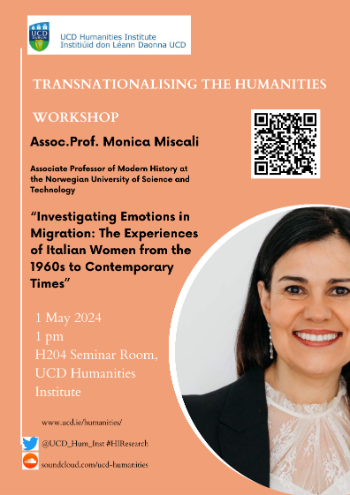
Abstract: Today, scholars increasingly recognize that emotional expressions are critical to understanding social, cultural, and political change and provide an important correction to the historically dominant approaches in migration studies. Yet, despite the growing significance of emotions in migration studies, less attention has been dedicated to the emotional impact of emigration on solitary migrants, particularly women, who decide to leave alone, without family or a husband. Leaving alone entails having to provide for oneself in a different country, presenting a significant emotional challenge that requires substantial preparation compared to those who decide to emigrate with their families. The purpose of my presentation has two main objectives. Firstly, it aims to explore the emotional impact that migration evokes in Italian women who choose to immigrate to Norway alone. Secondly, the study introduces a temporal perspective by comparing the emotional consequences of migration experienced by Italian women who immigrated during the 1960s and 1970s with those who immigrated after 2008. This comparative analysis of two different time periods facilitates an examination of how emotions and feelings can change over time and in response to the environment. Additionally, it allows us to evaluate how social factors, environments, and societal perceptions of a phenomenon can influence people's emotions.
29 April 2024 |Exchanging Tales: Celebrating Irish and Nigerian storytelling through D.O. Fágúnwà and Peig Sayers -350x350.jpg)
An event of entertainment and conversation to celebrate two of the world's greatest storytellers, D.O. Fágúnwà (1903-1963) and Peig Sayers (1873-1958). Dagogo Hart and Samuel Yakura of WeAreGriot will perform a selection of English translations of stories from Fágúnwà and Sayers. It was accompanied by a Q&A with Diipo Fágúnwà, Fágúnwà's son, and Éilís Ní Dhuibhne, writer and scholar.
Fágúnwà is best known for his book Ògbójú Ọdẹ nínú Igbó Irúnmọlẹ̀ (1938) which was one of the first works of extended prose fiction in the Yorùbá language. Through his five books, Fágúnwà pioneered an enduring Yorùbá novel form consisting of stories of supernatural adventure told by a hunter to a scribe. His work is therefore engaged with the interface of orality and text and is heavily informed by Yorùbá folklore and mythology as well as by his own Christian beliefs.
Peig Sayers meanwhile is known as one of Ireland’s greatest storytellers. She is best remembered for her autobiography, Peig, a Scéal Féin (1936), which was a staple of the Irish secondary school curriculum for decades. Outside of her autobiographical work, Sayers was famous for her knowledge and mastery of an Irish oral storytelling tradition. Hundreds of her stories were collected by the Irish Folklore Commission and are now held in the National Folklore Collection in UCD.
Sayers and Fágúnwà were contemporaries of each other telling their stories many thousands of miles apart. This event is therefore an opportunity to enter these two indigenous language literatures into conversation and see how their stories can live on in new contexts and forms.
------
This event was kindly supported by the Transnationalising the Humanities Research Strand, led by the UCD Humanities Institute.
Organiser: Clare Ní Cheallaigh (HI Resident Scholar)
25-26 March 2024 | Transnational Activisms Conference |Reimagining Boundaries in Political Cultural Production
Keynote Speaker: Natasha A. Kelly (Universität der Künste, Berlin) 
The conference explores contemporary activist cultural production, including literature, film, visual media, and performance, across national and political contexts to shed new light on the ways in which cultural practitioners use their art to communicate political ideas both with fellow activists and to wider audiences beyond their movements.
Email enquiries: (opens in a new window)transnationalactivisms@gmail.com
Conference organisers: Katherine Calvert (UCD) and Erika Teichert (University of Bristol)
Generously funded by UCD Humanities Institute and UCD College of Arts and Humanities.