21 November 2025 | "Haunting Times" Talk & Discussion with Prof. Sarah Colvin (Univ. of Cambridge)
Date: Friday, 21st November 2025 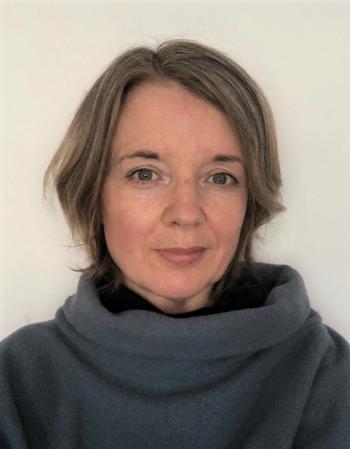
Venue: HI Seminar Room (H204 / top floor)
Haunting Times: Ghosted Memory and Epistemic Revenants in Zhadan’s Ukraine (Voroshilovgrad, 2010) and Bulawayo’s Zimbabwe (Glory, 2022)
Serhiy Zhadan’s novel Voroshilovgrad (2010) is set in a fictional Ukraine in the early 2000s, an imaginative world where the dead and the living intermingle; NoViolet Bulawayo’s Glory (2022) in a fictional Zimbabwe in the 2010s, where the protagonist encounters ghosts from a past that has not been dealt with. The talk and discussion considered how the novels expose the repressive practice of epistemic ghosting and stage the resistant practice of epistemic haunting. Those who have been ghosted return, bringing (back) memories and history that complicate linear and singular memory management.
(opens in a new window)Sarah Colvin held chairs at the universities of Edinburgh, Birmingham, and Warwick before becoming Schröder Professor of German at the University of Cambridge in 2014. Her research and teaching interests include the areas of literary aesthetics, cultural production and social justice, the political novel and prisoner writing as well as narrative theory and narrative ethics. She is PI of the Cambridge team for the Horizon Europe project Cartography of the Political Novel in Europe ((opens in a new window)www.caponeu.eu). Her recent publications include the monographs (opens in a new window)Literature and Epistemic Injustice: Power and Resistance in the Contemporary Novel (Routledge 2026) and (opens in a new window)Shadowland: The Story of Germany Told by its Prisoners(Reaktion Books 2022)and the edited collections (opens in a new window)Epistemic Justice and Creative Agency: Global Perspectives on Literature and Film (with Stephanie Galasso, Routledge 2023) and (opens in a new window)Sharon Dodua Otoo: Literature, Politics, Possibility (with Tara Talwar Windsor, Wiley 2024).
30 April 2025 | TNH Roundtable ‘The Crisis of the Humanities, Responses and Interventions: The Academy in Exile, a Case Study’
Date: Wednesday, 30 April 2025 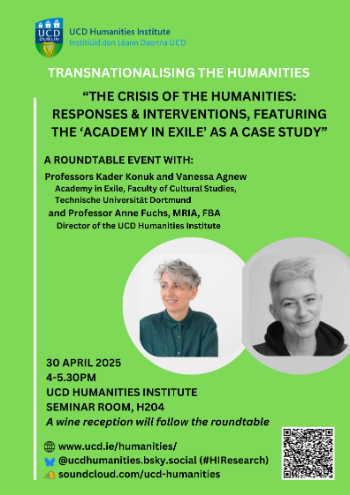
Venue: Humanities Institute (H204 / top floor)
The UCD Humanities Institute will host a roundtable discussion on the Crisis of the Humanitieswith Professors Kader Konuk and Vanessa Agnew (Technical University Dortmund), the Director and Associate Director of the (opens in a new window)Academy in Exile
The Trump administration’s campaign against universities, as exemplified by the threat to cancel major grants to Columbia University which then bowed to government interference, underlines the speed and scope of the assault on universities and on academic freedom. Direct political and legislative assaults have proliferated with more than 30 US states having enacted legislation limiting the teaching and discussion of certain topics, such as critical race theory, gender and sexual orientation. At the same time in the UK university management is responding to serious underfunding of the higher education sector by sacking staff, closing humanities programmes and axing Schools of Modern Languages, English, Ancient History, Theology, and Art History -- amongst others. Meanwhile academic freedom is being eroded across the EU too, as documented by the European Parliament (EP) Academic Freedom Forum.
In this disruptive context our roundtable broadly examines the crisis of the humanities, and interventions responses, featuring the ‘Academy in Exile’ as a case study. Founded in 2017, the Academy in Exile is a joint initiative to support cultural producers and scholars in the humanities, arts, social sciences, and law who are at risk because of their academic work and/or their civic engagement in human rights, democracy, and pursuit of academic freedom. The Academy in Exile is based on a model that creates multidisciplinary cohorts of scholars around a unified theme, with the aim of enabling persecuted scholars to collaborate with one another.
Professor Kader Konuk, Professor of German literature at the Technical University Dortmund and Director of the Academy in Exile, is a comparatist with expertise in the literary and cultural history of migration and exile. In 2022, she was made honorary professor of the Research School of Humanities & Arts at the Australian National University. Her research focuses on ethnic and religious communities in the Ottoman Empire, Germany, and Turkey, and examines discourses, cultural practices, and disciplinary formations that are shaped by travel, migration, and exile. In 2028, she initiated the ‘Transnational Literary Archive’ at the University of Duisburg-Essen’s Turkish Department. A first of its kind in Germany, the Archive collects transnational literature produced in Germany and provides a framework for conducting research into Germany’s multicultural heritage. Her monograph, East West Mimesis: Auerbach in Turkey (Stanford UP 2010) investigates the relationship between German-Jewish exile and the modernization of the humanities in Turkey. It won the annual prizes for the best book in comparative literature and Germany studies, receiving both the René Wellek Prize (from the American Comparative Literature Association) and the German Academic Exchange Service (DAAD) award (from the German Studies Association).
Professor Vanessa Agnew is Professor of Anglophone Studies in the Faculty of Cultural Studies at Technical University Dortmund, Associate Director of the Academy in Exile, and Honorary Professor in the Research School of Humanities and the Arts’ Humanities Research Centre at The Australian National University. Her research interests include: Anglo-German cultural history; Intercultural exchange and knowledge transfer; Postcolonial theory; and Music discourses from the 18th century to the present, among others. Her book Enlightenment Orpheus: The Power of Music in Other Worlds (Oxford, 2008) won the Oscar Kenshur Prize and the American Musicological Society’s Lewis Lockwood Award. She has co-curated numerous exhibitions including: Right to Arrive (Canberra, 2018); Fixing What’s Broken (Berlin, 2023); and What We Brought with Us (Re:Writing the Future Festival, 2021; German Literature Archive Marbach, 2022; Goethe-Institut New York and University of Cincinnati, 2023; and Dengê min tê te? Hörst du mich? Festival für kurdische Exilliteratur, Literaturhaus Berlin, 2024). Agnew’s children’s book Wir schaffen das – We’ll Make It (Sefa Verlag, 2021) has been translated into Ukrainian, Arabic, and Farsi.
27 March 2025 | TNH workshop “Migrant Mothers’ Subjectivities' with Prof. Eglė Kačkutė
Date: Thursday, 27 March 2025 
Venue: Humanities Institute (H204 / top floor)
The workshop “Migrant Mothers’ Subjectivities” with Prof. Eglė Kačutė, full Professor of French Literature and Gender Studies at Vilnius University, explores the complexities of migrant motherhood and the formation of subjectivities. Chaired by Dr. Bianca Rita Cataldi (University of Galway) and Dr. Megan Kuster (University College Dublin), this interdisciplinary conversation delves into the experiences, challenges, and narratives of migrant mothers as they navigate identities shaped by displacement, belonging, and cultural negotiation. This thought-provoking discussion sheds light on the intersection of motherhood and migration.