The “RIGHTS TO UNITE” Conference October 2025
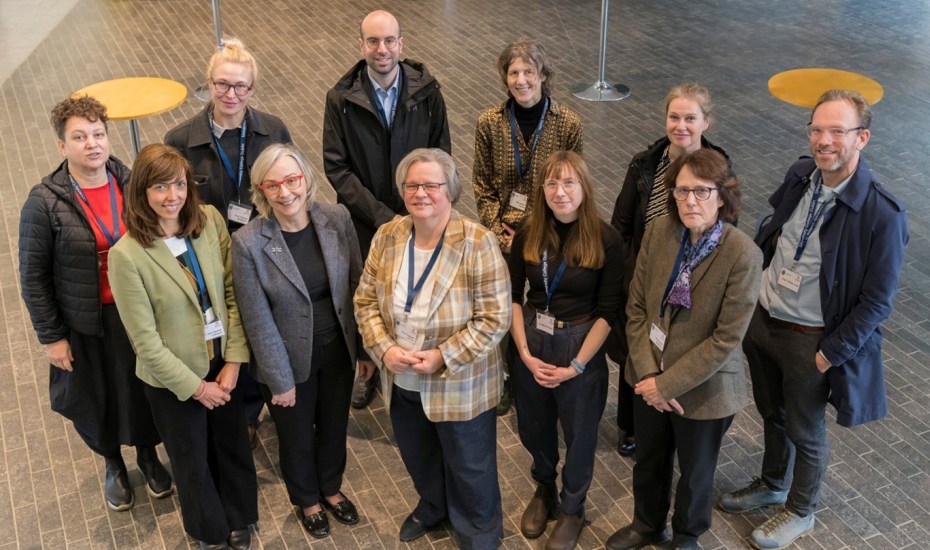
Speakers, Chairs, team and advisory board members: front row Sara Benedi Lahuerta, Imelda Maher, Dagmar Schiek, Mary Naughton and Karen Anderson (back row) Lilla Farkas, Ceciia Bruzelis, Alessandro Petti, Sabine Frerichs, Niamh NicShuibne (advisory board) and Tobias Lock
After 22 months, the ERC project “RIGHTS-TO-UNITE” sought peer feedback on its provisional theoretical framework, including the concept of integration as societalization, the conceptualisation of rights as claims, and its qualitative comparative research design. The team, led by Prof Dagmar Schiek and comprised of Dr Mary Naughton, Katerina Orfanidi, and doctoral researchers, outlined its core approach.
The project reconceptualises European integration as societalization: an ongoing, unfinished process shaped by increasing interaction across and beyond national borders. These interactions do not produce homogeneity. Rather, diversity and antagonism are essential features of contemporary societies. Cohesion is therefore not an inherent outcome of societalization; instead, contradictory processes of integration and disintegration may coexist and even generate stability.
The project’s understanding of rights is grounded in the concept of relational rights: reciprocal claims and duties that produce relationships between individuals and collectives both within and beyond national borders. This perspective moves beyond traditional state-centred liberal notions of rights. The project investigates rights exercised through transnational activity and those used without movement, focusing on economic, social, and digital rights.
The project recognises that rights are claimed in diverse ways, not only through courts but also through political and cultural discourse and everyday practices. Initial findings from Ireland, Northern Ireland, Sweden, Czechia, North Macedonia, and Georgia reveal significant variation in the recognition and enforceability of EU-derived rights. The research will focus on selected rights, including recognition of professional qualifications, consumer rights in online contracts, gender equality in employment, and the right to human oversight over algorithmic decision-making. Methods include legal and policy analysis, expert interviews, and the development of vignettes for use in citizen meetings.
Three panels provided critical perspectives. Key critiques challenged the feasibility of societal cohesion in today’s polarised Europe and urged greater attention to exclusion, belonging, autocratization, and de-Europeanisation. Scholars recommended expanding the concept of society to include systems, infrastructures, and ecosystems, distinguishing between communities and societies, and reflecting more deeply on sociological approaches to rights.
Several contributors suggested broadening the rights framework to include racial discrimination alongside gender, and to adopt an intersectional approach. Others highlighted the importance of considering both migration and emigration perspectives in relation to social protection, as well as addressing ethical concerns in the digital economy. While the project will continue to focus on its selected rights, it will adopt a stronger intersectional lens and situate rights in their wider political, social, and economic contexts.
Discussions on claiming rights emphasised the importance of agencies, institutions, and advocacy beyond judicial enforcement. Participants encouraged closer attention to access to justice, citizen engagement mechanisms such as the European Citizens’ Initiative, and the tensions between collective and individual rights. The project confirmed its commitment to examining the roles of both individual claimants and collective duty bearers in shaping societal relationships through rights.
Methodological critiques highlighted the challenges of comparative socio-legal research, particularly the risk of treating EU-derived rights as “foreign” legal transplants. The team confirmed its mixed-methods approach, combining scenario-based comparison with critical functionalism and attention to social practice and institutional contexts.
Overall, the conference underscored the complexity of rights as social, political, legal, and normative phenomena. Contributions reinforced the project's focus on the relational and non-linear nature of rights and the need to examine them as lived and contested practices in plural, polarised societies. Key themes included the interplay between individual and collective rights, the disintegrative pressures of financialization and deregulation, and the significance of institutional capacity in shaping outcomes.
The discussions affirmed a vibrant and evolving research agenda. They highlighted the need to strengthen sociological and intersectional perspectives and to situate EU-derived rights within broader dynamics of autocratization, uneven implementation, and social fragmentation. The project will continue linking formal legal entitlements to lived social realities, contributing to a more nuanced understanding of European integration through rights.