New UCD Module Brings Ireland’s Policy Makers and Shapers into the Lecture Hall
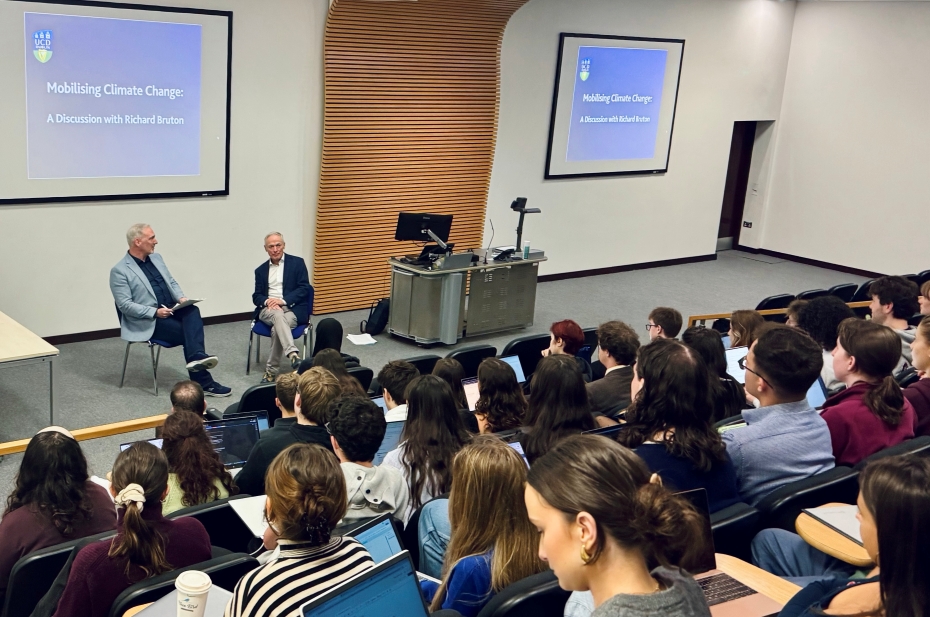
Why does it seem like good government is so hard to deliver? And how do we know ‘good government’ when we see it? A new module for undergraduate students tackled these questions by bringing Ireland’s policy makers and shapers directly into the classroom, allowing students to examine the gap between political science theories and political reality.
Understanding Government: Theory and Reality, coordinated by Assoc Prof Stefan Müller and Adjunct Assoc Prof Ciarán Conlon at the School of Politics and International Relations, investigated the tensions between ideal policy frameworks and the compromises, trade-offs and random events that daily impact real-world governance.
The module combined rigorous policy analysis with first-hand insights from former Ministers, a former European Commissioner, a Secretary General, a Ministerial Adviser to two Ministers, a Member of the European Parliament, and the Political Editor of a major Irish newspaper. The line-up of guest speakers spanned the political spectrum and multiple levels of government, the media and included representatives from all parties involved in government over the past 15 years.
The module coordinators believe that the module directly responds to UCD’s Strategy to 2030, particularly the Engaging for Impact pillar and recognise much scope for further development and impact.
Thank you very much for the course. It was amazing to hear directly from experts and politicians and to get insight into how government really works. It's always a bit surreal when you see these people constantly on the news/TV and then suddenly they’re speaking to you in class.
Direct email feedback from a student
Ministers, Officials, MEPs, Advisers and Journalists Pull back the Curtain
Richard Bruton, former Minister for Climate Action, examined Ireland's Climate Action Plan, exploring how evidence-based policy translates into political narrative and the institutional challenges of cross-government transformation.
Dr Pippa Hackett, former Minister of State at the Department of Agriculture, shared her experience implementing environmental policy as the smallest coalition partner during COVID-19, Brexit disruptions, and the Ukraine war.
Barry Andrews, Member of the European Parliament for the Dublin constituency, analysed the rise and decline of the European Union’s Corporate Sustainability Due Diligence Directive. The discussion explored what this policy reveals about interest representation and the EU’s shifting priorities.
Phil Hogan, former European Commissioner for Trade and Agriculture, discussed the formal and informal processes of negotiating EU trade deals, from obtaining mandates to consulting stakeholders.
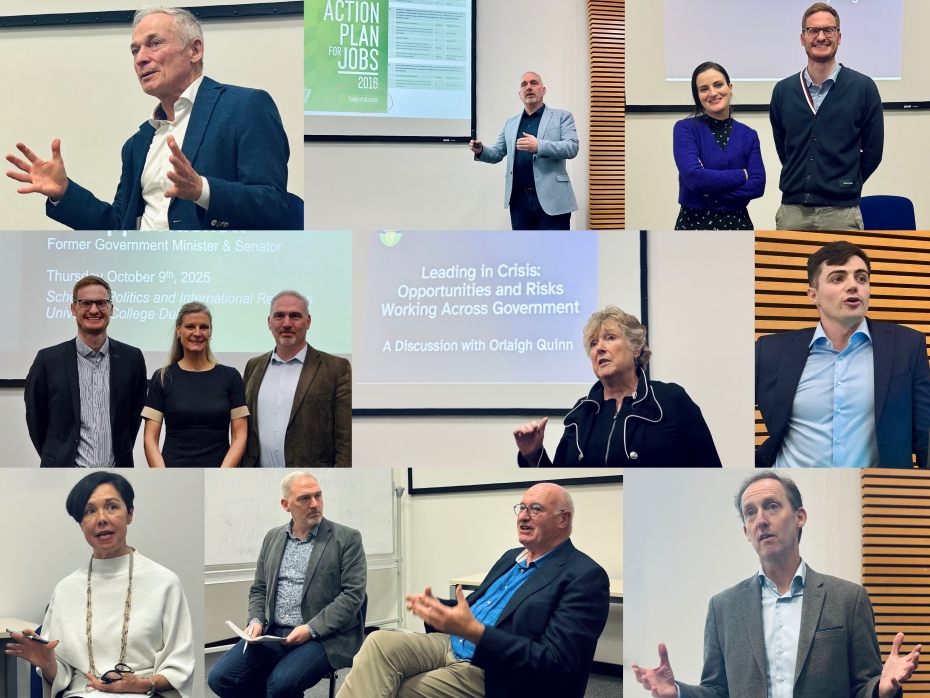
Ciarán Conlon, a former government adviser in the Department of Jobs, Enterprise and Innovation, discussed developing Ireland’s Action Plan for Jobs during the economic crisis, when unemployment reached 15%.
Dr Orlaigh Quinn, former Secretary General of the Department of Enterprise, explored leading through COVID-19 and managing cross-government working during unforeseen crises.
Deirdre Grant, former Special Adviser to two Labour ministers, examined the challenges smaller parties face in developing distinct policy platforms within coalitions.
Mary Regan, Political Editor of the Irish Independent, offered the journalist's perspective on policymaking and the changing role of journalism in the age of social media and disinformation.
Jack O’Neill, a PhD candidate with work experience in lobbying, closed the series by examining how multinational companies construct lobbying strategies across Ireland and the EU.
Innovative Assessment: From Podcasts, TikTok Explainers, and TV Discussions to Criticising AI Responses
The module introduced innovative assessment approaches that mirror real-world policy communication. Students worked in groups to analyse policies through both traditional academic reports and creative audiovisual formats such as podcasts, explainer videos, or documentary-style content aimed at public audiences.
A second assignment required students to engage directly with guest speakers by preparing questions in advance and writing response papers after each session. The final assignment took a novel approach to artificial intelligence: students generated an AI response to a policy question, then critically evaluated and improved upon it using evidence from academic literature, legislation, and class discussions.
As pointed out earlier, the module directly speaks to UCD’s Strategy to 2030, particularly the Engaging for Impact pillar. Students submitted over 350 questions to the presenters and wrote more than 300 reflection pieces throughout the module. These interactions between students and practitioners opened pathways to careers in government, policy analysis, journalism, and political advisory roles.