MSc Environmental & Engineering Geoscience
Sustainable engineering solutions are needed in our natural and built environments. Advanced knowledge and understanding of Earth’s near-surface materials and processes is crucial to solution success. This MSc program gives graduates a modern skillset in applied geoscience to inform successful engineering design, construction and operation.
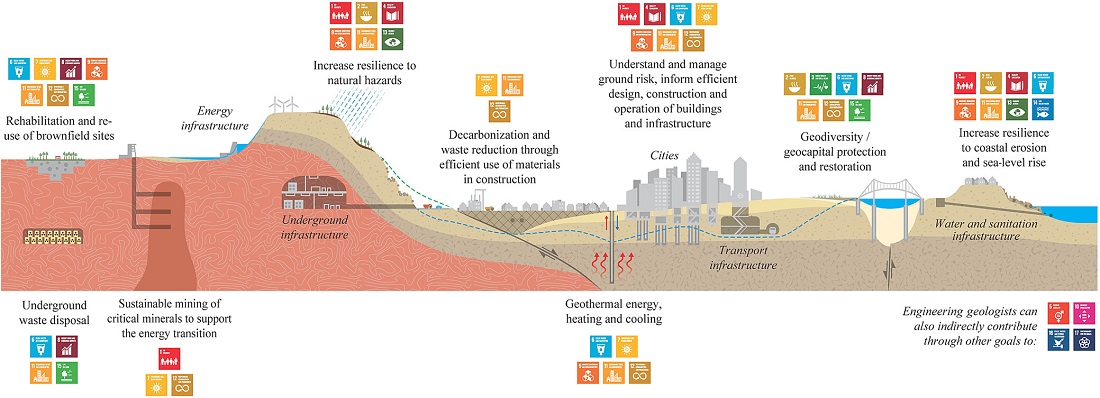
Overview of how Environmental and Engineering Geoscience relates to some aspects of our built and natural environment and to the Sustainable Development Goals ((opens in a new window)Lagesse et al., 2022). [CC BY 4.0]
The 1-year MSc Environmental & Engineering Geoscience program guides you through the principles and practices of modern geoscience as applied in industry areas such as:
- ground investigation and geotechnics
- slope/ground stability assessment
- groundwater resource management
- construction site investigation
- mine or contaminated land reclamation
- land-use planning and climate change mitigation
- environmental rehabilitation
- environmental impact assessment
The MSc is designed to bridge a current skills gap in these areas, particularly in geotechnics and ground investigation, in both Ireland and the UK. Graduate employment prospects are thus expected to be strong in the thriving geotechnical and environmental sectors, both in Ireland and internationally.
Successful completion of the MSc Environmental & Engineering Geoscience will count as at least one year of experience toward accreditation as a Professional Geologist (PGeo). This accreditation is awarded by the (opens in a new window)Institute of Geologists of Ireland (IGI(opens in a new window)). PGeo accreditation from the IGI is recognised by the (opens in a new window)European Federation of Geologists(opens in a new window) (EurGeol) and in jurisdictions of the USA, United Kingdom, Canada, Australia and New Zealand.
Note: Scholarships and stipends are available for Sept. 2026 enrollment to this program – see here for more information.
Is this MSc for me?
This MSc Environmental & Engineering Geoscience course is for you if you are:
- Seeking a distinctive skillset with which to help design and implement geo-scientifically robust engineering solutions to pressing environmental problems
- Looking to rapidly upskill for work or advancement as a geoscientist in the environmental, geotechnical and civil engineering sectors
- Seeking a springboard into future PhD research in environmental science or geotechnical engineering
- Seeking tailored tuition in small classes with close individual attention from experts at Ireland’s leading university in applied geoscience research
Tuition
The MSc Environmental & Engineering Geoscience will be delivered primarily by expert staff in the UCD Schools of Earth Sciences and Civil Engineering. Contributions will come also from the UCD Schools of Geography and Biological & Environmental Sciences.
Teaching comprises lectures, small-group tutorials, teamwork-based activities and hands-on practical exercises applied to real-world datasets and challenges. The programme will integrate classwork, laboratory work, fieldwork and industrial site visits Ireland (construction sites, quarries, drill-sites). You will also gain hands-on experience in site characterisation, in use of laboratory testing equipment and in data analysis with leading software packages.
Topics covered on the MSc will include relevant aspects of: engineering geology, geotechnics, hydrogeology, near-surface geophysics, digital mapping and computation, remote sensing, well drilling, environmental geochemistry, and environmental impact assessment. There is also a module dedicated to geoscience career development, and there will be a 30-credit applied research project (likely linked into an industry partner).
Course structure
The list of taught modules (subjects or courses) covered on the program is as follows:
Core modules from UCD School of Earth Sciences
- Hydrogeology (5.0 credits)
- Rock Engineering (5.0 credits)
- Near-surface Geophysics (5.0 credits)
- Environmental Geochemistry (5.0 credits)
- Drilling and well logging (2.5 credits)
- Applied Quaternary Geology (2.5 credits)
- Digital Field Skills (2.5 credits)
- Geocomputation (Python) (2.5 credits)
- Methods in Geomodelling (2.5 credits)
- Remote Sensing (2.5 credits)
- Geoscience Careers (5.0 credits)
Core modules from UCD School of Civil Engineering
- Geotechnics 1 (Intro to Soil Mechanics) (5.0 credits)
- Geotechnics 2 (Soil Mechanics & Design) (5.0 credits)
Optional Modules* (offered through Schools of Earth Sciences; Civil Engineering; Geography; Biological and Environmental Sciences)
- Marine Geoscience (5.0 credits)
- Applied Hydrology (5.0 credits)
- Sustainable Geoenergy (5.0 credits)
- Soil Ecology (5.0 credits)
- Minerals Geoscience (5.0 credits)
- Geostatistics & Geomodelling (5.0 credits)
- Environmental Impact Assessment (5.0 credits)
- Natural Hazards and Risk (5.0 credits)
- Peatlands and Environmental Change (5.0 credits)
*Module list maybe be subject to change.
Entry requirements
Entry to the programme requires an Honours undergraduate degree at 2.1 or higher (or equivalent) in Earth Science, Geology or Geoscience degrees. Consideration will be given to applicants with similar qualifications in cognate areas (e.g. Environmental Science, Sustainability, Geophysics, Geochemistry, or Physical Geography, Civil Engineering, Geotechnical Engineering or similar), and to those with significant and relevant work experience but who do not meet this criterion. Applicants whose first language is not English must also demonstrate English language proficiency of IELTS 6.5 (no band less than 6.0 in each element), or equivalent. Full details of the fees and application process are available on the UCD Graduate Admissions website.
Learning Outcomes
A selection of key learning outcomes from the MSc in Environmental and Engineering Geoscience are as follows:
Knowledge and understanding
- Detailed understanding of the scientific, engineering and mathematical principles of engineering geology, geotechnics and environmental geoscience.
- Knowledge of the key physical and chemical properties of natural materials (e.g. minerals, rocks, soils, liquids, gases, organic compounds).
- Recognition of advantages and limitations of a range of theoretical perspectives, empirical methods, as well as related data science and analytics.
- Advanced knowledge of a range of processes and phenomena occurring in the Earth and their impacts and interactions with both natural ecosystems and the built environment.
- Principles of ground investigation from geotechnical, geophysical, geochemical and environmental perspectives.
Application of knowledge
- Skills in the application of geotechnical, geophysical, hydrogeological and geochemical knowledge in the field and/or laboratory.
- Ability to identify and analyse both well-defined and broadly-defined problems in engineering and environmental geoscience.
- Capability for conducting supervised research into well-defined or broadly-defined issues related to environmental and engineering geoscience.
- Ability to select and apply appropriate mathematical/analytical/numerical methods to a broadly defined problem in engineering geoscience.
- Ability to use industry-standard software tools to contribute to design processes for the solution of well-defined engineering geoscience and environmental geoscience problems.
Judgement, communication and working skills
- Capability to integrate knowledge, to handle complexity, and to formulate judgments with incomplete or limited information in a range of environmental and engineering geoscience contexts.
- Appreciation and understanding of health, safety, cultural and risk issues in the discipline.
- Ability to write technical papers and reports, and to synthesise and explain work via various digital media.
- Ability to work effectively as a member of a diverse and inclusive team.
- Appreciation of how to pursue continuing professional development and to build a professional contact network in the geoscience community as part of career growth.
Application process
UCD is currently accepting application for enrolment in September 2026.
Apply here: https://hub.ucd.ie/usis/!W_HU_MENU.P_PUBLISH?p_tag=COURSE&MAJR=F290&
Course Director: (opens in a new window)Associate Professor Eoghan Holohan
Email enquiries to: (opens in a new window)Eoghan.holohan@ucd.ie
Fees
EU fee: €9,530
Non-EU fee: €24,960
Note: UK applicants pay EU fees because of membership of the Common Travel Area
For full details, please see:
https://www.ucd.ie/students/fees/
http://www.ucd.ie/graduateadmissions/