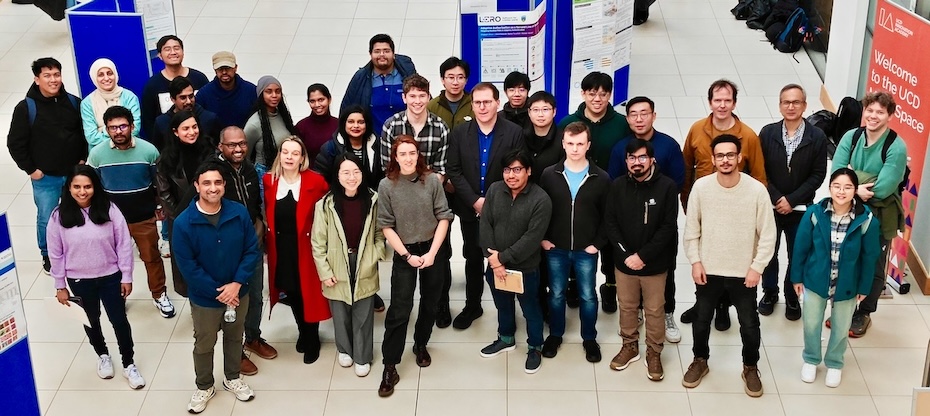
Image credit Rosemary Deevy
PhD Poster Event 2026
We were delighted with the turn-out for our PhD/MSc by Research Poster event on Friday 30 January 2026. 19 students prepared and displayed posters and a team of judges evaluated the posters. Our PhD poster event is a platform for research students to engage with fellow staff members, seeking valuable comments and advice to enhance the quality of their research work. It also offers a unique opportunity for staff and other participants to gain insights into the ongoing research work within the school.
There were five research themes:
- Bioinformatic, Health Information, HCI - 3 posters
- Data science, ML and AI - 6 posters
- Emerging Topics (Blockchain, Ethics, Quantum Computing, etc) - 1 poster
- Security and Network - 6 posters
- Software Engineering, Distributed Systems, Computing, Information systems - 3 posters
Afterwards, 50 people attended a special lunch where Assistant Professor Andrew Hines, Director of Graduate Research, presented the Outstanding Poster Prize to Md. Asif Iqbal Fahim and to Kanwal Aftab for the best presentation at the event.
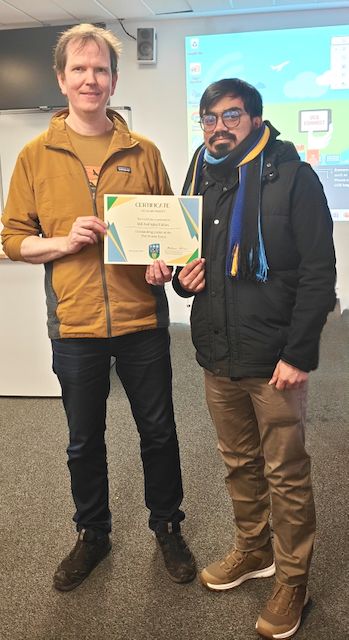
Md. Asif Iqbal Fahim receiving his prize from Assistant Professor Andrew Hines. Thesis title - Software Self-Extension with SelfEvolve: an Agentic Architecture for Runtime Code Generation (Supervisor - Assistant Professor Alessio Ferrari)
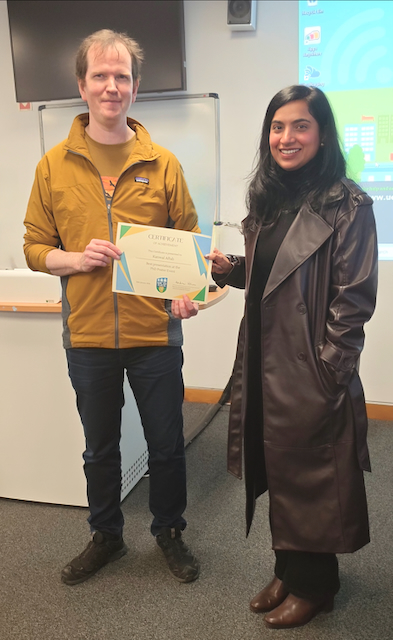
Kanwal Aftab receiving her prize from Assistant Professor Andrew Hines.
Thesis title - Computer Vision for Indoor Multimedia Geolocation (Supervisor - Associate Professor Mark Scanlon)
Image credits Rosemary Deevy
Full poster list
| Student |
Principal Supervisor |
Research theme |
Poster title |
| Paul Banahan |
Assist. Prof. Aonghus Lawler |
Bioinformatic, Health Information, HCI |
Quantitative and Qualitative Assessment of Generative AI for Cross-Modal CT-to-MRI Translation in Spine Imaging |
| Cristina Perea del Olmo |
Assoc. Prof. David Coyle |
Bioinformatic, Health Information, HCI |
Generative AI in the Online Mental Health Information Ecosystem: Young Adults’ Use and Perceptions |
| Aon Safdar |
Assist. Prof. Mohamed Saadeldin |
Bioinformatic, Health Information, HCI |
CAViT: Channel-Aware Vision Transformer for Dynamic Feature Fusion |
| Fraol Gelana Waldamichael |
Assist. Prof. Helard Becerra |
Data science, ML and AI |
Measuring What Matters: Anatomical Plausibility in Generated Medical Images |
| Xiao Li |
Assoc. Prof. Ruihai Dong |
Data science, ML and AI |
From Rules to Flexibility: A Resource and Method for SEC Item Extraction in Post-2021 10-K Filings |
| Cathal Ó Faoláin |
Assist. Prof. Andrew Hines |
Data science, ML and AI |
Éist: An Ear Inspired Speech Transformer |
| Zhonghe Chen |
Assist. Prof. Deepak Ajwani |
Data science, ML and AI |
Synthesizing Fault Localization Datasets |
| Reyhaneh Kheirbakhsh |
Assist. Prof. Aonghus Lawler |
Data science, ML and AI |
Modality Fusion of MRI and Clinical Data for Glioma Tumor Grading |
| Kanwal Aftab |
Assoc. Prof. Mark Scanlon |
Data science, ML and AI |
Computer Vision for Indoor Multimedia Geolocation |
| Rashmi Ratnayake |
Prof. Liam Murphy |
Emerging Topics (Blockchain, Ethics, Quantum Computing, etc) |
A Trust-By-Design Consensus Mechanism for Blockchains |
| Charuka Moremada |
Assoc. Prof. Madhusanka Liyanage |
Security and Network |
LLM-XAI: LLM Driven Explainable AI for Network Intrusion Detection |
| Vidura Ravihansa |
Assoc. Prof. Madhusanka Liyanage |
Security and Network |
Energy-Aware Security for Federated Learning: A Causal Framework |
| Haula Galadima |
Assist. Prof. Rob Brennan |
Security and Network |
Evaluating Incident Response in CSIRTs using Cube Socio-technical Systems Analysis |
| Hongyi Guo |
Assoc. Prof. Madhusanka Liyanage |
Security and Network |
Adaptive Model Poisoning Attacks in Federated Learning |
| Dinushika Chithrani |
Prof. Liam Murphy |
Security and Network |
Privacy-Preserving LLM Framework for Secure Data Sharing in O-RAN Digital Twins |
| Alkabashi Alnour |
Assist. Prof. Alzubair Hassan |
Security and Network |
Adaptive authorization as a second line of defence to mitigate residual risk |
| Zhenghao Wu |
Assist. Prof. Hadi Tabatabaee Malazi |
Software Engineering, Distributed Systems, Computing, Information systems |
Resilient Services Computing in the Edge-Cloud Continuum |
| Shaoshu Zhu |
Assist. Prof. Hadi Tabatabaee Malazi |
Software Engineering, Distributed Systems, Computing, Information systems |
Critical Evaluation of Energy-Carbon Trade-off in Sustainable Serverless Edge Scheduling |
| Md Asif Iqbal Fahim |
Assist. Prof. Alessio Ferrari |
Software Engineering, Distributed Systems, Computing, Information systems |
Software Self-Extension with SelfEvolve:an Agentic Architecture for Runtime Code Generation |
Many thanks to Rosemary Deevy and Travis Grotewald in the Postgraduate Programme Office and Assist. Prof. Andrew Hines, our Director of Graduate Research, for organising the event and also to all who came and supported the students and especially to the judges.
Graduate Research in UCD School of Computer Science
The School currently has over 100 PhD and MSc Research students, located in one of our research centres such as the (opens in a new window)Insight Centre for Data Analytics or our Centres for Research Training: (opens in a new window)ML-Labs and (opens in a new window)d-real. Many members of faculty are active in supervising PhD students. More info here https://www.ucd.ie/cs/study/researchdegrees/
Why do a PhD?
In 2023 we recorded some of the students talking about their PhD studies. (opens in a new window)Watch it here (2 mins 40 seconds)
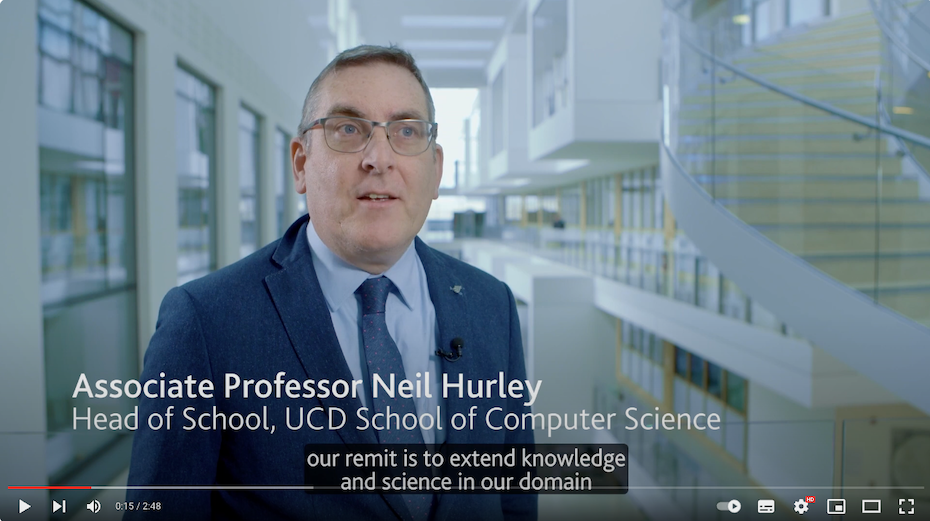
See our YouTube channel for (opens in a new window)more videos.
4 February 2026