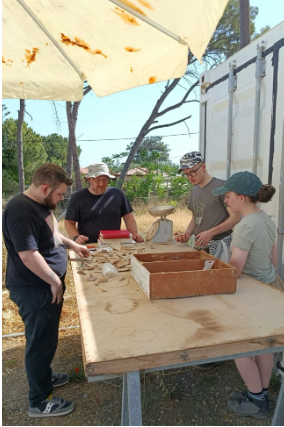
The UCD Team at work at Knossos – (l-r) Sebastian Trainer, Conor Trainor, Daniel Branigan, Lucy Woods. Photo credit Tara Verrette.
The Knossos Legacy and Sustainable Archaeology Project gears up for the 2026 field season at Knossos, on the island of Crete, and it seems like a good opportunity to introduce this to the TNH research strand members. This project is very much an international collaboration with Irish (Conor Trainor and Jo Day, UCD Classics) and US (Emilia Oddo, Tulane) co-directors, working at a British-run research centre in Greece.
Each co-director is responsible for their own research strand: mine is concerned with the lives of people in the years around the Roman conquests of the Greek states. While my research is primarily focused on the material objects of the past, my research is concerned with a larger, conceptual question: how do we approach political and cultural interactions between polities when multiple, and often competing, narratives coexist?
Roman literary sources frequently portrayed Greece during the Roman period as a cultural backwater, marked by economic decline, loss of political freedom, and once-famous religious sanctuaries that were either abandoned or reduced to little more than tourist destinations for wealthy Romans. Certain aspects of the archaeological record appear to support this view. Across mainland Greece and the Aegean islands, for example, we encounter Roman public inscriptions, imperial cults, and statuary that assert Roman authority. However, the material remains of everyday life from across Roman Greece suggests a rather different picture. In many cities, daily practices appear to have changed remarkably little in the generation or two that followed Roman conquest in each region. People continued to live in similar types of houses, consumed comparable diets, prepared food in familiar ways, and buried their dead according to long-standing traditions. Although Roman authorities clearly sought to project messages of power and legitimacy in public spaces, Roman rule seems to have brought relatively limited change to the daily lives of most inhabitants of Greek cities.
Over time, however, Greek communities did begin to adopt cultural practices that reflect their place in the broader “Roman” world. This adaptation was a gradual process unfolding over several generations, in contrast to what the loud and deliberate public messaging from Rome might have us believe. Cultural changes eventually become visible through new funerary customs, foodways, religious practices, and economic reorganisation. During the period commonly known as the Pax Romana (ca. 27 BCE–180 CE), relative political stability and economic growth facilitated an unprecedented expansion of mobility, exchange, and interaction across much of the Roman world, encompassing most of Europe, North Africa, and the Middle East. It was this stability, that appears to have served as a primary driver of deeper cultural transformations within Greek societies. Stability, not conquest, fostered openness to new ideas, new forms of cultural expression, and sustained engagement with diverse populations.
Narratives of cultural change can vary considerably depending on the types of evidence that we can consider. Official and elite sources often present a picture that contrasts sharply with insights derived from the material traces of everyday life. Roman Greece offers a compelling case study of competing transnational concepts from a time long before the nation-state.